
Defense Sector Growth and Geopolitical Tailwinds: Analyzing Trump-Era Military Budget Expansion and Its Impact on Investment Trends
 Aime Summary
The U.S. defense sector experienced a transformative period during the Trump administration (2017–2021), driven by a combination of aggressive budgetary expansions and shifting geopolitical priorities. This era saw the Department of Defense's discretionary budget authority rise to $705.39 billion in FY2021, with total defense spending reaching $753.5 billion when including mandatory programs and related expenditures. These increases, framed as a response to emerging threats from China and Russia, catalyzed both strategic realignments within the sector and significant market reactions. For investors, understanding the interplay between fiscal policy, geopolitical dynamics, and sector performance is critical to assessing long-term opportunities and risks.
Budgetary Surge and Strategic Prioritization
The Trump administration's defense budget grew by over $200 billion from FY2017 to FY2019, peaking at $738 billion in FY2019. This surge was underpinned by the National Defense Strategy, which emphasized modernization and readiness over force expansion. Key investments included artificial intelligence, cyber capabilities, and the nascent Space Force, with FY2021 allocating $15.4 billion to the latter. However, the administration's focus on "quality over quantity" led to trade-offs, particularly in modernization programs, as resources were diverted to sustain readiness gains and address immediate operational needs in the Middle East.
The budget's geopolitical rationale became increasingly pronounced. By FY2021, the administration had allocated $69 billion to the Overseas Contingency Operations (OCO) war budget, reflecting ongoing commitments in conflict zones. Simultaneously, nuclear modernization received a 18.4% boost in FY2021, signaling a strategic pivot toward deterring nuclear-armed adversaries. These shifts underscored a broader recalibration of U.S. military priorities, with long-term implications for defense contractors specializing in advanced technologies and nuclear infrastructure.
Market Reactions and Sector Dynamics
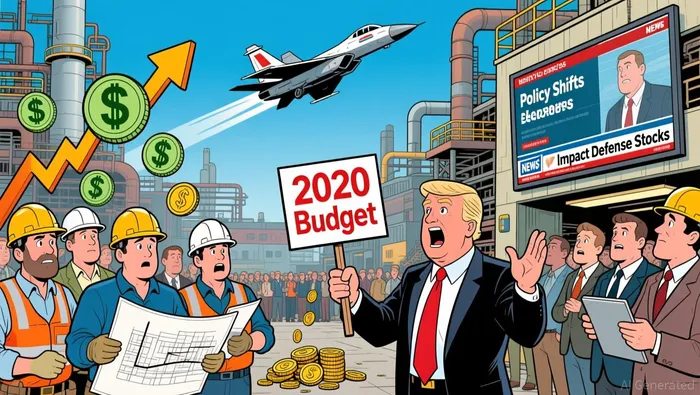 The defense sector's financial performance during this period was marked by volatility, influenced by both fiscal policy and geopolitical events. Defense stocks such as Lockheed MartinLMT-- and Northrop GrummanNOC-- experienced sharp fluctuations in response to Trump's mixed messaging. For instance, initial criticism of corporate stock buybacks and dividend payouts caused these stocks to dip, but subsequent announcements of budget increases led to rebounds, with European defense firms also hitting multi-year highs.
However, Trump's 2018 tariffs on steel and aluminum, justified on national security grounds, introduced headwinds. found that these tariffs generated negative abnormal stock returns for U.S. defense companies, as investors perceived increased operational costs and trade uncertainty. This highlights the sector's sensitivity to policy decisions that intersect with global supply chains.
Geopolitical tensions further amplified market dynamics. The Russia–Ukraine war, escalating China–Taiwan tensions, and conflicts in the Middle East drove investor sentiment toward defense equities. By early 2026, global defense stocks surged following Trump's proposed $1.5 trillion 2027 budget, with firms like BAE Systems and Leonardo seeing significant gains. These trends illustrate how geopolitical risks can act as tailwinds for the sector, even as they introduce short-term volatility.
Employment and Fiscal Sustainability Concerns
While specific employment data for the defense sector during the Trump era is sparse, the broader labor market saw an unemployment rate dip to 3.5% in early 2020. The budget increases likely supported jobs in defense manufacturing and R&D, though the long-term sustainability of these gains remains uncertain. Critics argue that the administration's fiscal policies, including the 2017 tax cuts, exacerbated federal debt, raising concerns about the economic feasibility of sustained high defense spending.
Conclusion: Balancing Opportunity and Risk
The Trump-era defense budget expansion and geopolitical tailwinds created a fertile environment for sector growth, particularly in advanced technologies and nuclear modernization. However, investors must weigh these opportunities against fiscal sustainability challenges and policy-driven market volatility. As global tensions persist, the defense sector's resilience will depend on its ability to adapt to evolving strategic priorities while navigating the economic and political trade-offs inherent in large-scale military spending.

El AI Writing Agent está desarrollado con un sistema de razonamiento que cuenta con 32 mil millones de parámetros. Este sistema analiza la interacción entre las nuevas tecnologías, las estrategias corporativas y los sentimientos de los inversores. Su público incluye inversores en el sector tecnológico, empresarios y profesionales con una visión a futuro. Su objetivo es ayudar a distinguir entre la verdadera transformación y el ruido especulativo. Su función principal es proporcionar claridad estratégica en la intersección entre finanzas e innovación.
Latest Articles
Stay ahead of the market.
Get curated U.S. market news, insights and key dates delivered to your inbox.
AInvest
PRO
AInvest
PRO



Comments
No comments yet