
Deere's Q4 2025 Earnings Call Reveals Contradictions in Tariff Mitigation, Inventory Management, and Sales Forecasts
 Aime Summary
Date of Call: November 26, 2025
Financials Results
- Revenue: $45.7B, down 12% YOY (FY2025 net sales and revenues); Q4 net sales $12.4B, up 11% YOY
- EPS: $18.50 per diluted share (FY2025); Q4 EPS $3.93 per diluted share (decreased vs prior year)
- Operating Margin: Equipment operations operating margin 12.6% for FY2025 (included ~1.5 points impact from tariffs); Q4 equipment operations margin 9.2%
Guidance:
- Net income forecast $4.0B–$4.75B for FY2026 (implied midpoint ~ $16 EPS).
- Projected pretax direct tariff expense ≈ $1.2B; additional indirect inflationary impacts contemplated.
- Effective tax rate expected 25%–27%.
- Equipment operations cash flow forecast $4B–$5B.
- Production & Precision Ag net sales down 5%–10%; operating margin 11%–13%.
- Small Ag & Turf sales up ~10%; operating margin 12.5%–14%.
- Construction & Forestry net sales up ~10%; operating margin 8%–10%.
- Financial Services net income forecast ≈ $830M.
Business Commentary:
- Financial Performance and Profitability:
- Deere & Company reported
net incomeof$5 billionfor fiscal year 2025, amidst a challenging market backdrop. - Equipment operations achieved a 12.6% operating margin, including about 1.5 points impact from tariffs.
The company's resilience and strategic management, including proactive inventory control, cost management, and ongoing R&D investments, contributed to these results.
Sales and Market Trends:
- Net sales and revenues for fiscal 2025 were
down 12%to$45.7 billion, primarily due to soft demand across major markets. - North American large ag equipment sales were projected to decline between
15% to 20%for fiscal 2026. Strong demand for U.S. corn and soy products, along with supportive government payments and trade agreements, are expected to positively impact the market.
Inventory and Supply Management:
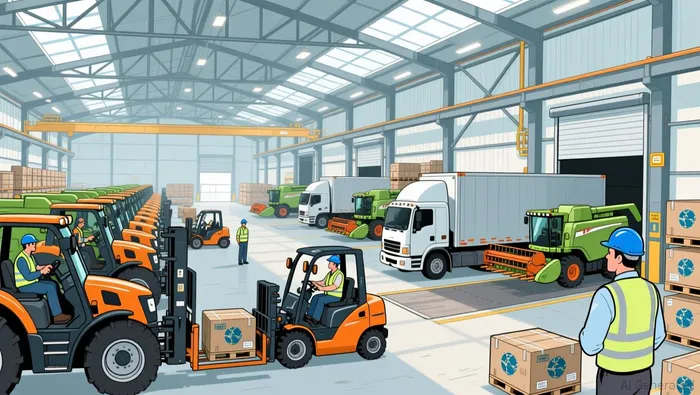
- Deere & Company managed new field inventory at low levels, with significant reductions in key product categories like tractors and combines.
- Inventory levels for North American earthmoving equipment decreased by around
35%from Q4 fiscal 2024. - Effective inventory management and collaboration with dealers were crucial in managing market uncertainty and addressing oversupply concerns.
- Technology and Automation:
- The company achieved significant progress in its technology stack, with over
24,000 kitssold for Precision Essentials and8,000orders for JDLink Boost. - Automation solutions like harvest settings automation and predictive ground speed automation saw increased adoption and use, particularly in North America.
- Deere also expanded its operations center into new sectors, enhancing fleet management and customer support.

Sentiment Analysis:
Overall Tone: Neutral
- Management repeatedly framed FY2025 as a demonstration of "resilience" and "best results yet for this point in the cycle" while also forecasting FY2026 headwinds (large ag down 15%–20% in N.A.) and a $1.2B tariff hit — balancing cautious near-term guidance with optimism around technology, diversification and cost actions (FY2026 net income guide $4.0B–$4.75B, implied midpoint ~ $16).
Q&A:
- Question from Stephen Volkmann (Jefferies LLC): You referenced a $1.2 billion tariff headwind for 2026 — how do you plan to offset that and over what cadence through the year?
Response: Tariffs are ~ $1.2B pretax in 2026 (~$300M/quarter); company expects to be price/cost positive for the year and will offset via pricing, cost actions and other mitigations but will not fully eliminate the tariff impact in 2026.
- Question from Jamie Cook (Truist Securities): With a ~7% sales decline in PPA and implied decrementals approaching ~60%, how much is driven by tariffs versus mix and other factors?
Response: Implied PPA decrementals ~60%; tariffs account for ~1.5 points of margin impact — removing tariffs brings decrementals to the low‑to‑mid‑50s; negative mix from a larger North American large‑ag decline (most profitable market) is the primary driver of elevated decrementals.
- Question from Kristen Owen (Oppenheimer & Co.): The company guide shows 1.5% price realization for large ag while early orders showed 3%–4% list increases in North America — why is realized guide lower?
Response: The 1.5% company guide is a blended realization: NA list increases are 3%–4% but are pulled down by geographic mix (more muted Brazil pricing in 2026) and a higher parts/complete‑goods mix where parts pricing is more muted.
- Question from Timothy Thein (Raymond James): Excluding tariffs, how should we think about production costs in 2026 after the build in 2025?
Response: Excluding the incremental $600M tariff step, production costs are expected to be slightly unfavorable in 2026 (labor step‑up and overhead headwinds partially offset by lower profit‑sharing); material costs ex‑tariffs roughly flat to slightly negative; overall price/cost still expected to be favorable for the full year.
- Question from David Raso (Evercore ISI): With FY large‑ag guide and a Q1 implied flat, will PPA be down every quarter and how should we think about margin cadence through the year?
Response: Expect Q1 PPA sales close to Q1 2025 with margins in the low single digits; sales down YoY across quarters given the guide but margins improve materially in Q2 and remain higher (Jepsen indicated ~north of 14% for Q2–Q4) with more normal seasonality after Q1.
- Question from Jerry Revich (Wells Fargo): Can you update expectations for See & Spray retrofit deliveries and acres covered; any subscription build progress?
Response: Factory take rates for See & Spray in early orders are similar to 2025; retrofit orders will be placed over winter; returning customers averaged ~20% more acres in 2025 and company expects acres covered and adoption to grow in 2026, including global expansion.
- Question from Charles Albert Dillard (Bernstein): Does the 2026 guide embed additional government farmer assistance, and how should we think about operating leverage as the cycle inflects?
Response: Baseline guide does not assume additional government assistance; flexibility is preserved to respond to order velocity changes; operating leverage should be positive as volumes recover — strong incrementals expected in small ag/turf and C&F and continued product/process cost‑out opportunity.
- Question from Steven Fisher (UBS): Why is South America guided flat given caution there, and have you seen signs of housing‑driven turf improvement yet?
Response: Flat guide for South America reflects caution and optimism — easing inflation expectations could lower rates in 2026 which would support demand and current order books in Brazil look strong (~5 months out); small ag/turf recovery assumes a low single‑digit rise in U.S. home sales, providing modest early support but not a large rebound yet.
Contradiction Point 1
Tariff Impact and Mitigation
It involves differing explanations of how the company is addressing tariff impacts, which can affect financial performance and strategic decision-making.
How do you plan to offset $1.2 billion in tariffs, and over what period? - Stephen Volkmann (Jefferies LLC)
2025Q4: Deere expects to capture the incremental tariff exposure through price/cost actions. The tariff run rate is spread across quarters. The company anticipates being price/cost positive for 2026, which will help offset 2025 tariff costs and some of the new 2026 expenses. - Josh Beal(Investor Relations)
How do you categorize the tariff assumptions into direct and steel/aluminum impacts? - Kristen Owen (Oppenheimer & Co. Inc.)
2025Q3: This year's tariff impact is $300 million, with an expected $600 million in fiscal 2025. Europe and steel constitute about 50%, while India and Japan make up about 25%. We are mitigating through USMCA certifications and strategic sourcing. - Unknown Executive
Contradiction Point 2
Inventory Management and Channel Inventory Variability
It highlights differing expectations regarding inventory management and channel inventory variability, which can impact production planning and financial forecasts.
What do you expect production costs to be in 2026, excluding tariffs? - Timothy Thein (Raymond James & Associates, Inc.)
2025Q4: We expect to be in line with our inventory forecasts at year-end. As we go into 2026, we expect to have the right level of product in place to support the full production plans that we have. - Josh Beal(Investor Relations)
How does cash flow guidance reflect channel inventory variability? - Timothy Thein (Raymond James)
2025Q3: We feel confident about our inventory management, with significant reductions across segments. We expect to end the year within our inventory forecasts. - Josh Jepsen(CFO)
Contradiction Point 3
Large Ag Sales and Margin Expectations
It involves differing expectations for large ag sales and margins, which are critical for financial performance and market positioning.
Can you discuss the cadence of large ag sales and margins for the rest of 2026? - David Raso (Evercore ISI Institutional Equities, Research Division)
2025Q4: In Q1, there will be a lower volume due to lean production, impacting margins. However, margins improve in Q2 and remain elevated through the year. - Josh Jepsen(CFO)
What does producing to retail demand next year mean if retail sales grow by 5% or 10%? - Tami Zakaria (JPMorgan)
2025Q3: We expect 2025 fiscal year sales of the Wirtgen Group to be around 4 billion euros, which includes about 1 billion euros of organic sales growth. - Samir Y. Mehta(CEO)
Contradiction Point 4
Small Ag and Turf Expectations
It involves differing expectations for small ag and turf growth, which can impact strategic focus and resource allocation.
What are the assumptions for South America and small ag in your 2026 outlook? - Steven Fisher (UBS Investment Bank, Research Division)
2025Q4: Our outlook for our small ag and turf business in 2026 is for modest sales growth. driven by improved housing activity and better demand for turf. - Josh Jepsen(CFO)
Can you discuss trends in planters and combines compared to sprayers in early order programs? - Angel Castillo Malpica (Morgan Stanley)
2025Q3: We are encouraged by increased quoting activity in the Midwest. And we are excited about the upcoming launch of our new 18 row corn header. - Cory Reed(CEO)
Contradiction Point 5
Tariff Cost Offsetting Strategy
It highlights a shift in Deere's strategy for offsetting tariff costs, which is crucial for investor understanding of the company's financial management and pricing strategy.
How will you offset the $1.2 billion in tariffs, and over what period? - Stephen Volkmann (Jefferies LLC)
2025Q4: Deere expects to capture the incremental tariff exposure through price/cost actions. The tariff run rate is spread across quarters. The company anticipates being price/cost positive for 2026, which will help offset 2025 tariff costs and some of the new 2026 expenses. - Josh Beal(CIO)
What is Deere's approach to early order programs in 2026, and can it fully offset tariffs? - Jamie Cook (Truist Securities, Inc.)
2025Q2: Early order programs will have structured pricing flexibility phases as tariffs evolve. Deere aims to be in line with retail demand in 2026 with low inventory levels. - Josh Jepsen(CFO)

Discover what executives don't want to reveal in conference calls
Latest Articles
Stay ahead of the market.
Get curated U.S. market news, insights and key dates delivered to your inbox.
AInvest
PRO
AInvest
PRO



Comments
No comments yet