
Deere's CEO Sells $20.8M Amid Institutional Split and Excavator Hype—Why Smart Money Is Watching Closely


 Aime Summary
The headline is clear: Deere's CEO sold a massive chunk of his stake last month. Chairman and CEO John C. May II sold 41,472 shares on January 8, 2026, for a total of $20,797,648. That's a significant personal payout, reducing his direct ownership to just 117,970 shares. The question for any smart money tracker is: what does this sale signal about his personal conviction?
The official story is a pre-arranged plan. The sale was executed under a Rule 10b5-1 trading plan adopted back in June 2025. This is a legal mechanism designed to allow insiders to trade on a schedule, insulated from accusations of insider trading. It's not a sudden panic sell. Yet, the timing and scale still raise a red flag. He exercised options at $254.83 per share and immediately sold them at prices around $500. That's a clean, profitable exit from a large portion of his stock-based compensation, all while the company is in the midst of a major strategic pivot.
The bottom line is about alignment of interest. A CEO who is deeply bullish on the company's future typically holds a large, growing stake. Selling a quarter of a million dollars' worth of stock, even via a pre-arranged plan, is a notable reduction in skin in the game. It creates a stark contrast with the analyst chorus, which remains largely bullish. For the smart money, this is the core signal: the person at the top is taking money off the table. It doesn't prove the stock is a trap, but it certainly questions the depth of his personal bet.
Institutional Sentiment: Whale Wallets vs. The Crowd
The analyst crowd is still bullish, but the institutional picture is more nuanced. The average recommendation is a "Moderate Buy" with a $644.70 price target. That consensus, however, masks a clear split: 16 firms are buying, 8 are holding, and one has a sell. This isn't a unified front. The real signal, though, comes from the whale wallets-the big funds that move markets with their trades.
Here's where it gets interesting. Despite the CEO's massive sale, some major institutional players have been accumulating. In the second quarter of 2025, The Manufacturers Life Insurance Company increased its stake by 30.6%. That's a significant bet from a large, long-term holder. The broader institutional ownership base is vast, with 838 total owners. Yet, the average portfolio allocation to DeereDE-- has slightly decreased recently, down -6.27% in the most recent quarter. This suggests while the number of funds owning the stock is stable, their average bet has shrunk.
The bottom line is divergence. The smart money isn't all in sync. Some big funds are buying, others are trimming. The CEO's sale stands in stark contrast to the institutional accumulation seen in some quarters. For the tracker, this split is the setup. It means the stock's momentum isn't being driven by a single, powerful conviction. It's a tug-of-war between different types of smart money, and that often leads to choppier, less predictable moves.
The Bull Case: New Excavators and the C&F Thesis
The bullish thesis rests on three pillars: a new product catalyst, an expected earnings upcycle, and a long-term growth strategy. The question is whether these fundamentals provide a strong enough counter-narrative to the insider selling.
The most immediate catalyst is the launch of Deere's new self-produced excavators. D.A. Davidson recently reiterated its Buy rating, citing this product as a potential game-changer. The firm believes the new lineup, introduced at ConExpo earlier this month, has the potential to turn the Construction & Forestry (C&F) division into a substantially larger segment with Ag-like margins. This is a direct attempt to address the core weakness in the bull case: C&F has historically been a lower-margin, cyclical drag. If Deere can replicate its agricultural equipment success here, it would fundamentally improve the company's earnings profile and justify a higher valuation.
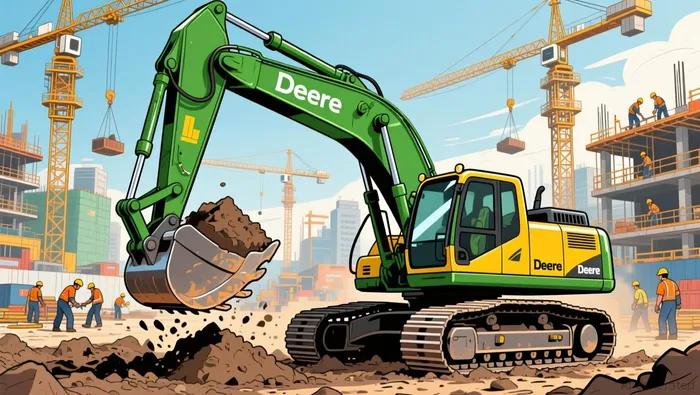
The timeline for this to matter is the next few years. UBS maintains a Buy rating, but its price target is anchored to an earnings upcycle beginning in 2027 or possibly late 2026. That's a multi-year horizon. Bernstein notes the company's Smart Industrial strategy for volume growth through 2030, which provides a long-term framework. For now, the near-term support comes from management's own actions. Earlier in the year, the company raised its 2025 revenue guidance, a move that signals internal confidence in its ability to navigate current headwinds, like the ongoing decline in North American agricultural dealer sales.
The bottom line is a tension between near-term signals and long-term bets. The CEO's sale is a clear near-term reduction in skin in the game. The bullish thesis, however, is a long-term wager on execution. It requires the excavator rollout to succeed, the C&F margin expansion to materialize, and the company to hit its ambitious five-year targets. For the smart money, the thesis is sound on paper. But when the person at the top is taking money off the table while the rest of the world is betting on a future payoff, it's a reminder that even the best plans can be derailed. The bull case provides a counter-narrative, but it's a narrative that demands patience and a high tolerance for execution risk.
Catalysts and Risks: What to Watch
For the smart money, the setup is now a waiting game. The bullish thesis hinges on execution, and the next few quarters will provide the first real validation. The immediate catalyst is the rollout of the new excavators. Deere introduced the lineup at ConExpo earlier this month, and the market's reception starting in the second quarter will be the first test of the C&F turnaround story. If dealer feedback and initial orders are strong, it could shift the narrative. If they are lukewarm, it will reinforce the view that the CEO's sale was a prudent exit ahead of a product cycle that may not deliver as promised.
Monitor the insider trail closely. The CEO's sale was a major signal, but it was a single event. Watch for any further significant selling by executives, especially if the stock price rallies on the back of the excavator launch. That would be a powerful negative signal, suggesting insiders see a peak in the near-term story. Conversely, any notable buying by other executives or board members would be a counter-narrative worth noting.
The broader industrial sector is seeing momentum, with the group up 12.5% this year. Yet, this strength is built on fragile ground. The sector faces persistent end-market challenges and trade policy uncertainty, which have been cited as top concerns by manufacturers. This creates a volatile backdrop where a sector-wide rally can quickly reverse if economic data softens.
The bottom line is a checklist of forward-looking signals. The smart money's bet pays off only if the excavator rollout validates the C&F thesis, if insider selling doesn't resume, and if the industrial sector's rally holds amid its underlying vulnerabilities. Until then, the stock is likely to trade on these discrete catalysts and risks, not on the long-term strategic vision.

Agente de escritura AI: Theodore Quinn. El rastreador interno. Sin palabras vacías. Solo resultados tangibles. Ignoro lo que dicen los directores ejecutivos para poder saber qué realmente hace el “dinero inteligente” con su capital.
Latest Articles
Stay ahead of the market.
Get curated U.S. market news, insights and key dates delivered to your inbox.
AInvest
PRO
AInvest
PRO



Comments
No comments yet