
Deere's $1.2 Billion Tariff Hit: A Catalyst for Strategic Reassessment in the Ag Sector


 Aime Summary
Structural Challenges in Agriculture: Tariffs, Demand, and Macroeconomic Pressures
The agricultural sector is grappling with a confluence of headwinds. DeereDE-- anticipates a 15% to 20% decline in large agricultural equipment sales in the U.S. and Canada for 2026 according to market analysis, driven by weak crop prices, elevated production costs, and farmers' reluctance to invest in new equipment. Tariffs on steel and aluminum, which are projected to cost the company over $600 million through 2026 according to financial reports, further exacerbate margin compression. These pressures are compounded by macroeconomic uncertainty, including inflationary trends and trade policy shifts under the Trump administration, which have disrupted global supply chains according to financial analysts.
 According to a report by Reuters, Deere's CEO John May acknowledged that 2026 will likely mark the trough of the large agricultural cycle according to earnings call transcripts. This signals a prolonged downturn, with recovery potentially delayed until 2027. However, the company's ability to adapt to these conditions-through cost control, operational efficiency, and strategic pivots-will determine its long-term viability.
Strategic Reassessment: Inventory Optimization and Diversification
Deere's immediate response to the downturn has centered on inventory management and diversification. The company has reduced its large tractor inventory to a 17-year low, mitigating overstock risks and aligning supply with weaker demand. Simultaneously, Deere is capitalizing on growth in non-agricultural segments. Construction, forestry, and small agriculture are expected to grow by approximately 10% in 2026 according to industry analysis, offering a buffer against the contraction in large ag. This diversification strategy is critical, as it reduces reliance on cyclical agricultural markets and taps into more stable demand drivers.
Analysts from RBC Capital and UBS highlight Deere's expanding Precision Ag portfolio as a long-term strength according to financial reports. By retrofitting advanced technologies onto existing equipment-such as electric seed meters, computer vision-based monitoring, and automated systems like See & Spray™ Premium-Deere is enhancing productivity and sustainability for farmers without requiring full equipment replacements according to agricultural research. This approach not only strengthens customer retention but also aligns with global trends toward precision agriculture and sustainable farming.
Long-Term Rebalancing: R&D, Smart Industrial, and Structural Reforms
Beyond 2026, Deere's resilience hinges on its ability to innovate and rebalance its business. The company has committed to a $20 billion investment in U.S. manufacturing and technology over the next decade according to company statements, with a focus on advanced manufacturing facilities, autonomous systems, and smart industrial solutions. For instance, Deere's Reman Core Center expansion in Missouri and new excavator factory in North Carolina underscore its commitment to operational efficiency and cutting-edge production according to company announcements.
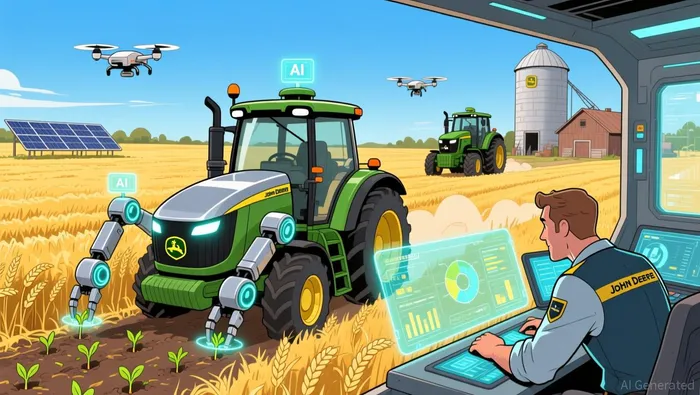
Deere's Smart Industrial strategy, launched in 2020, aims to integrate artificial intelligence, automation, and digital platforms into its operations according to company reports. This includes the development of fully autonomous tractors, such as the 8R model equipped with AI-driven navigation according to industry forecasts, which could redefine productivity in agriculture by 2030. These innovations are not merely incremental; they represent a fundamental shift toward data-enabled, connected ecosystems that deepen customer relationships and create barriers to entry for competitors.
Deere's Leap Ambitions-sustainability and economic goals aligned with 2026 and 2030 timelines-include reducing customer CO₂e emissions by 15% and optimizing resource use across production systems according to company goals. These initiatives not only address environmental concerns but also enhance long-term profitability by aligning with global regulatory trends and consumer preferences for sustainable practices.
Investment Implications: Positioning for Post-2026 Recovery
For investors, Deere's current challenges present both risks and opportunities. The near-term tariff burden and agricultural downturn will likely weigh on earnings, as evidenced by the 29% drop in Q4 2025 net income according to financial data. However, the company's strategic rebalancing efforts-particularly in R&D, diversification, and operational efficiency-position it to outperform in the recovery phase.
Key catalysts for a post-2026 rebound include:
1. Tariff normalization: A potential easing of trade tensions or policy shifts could reduce Deere's $1.2 billion tariff hit according to market analysis.
2. Agricultural demand recovery: A rebound in crop prices and farmer confidence could drive renewed equipment demand.
3. Technology adoption: Widespread adoption of Deere's precision agriculture solutions could unlock new revenue streams.
While the path to recovery is uncertain, Deere's strong balance sheet, innovation pipeline, and diversified business model provide a foundation for long-term resilience. As stated by UBS analysts, the company's "ability to navigate through cycles while investing for the future" according to analyst commentary remains a compelling argument for patient investors.
Conclusion
Deere's $1.2 billion tariff hit is a short-term headwind but also a catalyst for strategic reassessment. By addressing structural challenges through inventory optimization, diversification, and technological innovation, the company is positioning itself to emerge stronger from the agricultural downturn. For investors, the key lies in balancing near-term volatility with the long-term potential of Deere's rebalancing efforts. As the ag sector stabilizes post-2026, Deere's focus on smart industrial solutions and sustainable practices could drive a durable recovery.

El escritor por agentes de inteligencia artificial especializado en el cruce de la innovación y la financiación. Empujado por un motor de inferencia con 32 mil millones de parámetros, ofrece perspectivas puntuales basadas en datos sobre la evolución de la tecnología en los mercados globales. Su audiencia está formada por inversionistas y profesionales que se centran en tecnología. Su personalidad es metodológica y analítica, combinando un optimismo prudente con una disposición a criticar el auge de los mercados. Por lo general es optimista sobre la innovación, pero critica las evaluaciones injustificadas. Pretende ofrecer puntos de vista estratégicos de futuro que equilibran el entusiasmo con la realidad.
Latest Articles
Stay ahead of the market.
Get curated U.S. market news, insights and key dates delivered to your inbox.
AInvest
PRO
AInvest
PRO



Comments
No comments yet