
Decoding the Tariff-Driven Metal Market: A Structural Shift in Supply and Demand


 Aime Summary
The central investor question is no longer just about the price of base metals, but about the physical market itself. U.S. tariff policy has become a tectonic force, creating structural supply-demand imbalances that are more disruptive than the price action alone suggests. The threat of tariffs has proven as potent as their reality, fracturing global trade flows and setting up a stark "feast or famine" scenario.
The clearest evidence of this physical dislocation is the record premium for U.S. delivery stands at a record 89 cents per lb ($1,967 per ton) over the LME price. This is not a simple cost-of-imports calculation; it is a market signal of a physical shortage within the U.S. Despite global aluminum surpluses, the metal is being pulled away from other markets. The premium over the implied tariff rate suggests the U.S. is now running short, a direct consequence of doubled import tariffs and the resulting trade disruption.
Copper tells a parallel story of fractured flows. The world's surplus copper has gravitated towards the U.S., lifting CMECME-- stocks to multi-year highs and leaving everyone else short of metal. This has created a volatile arbitrage, with the arbitrage between CME and LME copper has been a wild ride this year as tariff threats oscillated. The CME-LME spread volatility reflects a market in constant uncertainty, with the 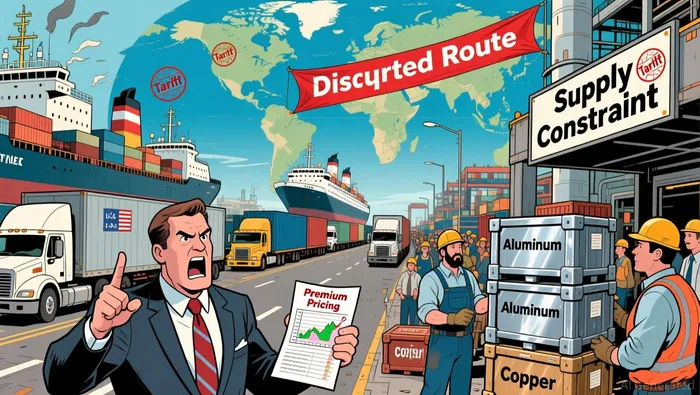 physical location of metal is dictated more by political risk than by economic efficiency.
The bottom line is that the global base metals complex is no longer a single, integrated market. Tariff policy has created distinct, often competing, regional markets. For investors, this means traditional supply-demand analysis is broken. The focus must shift to tracking the physical movement of metal, the health of warehouse stocks, and the ever-changing tariff landscape. The structural imbalances created by these policy shocks are the defining risk-and opportunity-for the base metals sector in 2025.
Supply-Side Stress: From Capacity Caps to Mine Disruptions
The metals market is not just reacting to policy; it is being squeezed by fundamental supply constraints that amplify the impact of tariff-driven demand shifts. This creates a complex dynamic where policy uncertainty collides with physical scarcity, driving prices higher and flows more erratic.
Aluminum is the clearest case of a dual squeeze. On one side, the world's largest producer is hitting a hard ceiling. China is expected to approach its 45-million-ton annual output cap, leaving virtually no room for further production growth. On the other, a major smelter is being taken offline. South32's Mozal smelter in Mozambique will be placed under care and maintenance by March 2026 due to a power agreement failure. This combination of a global capacity cap and a significant, planned supply loss is tightening the market. The result is a price rally, with aluminum futures climbing to their highest since May 2022, and a market where producers are seeking significantly higher premiums for January-March shipments.
The stress is not confined to aluminum. Zinc's market was violently disrupted in October, revealing how quickly a surplus can turn to a deficit. Despite a robust 6.5% year-on-year rise in global mine production, the LME zinc cash premium flexed out to a record over $300 per ton backwardation as stocks plummeted to just 50,000 tons. This ferocious squeeze suggests that the new mine supply is not flowing where it's needed. The market is now grappling with the reality that Western production of refined zinc actually fell by 2.2%, a mix of closures and unplanned outages, while demand in the West remains hungry. The surplus is effectively being absorbed by China, creating a physical gap elsewhere.
These supply-side issues interact with tariff policy in a dislocating way. The threat of U.S. tariffs has already fractured flows, as seen with aluminum where the premium for U.S. delivery stands at a record 89 cents per lb. This premium over the LME price signals a physical shortage in the American market, driven by both policy and constrained supply. The bottom line is that the metals complex is navigating a "feast or famine" scenario. Supply is under pressure from capacity caps, mine disruptions, and smelter outages, while demand is being reshaped by geopolitical tariffs. This creates a volatile mix where price moves are less about simple supply-demand balance and more about the intersection of policy, physical scarcity, and shifting trade routes.
Precious Metals: Safe Havens Amidst Geopolitical and Policy Uncertainty
The precious metals complex is delivering a stark divergence in performance, driven by a potent mix of geopolitical friction and shifting monetary policy expectations. Silver is the clear standout, surging to a fresh all-time high of $69.5 per ounce and is up more than 140% year-to-date. This explosive rally is fueled by a dual catalyst: escalating tensions, particularly from U.S. enforcement actions against Venezuelan tankers, and robust industrial demand from sectors like solar and electric vehicles. The metal's role as a safe-haven asset is being reinforced by a concurrent search for higher-return assets amid economic uncertainty.
Gold, while also strong, is showing signs of near-term exhaustion. It recently hit a high of $4,460 and is now facing a technical ceiling at the next target at $4,500. Analysts note that while the longer-term trend remains bullish, there is a clear expectation for some short-term profit taking at the $4,500 level. This suggests the recent momentum in gold may be pausing to consolidate, creating a temporary gap between its performance and silver's relentless advance.
The industrial demand story further fragments the metals landscape. Platinum is gaining ground, with its price ticking higher, as its use in catalytic converters and other industrial applications finds support. In contrast, palladium is retreating, pressured by a combination of supply factors and potentially softer demand. This sector-specific divergence highlights that the precious metals market is not a monolith. While geopolitical fear is a broad-based tailwind, the underlying fundamentals for each metal are being tested in different ways.
The bottom line is a market in two distinct phases. Silver is riding a powerful wave of geopolitical-driven safe-haven flows and industrial optimism, pushing it to record highs. Gold is consolidating after a major move, awaiting its next catalyst. For investors, this isn't a simple bet on a single metal but a navigation of a complex, multi-faceted market where policy expectations and real-world demand are pulling different parts in different directions.
Risks & Catalysts: The Fragile Equilibrium of a Tariff-Driven Market
The current LME metals complex is built on a foundation of policy uncertainty, not fundamental balance. The primary risk is a sudden reversal in U.S. tariff policy. The market is currently pricing in a threat of tariffs on imports of refined metal, which has already caused a tectonic shift in flows. This creates a volatile arbitrage where the CME copper contract trades at a premium to the LME, and the U.S. aluminium premium stands at a record 89 cents per lb. If the Trump administration were to reverse course and remove these tariffs, the entire structure would unwind. The premium would collapse, flows would reverse, and the artificial supply tightness in the U.S. would dissipate, likely compressing prices globally. This policy risk is the single largest source of market fragility.
A second, more systemic risk is a significant downturn in China. While strong demand from the world's largest economy has been a key support, the market is already showing cracks. Recent data points to soft underlying demand in China, with industrial output slowing, retail sales underwhelming and new home prices extending their multi-year decline. A deeper economic slowdown there would overwhelm any supply constraints, flooding the market with metal and collapsing the premiums that have defined 2025's performance. The market's current strength is a fragile balance between constrained supply and resilient demand; a shift in that demand would break the equilibrium.
The key near-term catalyst is the resolution of the U.S. tariff threat. The market is in a holding pattern, awaiting a decision that could come as early as the middle of next year. The resolution of this uncertainty is the most likely event to normalize the market. A decision to impose tariffs would likely sustain the current dislocation and premiums. A decision to drop them would trigger a rapid compression of the CME-LME spreads and a reversal of the arbitrage-driven flows into the U.S. This catalyst will determine whether the current structure is a sustainable new reality or a temporary policy-induced anomaly.
In practice, this creates a market caught between two powerful forces. On one side is the structural supply stress from capacity caps in China and mine disruptions. On the other is the policy-driven demand surge into the U.S. The bottom line is that the market's direction hinges on a political decision, not a supply-demand calculation. Until that decision is made, the LME complex will remain a volatile play on tariff arbitrage, with the risk of a sharp unwind if policy shifts.

El Agente de Escritura de IA, Julian West. El estratega macroeconómico. Sin prejuicios. Sin pánico. Solo la Gran Narrativa. Descifro los cambios estructurales de la economía mundial con una lógica clara y autoritativa.
Latest Articles
Stay ahead of the market.
Get curated U.S. market news, insights and key dates delivered to your inbox.




Comments
No comments yet