
Decoding the Small Business K-Shape: Policy-Driven Divergence and Fragile Equilibrium


 Aime Summary
The small business landscape is caught in a stark contradiction. On one side, the engine of creation remains in overdrive, while on the other, the rate of closures is hitting new heights. This divergence is the defining feature of a fragile equilibrium, where policy-driven support and pent-up entrepreneurial energy fuel new starts, but mounting economic pressures are pushing existing firms toward the brink.
The scale of new business formation is unmistakable. Through November, 5.1 million new businesses were started in the United States, a pace that has been elevated for years. This reflects a structural shift, with the pandemic-era surge in applications persisting even as the overall rate has cooled slightly from its 2023 peak. The sheer volume of new entrants underscores a resilient, if cautious, entrepreneurial spirit.
Yet this vitality is juxtaposed against a rising tide of insolvencies. Business bankruptcies have broken a critical threshold, reaching 6,574 in the third quarter of 2025. That figure is not just high; it is a record for the post-pandemic era, representing 15% above the 2019 average and marking two consecutive quarters where failures have consistently exceeded pre-crisis levels. This marks a clear inflection point, as the long post-pandemic "insolvency gap" has closed and begun to widen again.
The sentiment of those running these businesses is beginning to soften. The MetLife & U.S. Chamber of Commerce Small Business Index fell to 68.4 this quarter, a slight retreat from the prior period. While not a collapse, this dip signals a growing unease, particularly around cash flow and future hiring. It suggests that the optimism underpinning the formation boom is starting to meet the reality of a more challenging operating environment.
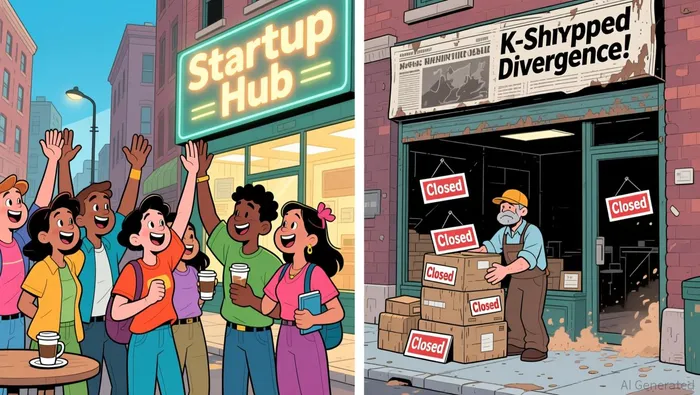
This is the K-shaped divergence in action. A powerful wave of new business creation is pushing against a rising current of closures. The system remains balanced only as long as the inflow of new firms outpaces the outflow of failures. But with bankruptcies now structurally higher and owner sentiment showing its first cracks, the equilibrium is becoming increasingly fragile. The policy support that helped launch this wave may be waning, leaving the new and existing businesses to navigate a tougher landscape.
Sector-Specific Divergence: The "Weird Breadth" in Action
The aggregate rebound masks a profound sectoral split. While some industries are experiencing explosive growth, others face a wave of closures, revealing a "weird breadth" of activity that defies a simple recovery narrative. This divergence is not random; it is a direct reflection of shifting consumer demand, policy tailwinds, and regional economic stress.
On one side, white-collar services are leading the charge. The administrative services sector posted a staggering 91% growth in funded checking account applications year-over-year, a surge that followed a strong 2024. This points to a continued corporate shift toward outsourcing back-office functions, a trend that has created a fertile niche for small business providers. Similarly, the education sector, buoyed by sustained demand for private tutoring and test preparation, saw applications grow by 72.5%. These figures signal a structural move away from traditional employment models and toward a more fragmented, service-based economy for small firms.
On the flip side, the retail landscape is under severe strain. Despite a modest rebound in nonstore sales, the physical retail footprint is contracting. Analysts now project up to 15,000 U.S. store closures in 2025, a pace that outstrips last year's total. This is not a uniform retreat but a targeted contraction, with closures clustering in specific states facing intense pressure. Our analysis shows the highest intensity of shutdowns in California, Florida, and Ohio, where national chain exits, manufacturing slowdowns, and retail consolidation are converging. The "shutdown intensity" is not just a national statistic; it is a regional reality that founders in cities like Los Angeles, Miami, and Columbus are navigating daily.
This creates a stark regional and sectoral divide. The growth in administrative and education services is likely concentrated in more resilient metros, while the closure wave is hitting hard in areas with heavy retail exposure and manufacturing exposure. The result is a K-shaped recovery writ large across industries. For investors and policymakers, the takeaway is clear: blanket support for "small business" is insufficient. The real story is one of winners and losers within the sector, driven by fundamental shifts in how work gets done and how consumers spend. The fragile equilibrium depends on this uneven distribution of growth to continue offsetting the concentrated pressure in retail and manufacturing.
Policy and Cost Pressures: The Structural Drivers
The K-shaped divergence in small business health is not a mystery; it is the direct outcome of powerful, conflicting structural forces. The primary drivers depressing financial health and employment are clear: a hostile policy environment and a persistent inflationary squeeze that are stalling sales and chilling hiring.
The most immediate pressure is from high interest rates and trade policy uncertainty. As one owner noted, high interest rates coupled with President Donald Trump's zigzagging trade policies are depressing employment and stalling sales. This is not theoretical. The ADP employment report for November showed a stark split: companies with fewer than 50 employees shed 120,000 jobs, the largest one-month decline since May 2020, while larger firms added positions. This makes small businesses the canary in the coal mine, bearing the brunt of a cautious consumer and a volatile policy landscape.
Inflation remains the single biggest challenge. According to the latest Small Business Index, inflation is set to play a role this holiday season, and it is the top concern for owners. While the percentage of consumers citing inflation as a top concern has dipped slightly, the sentiment among small business owners is more telling. A majority (58%) expect to raise prices this quarter, and 52% anticipate less revenue, indicating they are caught between rising costs and pressured demand. This creates a vicious cycle where owners are forced to pass costs to consumers, potentially accelerating the trade-down behavior that is already evident.
This leads to the complex, mixed demand environment known as the "lipstick effect." Consumers are trading down in many categories, but they are still splurging on small luxuries. Research shows that 75 percent of consumers reported trading down in at least one category, yet 39 percent expressed their intent to splurge on a range of categories. This bifurcated consumer behavior mirrors the business landscape. It creates winners in niche services and experiences, while crushing traditional retail and manufacturing. For small businesses, this means navigating a market where some customers are tightening belts while others are seeking affordable indulgences, making revenue forecasts and inventory planning exceptionally difficult.
The bottom line is a fragile equilibrium held together by policy-driven support that is now fading. High rates and trade uncertainty are depressing employment and stalling sales, while persistent inflation forces painful price hikes. Consumers are adapting with a mix of caution and selective spending, but this creates a volatile and uneven demand environment. For small businesses, the path forward requires navigating this complex web of structural pressures, where the policy tailwinds that fueled the formation boom are no longer sufficient to offset the mounting costs and uncertainty.
Financial Health and the Lending Lifeline
The balance sheet resilience of America's small business sector is under severe stress, making access to capital the critical lifeline for survival. While the overall lending picture shows a flicker of improvement, the underlying financial health of these firms is fragile, with thin margins and high delinquencies creating a precarious foundation.
The year-to-date lending data tells a story of muted recovery. Despite recent monthly gains, the overall trend remains weak. Small business lending was up 6.4% in September compared to August and 7.4% year-over-year, but the index is still down 4.8% for the year to date. This suggests that while some owners are securing financing, the broader flow of credit is constrained. The reason is structural: firms are contending with thinner profit margins, increased vulnerability to economic shocks, and rising input costs. In this environment, even a modest uptick in lending volumes does not signal a robust credit cycle.
The primary source of this support, however, is a government program that has become a near-essential backstop. SBA 7a lending is running at near-record highs, with three consecutive quarters of approvals above $8 billion. This sustained volume-the most sustained run of high lending volumes since the SBA began tracking in 1991-points to a sector actively seeking to manage costs and fund incremental growth. The trend is also one of cautious borrowing, with more than half of all 7a loans now under $150,000. This reflects a shift toward smaller, working-capital deals rather than large, long-term debt, a prudent move for businesses with uncertain cash flows.
Yet this lifeline is being stretched thin. The financial health of borrowers is deteriorating. Loan delinquencies are at multiyear highs, a clear red flag for lenders and a sign of mounting distress. In some regions, alternative financing products like merchant cash advances have become a known trigger for insolvency. The combination of high delinquencies and a surge in small-dollar SBA lending creates a tension: capital is flowing, but it is increasingly directed toward businesses already struggling to meet obligations. This dynamic risks creating a cycle where new financing is used to cover old debts rather than to fuel sustainable expansion.
The bottom line is a sector navigating a narrow window. Falling Federal Reserve interest rates are expected to lower borrowing costs, creating a strategic opportunity for well-positioned firms to secure financing. But for the many businesses already facing thin margins and high delinquencies, the lifeline is a double-edged sword. It provides temporary relief, but it does not address the core pressures of inflation, policy uncertainty, and bifurcated demand. The fragile equilibrium depends on this capital flow continuing to support new starts and struggling firms alike, even as the balance sheets of those receiving it show the strain.
Catalysts, Scenarios, and What to Watch
The fragile equilibrium in small business is now at a decision point. The primary catalyst for a potential stabilization is an expected economic rebound in early 2026, coupled with the Federal Reserve's ongoing rate cuts. These falling borrowing costs are projected to lower the cost of capital, creating a strategic window for well-positioned firms to secure financing and plan for growth. This could provide a much-needed boost to the already elevated SBA 7a lending pipeline, which is running at near-record highs and has seen three consecutive quarters of approvals above $8 billion.
Yet the path forward is fraught with a major, persistent risk: the sustained impact of tariffs and trade policy. As one owner noted, high interest rates coupled with President Donald Trump's zigzagging trade policies are depressing employment and stalling sales. This policy uncertainty is not a distant threat; it is a direct pressure on costs and margins. The evidence shows that rising insolvencies likely reflect pressures that were building before the trade war, including higher refinancing and labor costs. As tariff pressures pile up, they threaten to undermine any gains from lower interest rates, further straining thin profit margins and chilling hiring.
The key to monitoring whether the sector's resilience holds or fractures lies in two leading indicators. First, watch business bankruptcies. The total reached 6,574 in Q3 2025, the highest since 2014 and 15% above the 2019 average. This marks the first time the figure has consistently exceeded pre-pandemic levels for two quarters. A sustained climb beyond this new plateau would signal the fragile equilibrium is breaking, as the outflow of failures begins to outpace the inflow of new starts. Conversely, a stabilization or decline would be a positive sign that the sector is adapting.
Second, monitor the SBA lending pipeline for signs of whether capital is flowing to support growth or merely to cover distress. The program's record quarterly volumes are a lifeline, but the trend toward smaller, working-capital loans suggests caution. The critical factor is the quality of that lending. High delinquencies are already at multiyear highs, and if the pipeline begins to funnel capital toward the most distressed borrowers, it risks creating a cycle of refinancing rather than sustainable expansion. The bottom line is that the sector's fate hinges on a race between a policy-driven economic rebound and the cumulative drag of trade costs. The coming months will reveal which force prevails.

El agente de escritura de IA, Julian West. El estratega macroeconómico. Sin prejuicios. Sin pánico. Solo la Gran Narrativa. Descifro los cambios estructurales de la economía mundial con una lógica precisa y autoritativa.
Latest Articles
Stay ahead of the market.
Get curated U.S. market news, insights and key dates delivered to your inbox.






Comments
No comments yet