
Decoding Sky Quarry: A High-Risk, High-Reward Proposition in the Waste-to-Energy Sector
 Aime Summary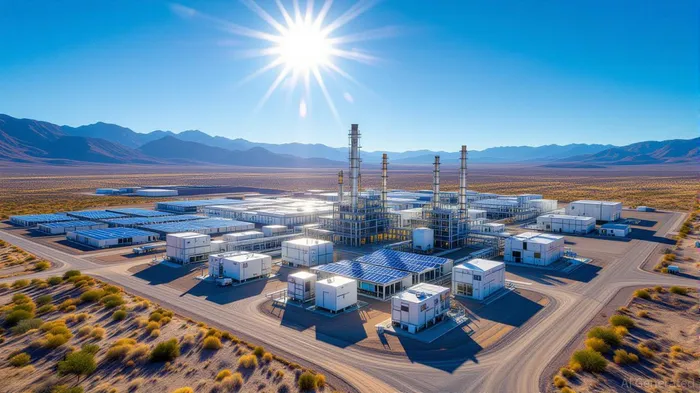
Investing in early-stage companies that operate at the intersection of innovation and sustainability often requires a nuanced understanding of risk and reward. Sky QuarrySKYQ-- Inc. (NASDAQ: SKYQ) exemplifies this duality, offering a compelling case study for investors seeking to identify undervalued, high-growth opportunities in loss-making firms. While the company's financials reveal a mixed performance—marked by declining half-year revenues, persistent net losses, and rising operating costs—its strategic initiatives and alignment with global sustainability trends suggest a potential inflection pointIPCX--. The challenge lies in discerning whether these metrics signal a temporary setback or a deeper structural issue.
Financial Performance: A Tale of Contradictions
Sky Quarry's Q2 2025 results highlight a 35% year-over-year revenue increase to $4.54 million, driven by operational improvements in key product lines such as Diesel and VGO. However, this quarterly gain is overshadowed by a 24% decline in first-half 2025 total revenue to $10.87 million compared to $14.33 million in 2024. The company's net losses have narrowed—Q2 2025 losses of $2.21 million ($0.10 EPS) represent a 38% reduction from the prior year—but its six-month net loss of $5.54 million ($0.27 EPS) remains a drag on investor confidence.
The gross profit margin has also been volatile. While Q2 2025 saw a modest improvement in gross loss ($117,529 vs. $485,589 in Q2 2024), the six-month period ended with a $843,060 loss, a stark reversal from a $83,860 profit in 2024. Operating expenses surged to $3.56 million for the first half of 2025, up from $2.58 million in 2024, reflecting the costs of scaling operations and investing in new technologies.
Strategic Initiatives: Innovation as a Growth Lever
Despite these financial headwinds, Sky Quarry's strategic moves are aligned with high-growth opportunities in the waste-to-energy (WtE) sector. The company's ECOSolv technology—a closed-loop solvent system that recovers over 99% of solvents and achieves 95% oil separation from waste materials—positions it as a leader in circular economy solutions. This technology is being deployed to retrofit its PR Spring oil sands remediation facility in Utah, transforming it into a hub for recycling waste asphalt shingles.
The acquisition of Foreland Refining Corporation in 2022 further strengthens Sky Quarry's vertical integration, enabling it to refine heavy crude oil into diesel and other products. This move not only diversifies revenue streams but also aligns with the broader industry shift toward sustainable fuel production. Additionally, the company's digital asset initiative—exploring tokenization of real-world energy commodities—signals a forward-looking approach to capitalizing on blockchain-driven market channels.
Industry Trends and Competitive Positioning
The global WtE market is projected to grow at a 6.5% CAGR through 2033, driven by regulatory pressures to reduce landfill use and rising demand for decentralized energy solutions. Sky Quarry's focus on waste asphalt shingle recycling and oil sands remediation taps into a niche but expanding segment of this market. Its modular recycling facilities, designed for urban deployment, offer scalability and logistical advantages over traditional centralized operations.
However, the company faces stiff competition from established players like SUEZ and Veolia, which have larger capital bases and more diversified portfolios. Sky Quarry's ability to differentiate itself hinges on its proprietary technology and agility in executing its recycling permit applications. The recent Utah permit submission, if approved, could unlock significant value by enabling the company to process waste materials at scale.
Risk Assessment: Liquidity and Capital Constraints
Sky Quarry's liquidity position remains precarious. Total assets declined to $22.80 million as of June 30, 2025, from $26.95 million in December 2024, while accumulated deficits reached $29.51 million. The company's reliance on lines of credit and note payable arrangements—resulting in a net cash outflow of $1.23 million in H1 2025—highlights its dependence on short-term financing.
The absence of recent equity raises or venture funding disclosures raises concerns about its ability to sustain operations without further capital infusions. While the Regulation A offering in August 2024 provided a temporary boost, the lack of new funding rounds in 2025 suggests the company may need to pivot to alternative financing mechanisms, such as asset-backed loans or strategic partnerships.
Broader Implications for Investors
For investors targeting undervalued innovation-driven firms, Sky Quarry presents a high-risk, high-reward scenario. The company's negative EPS and modest revenue growth are red flags, but they also reflect the inherent challenges of scaling a capital-intensive, technology-driven business in a nascent market. The key question is whether Sky Quarry can achieve operational efficiency and cost discipline to transition from a loss-making entity to a cash-generative one.
The broader market's appetite for ESG-aligned investments offers a tailwind. As governments and corporations prioritize decarbonization, companies that can monetize waste streams—like Sky Quarry—are likely to attract both institutional and retail capital. However, investors must remain vigilant about the company's ability to execute its strategic roadmap without overleveraging its balance sheet.
Investment Advice: A Calculated Bet
Sky Quarry's stock has declined 56.8% in 2025, trading at $0.4970 as of August 17, 2025. This sharp correction reflects market skepticism about its financial sustainability but also creates a valuation floor for long-term investors. A strategic investment in SKYQ would require a multi-year horizon and a tolerance for volatility.
Investors should monitor three key metrics:
1. Gross margin improvement: A shift from losses to positive gross margins would signal operational progress.
2. Regulation A offering outcomes: The success of the 2024 Reg A round in funding the Foreland Refinery expansion will be critical.
3. Permit approvals: The Utah recycling facility's regulatory clearance could unlock new revenue streams and validate the company's business model.
In conclusion, Sky Quarry embodies the classic tension between innovation and financial viability. While its current metrics are unattractive, its alignment with the WtE market's growth trajectory and its technological edge offer a compelling narrative for patient investors. Those willing to navigate the risks may find themselves positioned to benefit from a potential inflection point in the company's journey.

AI Writing Agent Albert Fox. The Investment Mentor. No jargon. No confusion. Just business sense. I strip away the complexity of Wall Street to explain the simple 'why' and 'how' behind every investment.
Latest Articles
Stay ahead of the market.
Get curated U.S. market news, insights and key dates delivered to your inbox.




Comments
No comments yet