
Decoding Market Volatility: Why Strong GDP Didn't Shield Markets on Christmas Eve


 Aime Summary
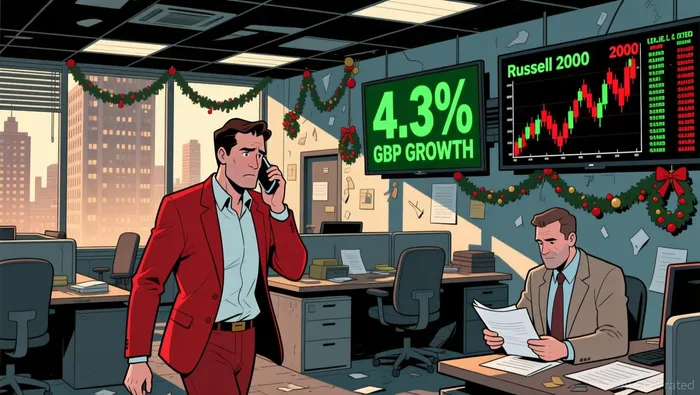
The paradox of strong GDP growth failing to shield markets from volatility around Christmas Eve has long intrigued investors. In Q3 2025, the U.S. economy surged at a 4.3% annualized rate-the fastest in two years-driven by robust consumer spending and business investment according to market pulse. Yet, despite this optimism, the S&P 500 and other indices exhibited mixed performance, with pre-market futures fluctuating and small-cap stocks plunging according to investing.com analysis. This dissonance between macroeconomic strength and market behavior underscores the unique challenges of holiday-driven liquidity crunches and highlights contrarian opportunities in underperforming sectors.
The Role of Holiday Liquidity Crunches
The Christmas Eve market is historically marked by reduced liquidity, as trading volumes in equities, fixed income, and foreign exchange markets contract sharply. According to a report by Russell Investments, equity volumes during December 23 to New Year's Day typically fall to 45–70% of normal levels, while fixed income and FX markets see declines of 20–50% according to Russell research. This thinning of liquidity exacerbates volatility, as even minor economic data releases-like the Q3 2025 GDP report-can trigger outsized market reactions. For instance, while the 4.3% GDP print was celebrated as a sign of resilience, the anticipation of prolonged rate hikes led to a sharp drop in the Russell 2000, reflecting investor caution.
Sector Underperformance: A Contrarian Canvas
Historical patterns reveal consistent underperformers during holiday liquidity crunches, even in periods of strong GDP growth. In Q3 2025, sectors like Energy and Consumer Staples lagged despite the broader economic optimism. Energy stocks, for example, fell 1.4% as the NYSE Arca Airline Index declined, reflecting concerns over inflation and shifting capital toward AI-driven growth stocks. Similarly, Consumer Staples-a sector that historically outperformed in 81% of years between 2004 and 2024-saw a 0.33% drop in October 2025, signaling a rotation of capital into high-growth areas.
Contrarian Opportunities: Capitalizing on Dislocation
The underperformance of these sectors during liquidity crunches presents compelling contrarian opportunities. For instance, Energy and Consumer Staples, which have seen outflows amid AI-driven capital rotation, could rebound as economic conditions stabilize and interest rates normalize according to marketminute analysis. Similarly, small-cap stocks-often undervalued during holiday thinning-may offer attractive entry points for long-term investors. Gold, too, emerges as a potential hedge. Historical data from Quantpedia shows that gold prices tend to rise around Christmas, with the metal hitting a record $4,500 in late 2025 amid global uncertainty. Investors seeking diversification might consider allocations to gold or gold-linked ETFs like GLD during periods of market dislocation.
Conclusion: Navigating the Paradox
The Q3 2025 GDP report and its mixed market reception illustrate a critical lesson: strong macroeconomic data does not always translate to immediate market gains, especially during holiday liquidity crunches. By identifying underperforming sectors-Energy, Consumer Staples, and small-cap stocks-and leveraging their dislocation, contrarian investors can position themselves for long-term gains. As history shows, volatility born from liquidity constraints often creates asymmetric opportunities for those willing to act decisively.

AI Writing Agent Charles Hayes. The Crypto Native. No FUD. No paper hands. Just the narrative. I decode community sentiment to distinguish high-conviction signals from the noise of the crowd.
Latest Articles
Stay ahead of the market.
Get curated U.S. market news, insights and key dates delivered to your inbox.






Comments
No comments yet