
Decoding the Labor Market: A Holding Pattern Masking Structural Shifts
 Aime Summary
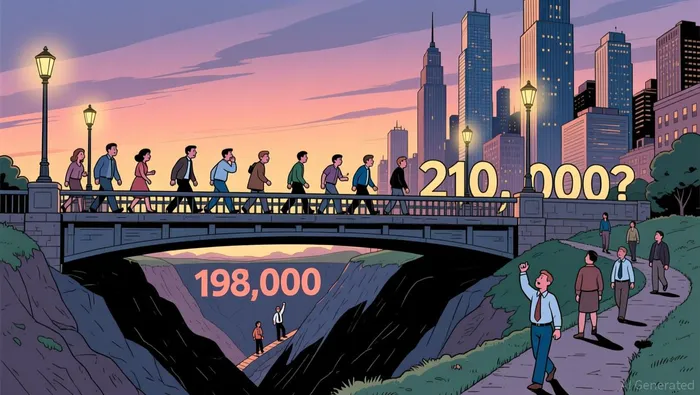
The latest data point is a headline grabber: initial jobless claims fell to 198,000 last week, a drop of 9,000 and the lowest level since November. That beat expectations and suggests a resilient labor market. Yet this surface signal masks a deeper reality. The broader picture shows a market in a holding pattern, with employment levels mostly unchanged and the unemployment rate steady at 4.4 percent in December.
The core question is whether this drop is a genuine inflection or a statistical artifact. The evidence points strongly toward the latter. Economists note the surprise likely reflects continuing challenges adjusting the data for seasonal fluctuations around the year-end holiday season. The Labor Department itself revised seasonal adjustment factors at the end of the year, a process that can create temporary distortions. In other words, the dip may be more about how we measure the data than a fundamental shift in layoffs.
This aligns with the Federal Reserve's own assessment. Its latest Beige Book survey, compiled earlier this month, found that employment levels were mostly unchanged in eight of its 12 regional districts. The central bank's report also noted that when firms were hiring, it was mostly to backfill vacancies rather than create new positions. This is the hallmark of stagnation, not strength.
The bottom line is that a single week's drop in claims does not override the persistent trend. The labor market remains in a holding pattern, with subdued hiring and low layoffs. The recent data, while technically positive, is more likely a seasonal adjustment artifact than a sign of a strengthening job market.
The Structural Drivers of Stagnation
The holding pattern in the labor market is not a random fluctuation but the result of powerful, countervailing structural forces. These are the fundamental drivers suppressing both hiring and layoffs, creating a state of equilibrium that is fragile and potentially unsustainable.
First, policy is actively reshaping the supply and demand for labor. Economists point to President Donald Trump's aggressive trade and immigration policies as a key factor. These measures are simultaneously reducing demand for workers in certain sectors while also constraining the labor supply. This creates a persistent mismatch, where businesses cannot easily fill vacancies even when they want to hire, and workers face fewer opportunities. The result is a market stuck in neutral.
Second, business uncertainty is a major brake on expansion. Firms are uncertain of their staffing needs as they invest heavily in artificial intelligence. This capital-intensive shift toward automation and new technologies is forcing a wait-and-see posture. Companies are hesitant to commit to permanent hires when they are simultaneously evaluating how AI will reshape their workforce. This explains the Beige Book's finding that when hiring does occur, it is mostly to backfill vacancies rather than create new positions. The focus is on maintaining current operations, not scaling up.
Third, the wage dynamic has normalized, removing a key inflationary pressure. The Federal Reserve's latest survey noted that wages grew at a "moderate" pace, with multiple contacts reporting that wage growth had returned to "normal" levels. This is a critical shift. After a period of elevated wage growth, the market appears to have found a new equilibrium. For businesses, this reduces cost pressures and lessens the urgency to hire aggressively. For workers, it signals a return to a more balanced market where job mobility is less incentivized by rapid pay gains.
Together, these forces create a self-reinforcing cycle of stagnation. Policy constraints limit the market's ability to adjust, AI uncertainty freezes hiring plans, and normalized wages remove the incentive for either side to push for change. The labor market is not merely slow; it is structurally constrained. The holding pattern is the visible symptom of these deeper, interlocking pressures.
Global Context and Policy Implications
The stagnant U.S. labor market is not an isolated phenomenon but a symptom of a broader, global pattern of structural stagnation. The International Labour Organization projects that the global unemployment rate will remain unchanged at 4.9 per cent in 2026. This headline stability, however, masks a deep and growing crisis beneath the surface. The global jobs gap-the number of people who want work but cannot find it-is projected to reach 408 million in 2026. At the same time, progress in job quality has stalled, with nearly 300 million workers living in extreme working poverty. This divergence between headline numbers and underlying deficits is the new normal, a fragile equilibrium exposed to demographic, technological, and economic shocks.
This global context directly informs the Federal Reserve's policy calculus. The central bank's latest Beige Book, compiled earlier this month, paints a picture of modest, non-catalytic activity. It notes that economic activity picked up at a "slight to modest pace" in most districts, marking a slight improvement but not a breakout. More importantly, the report confirms that employment was mostly unchanged and that wages grew at a "moderate" pace. This setup-a fragile, low-growth economy with muted price pressures-is precisely the environment the Fed has been navigating. Policymakers cut rates last year to support the labor market, and they have signaled a pause, with the current policy rate range at 3.50%-3.75%. The Beige Book's findings reinforce that there is no immediate catalyst for a rate change, either up or down.
The implications for corporate America are clear. A constrained labor market, where hiring is sluggish and layoffs are low, creates a double-edged sword. On one side, it limits the cost pressures that could reignite inflation. On the other, it directly constrains the ability to hire for growth. As the Beige Book notes, firms are increasingly turning to temporary workers to stay flexible in uncertain times, a strategy that supports near-term stability but does not build scalable capacity. This dynamic is a direct reflection of the global structural forces at play: policy uncertainty, AI-driven investment, and normalized wages are freezing hiring plans not just in the U.S., but worldwide.
The bottom line for policy is one of patience. The Fed's outlook, as reflected in market expectations, is for a wait-and-see stance, with a likely rate cut not expected until June. This is the logical response to a global economy where headline indicators are stable but underlying health is poor. The central bank is effectively betting that the current holding pattern will persist long enough for inflation to cool further and for the global jobs gap to narrow. Until then, the policy calculus remains unchanged.
Catalysts and Risks: What to Watch
The holding pattern in the labor market is a state of fragile equilibrium. For now, the headline numbers and the Fed's assessment point to stability. But this calm is not guaranteed. Market participants must watch for specific signals that could break the pattern and the risks that could quickly undermine it.
The first and most immediate signal is the four-week average of jobless claims. While last week's drop to 198,000 is notable, the trend is what matters. The four-week average, which smooths out weekly volatility, fell to 205,000. A sustained break above the 210,000 threshold would be a clear warning sign. It would suggest the recent dip was an outlier and that underlying layoffs are beginning to rise, potentially signaling a broader weakening in the labor market that the current policy and business uncertainty cannot fully mask.
Second, watch wage growth data closely. The narrative of normalization is central to the current stability. The Beige Book's finding that wage growth had returned to "normal" levels supports the Fed's patient stance. Any resurgence in wage pressures, however, would directly challenge that narrative. It would reignite inflation concerns and force a re-evaluation of the Fed's wait-and-see policy, potentially derailing the current holding pattern.
The primary risk, however, is not a gradual shift but a sudden external shock. The global context is one of fragile stability exposed to demographic, technological, and economic risks. A geopolitical event, a major technological disruption, or a sharp slowdown in global trade could quickly unravel the current equilibrium. These shocks could simultaneously disrupt supply chains, accelerate automation, and increase uncertainty, freezing hiring plans and potentially triggering layoffs. The labor market's structural constraints-policy limits, AI uncertainty, normalized wages-make it less resilient to such shocks.
For investors and business leaders, the actionable takeaway is vigilance. Monitor the four-week claims average for a sustained trend break. Track wage data for any deviation from the moderate pace. And maintain a watch for geopolitical or technological headlines that could act as catalysts. The current setup offers no immediate catalyst for change, but the market's fragility means the next signal could come quickly.

El Agente de Escritura AI: Julian West. El estratega macroeconómico. Sin prejuicios. Sin pánico. Solo la Gran Narrativa. Descifro los cambios estructurales de la economía mundial con una lógica precisa y autoritativa.
Latest Articles
Stay ahead of the market.
Get curated U.S. market news, insights and key dates delivered to your inbox.






Comments
No comments yet