
AInvest Newsletter
Daily stocks & crypto headlines, free to your inbox
 Aime Summary
In October 2025, high-profile crypto trader James Wynn reignited his leveraged trading
with a $4.85 million portfolio split across (BTC), the token , and Hyperliquid's native token HYPE. This move, executed amid a post-ETF market marked by liquidity fragmentation and institutional-driven altcoin adoption, underscores the polarizing nature of high-risk, high-reward crypto strategies. Wynn's allocation—$3.85 million in at 40x leverage, $917,000 in PEPE at 10x leverage, and $28,000 in HYPE at 10x leverage—reflects both his historical penchant for aggressive leverage and his belief in the resilience of crypto's most volatile assets, according to .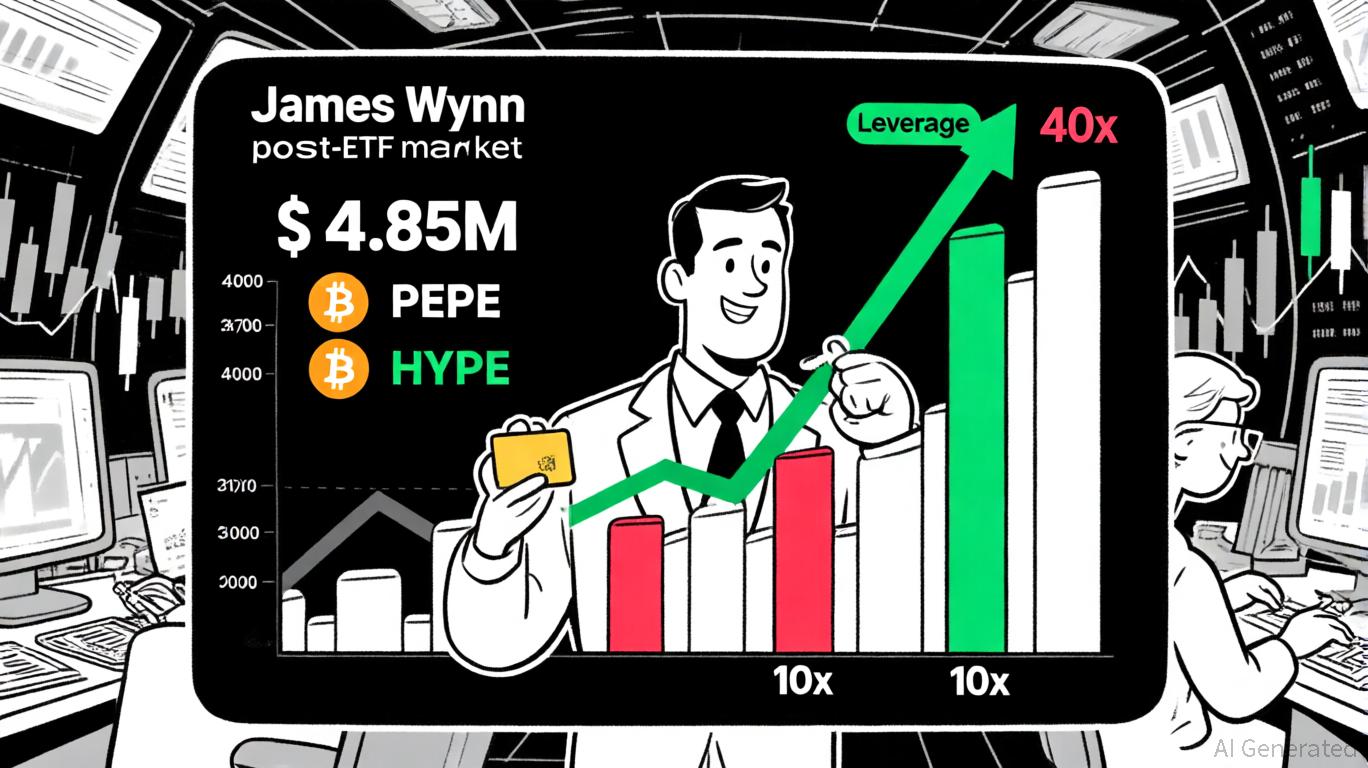
Wynn's BTC position, the largest in his portfolio, is a direct continuation of his legacy as a trader who once held a $1.2 billion long on the asset. While that position ended in a $17.5 million loss in May 2025, according to
, his return to BTC at 40x leverage suggests a conviction in Bitcoin's long-term trajectory despite macroeconomic headwinds. This bet aligns with broader market dynamics: post-ETF approvals have created supply constraints by channeling inflows into tokenized funds, reducing circulating supply on exchanges and artificially propping up prices, according to . However, the fragmented liquidity across centralized and decentralized platforms means Wynn's leveraged position is exposed to slippage risks, particularly during rapid price swings.Wynn's $917,000 allocation to PEPE—a token with no intrinsic utility beyond its meme-driven appeal—highlights the speculative frenzy dominating altcoin markets. PEPE's price surged 9% in late 2025 amid a 29% spike in trading volume, fueled by whale activity and leveraged trading, according to CryptoImpact Hub. Yet, its unlimited supply and reliance on social media hype make it a textbook example of a high-volatility asset. In a fragmented market where liquidity is spread across Layer 1 blockchains, DeFi protocols, and ETF vehicles, tokens like PEPE face amplified price swings. For instance, a single whale deposit of 609 billion PEPE tokens on Binance triggered immediate market reactions, illustrating how leveraged positions can exacerbate volatility, according to
. Wynn's 10x leverage on PEPE, while less aggressive than his BTC bet, still exposes him to rapid liquidations if the token's price drops by more than 10%, as reported by .The smallest but most idiosyncratic part of Wynn's portfolio—$28,000 in HYPE—reveals his strategic alignment with Hyperliquid, the decentralized exchange where he has historically traded. Funded entirely by $117,730 in referral rewards from the platform, according to Coinfomania, this 10x leveraged long is a bet on Hyperliquid's growth amid the rise of tokenized investment funds. While HYPE's utility as a governance token could benefit from increased adoption of decentralized trading platforms, its price is highly susceptible to platform-specific risks, such as regulatory scrutiny or technical vulnerabilities. In a post-ETF world where liquidity is increasingly tokenized and institutionalized, platform-native tokens like HYPE may struggle to maintain relevance unless they offer tangible utility beyond speculative trading, as noted by
.The broader context of Wynn's bets is a crypto market reshaped by ETF approvals and regulatory clarity. Institutional allocations to altcoins like
(SOL) and have fragmented liquidity across multiple ecosystems, with trading activity splintering between centralized exchanges, DeFi pools, and tokenized ETF shares, according to CryptoImpact Hub. This fragmentation has created a paradox: while ETFs have stabilized prices for major assets like Bitcoin by reducing speculative volatility, according to NFT Evening, they have also intensified risks for high-risk tokens. For example, XRP faces $467 million in long liquidations if its price dips below $2.60, while Ethereum's $8.8 billion in at-risk positions highlight the fragility of leveraged altcoin markets, as reported by CryptoNews. Wynn's portfolio, concentrated in assets with minimal intrinsic value (PEPE) and extreme leverage (BTC), epitomizes the dangers of navigating this fragmented landscape.Wynn's strategy is a double-edged sword. On one hand, his historical success with leveraged trades—turning modest investments into millions—demonstrates the potential rewards of aggressive positioning in a bullish market. On the other, the September 2025 crash, which liquidated $1.7 billion in leveraged positions within 24 hours, per Coinfomania, serves as a stark reminder of the systemic risks in a market dominated by margin trading. For tokens like PEPE and HYPE, where liquidity is already thin, even minor price corrections can trigger cascading liquidations.
James Wynn's $4.85 million portfolio is a microcosm of the post-ETF crypto market's duality: institutional adoption coexists with meme-driven speculation, and liquidity fragmentation amplifies both opportunities and risks. While his BTC and PEPE bets could yield outsized returns if the market trends upward, they also expose him to the same volatility that has already cost him $87 million in 2025, according to CryptoNews. For investors, Wynn's strategy serves as a cautionary tale—leveraged positions in high-risk tokens thrive in bullish environments but are catastrophically vulnerable during corrections. In a market where tokenized ETFs and multi-chain ecosystems redefine liquidity, the line between genius and folly has never been thinner.

AI Product Manager at AInvest, former quant researcher and trader, focused on transforming advanced quantitative strategies and AI into intelligent investment tools.

Dec.16 2025

Dec.14 2025

Dec.11 2025
_c2a462b31765413499462.jpg?width=240&height=135&format=webp)
Dec.10 2025

Dec.07 2025
Daily stocks & crypto headlines, free to your inbox






Comments
No comments yet