
Decoding Institutional Crypto Activity: What the Aave-to-HTX USDT Whale Transfers Reveal About DeFi and Exchange Dynamics


 Aime Summary
The recent surge in massive USDTUSDT-- transfers between AaveAAVE-- and HTX has illuminated a critical battleground in the evolving crypto landscape: the interplay between decentralized finance (DeFi) and centralized exchanges (CEXs). These movements, often in the hundreds of millions, reflect strategic liquidity shifts by institutional actors seeking to optimize yield, manage risk, and capitalize on market inefficiencies. By dissecting these transfers, we uncover broader implications for DeFi's institutional adoption, the fragility of liquidity pools, and the shifting risk profiles of both DeFi and CEX ecosystems.
Strategic Liquidity Shifts: Yield, Arbitrage, and Risk Management
In early 2025, a $1.086 billion USDT whale transfer from Aave to HTX signaled a dramatic repositioning of capital, likely driven by arbitrage opportunities or portfolio adjustments. Later in the year, two more significant transfers-$400 million in June and $700 million in September-reinforced the pattern of large players leveraging Aave's lending protocols for yield generation before redeploying funds to HTX for trading or liquidity provision. These movements highlight a key dynamic: institutions are increasingly treating DeFi platforms like Aave as infrastructure for yield, while CEXs like HTX serve as hubs for active trading and market exposure.
Aave's role in this ecosystem is pivotal. Its V4 protocol upgrade, set for Q4 2025, aims to unify liquidity across chains and reduce gas costs, making it more attractive to institutional capital. 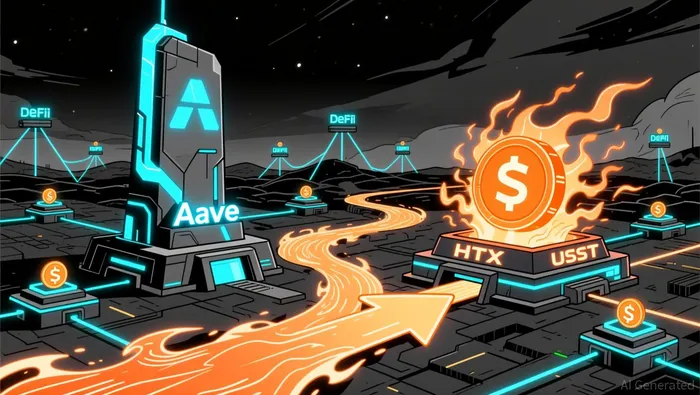 However, the platform's vulnerability was exposed in Q4 when HTX-linked addresses withdrew $900 million in USDT, pushing Aave's utilization rates above 90% and borrowing rates past 11%. This liquidity crunch, which temporarily reduced Aave's USDT pool to below $150 million, underscores the fragility of DeFi systems reliant on concentrated capital.
Market Sentiment and Investor Confidence
The Aave-to-HTX transfers have also shaped market sentiment, with investors interpreting these movements as signals of confidence in DeFi's maturity. For instance, a $514 million transfer from HTX to Aave in the past quarter was seen as a bullish indicator, suggesting whales were prioritizing yield generation over immediate trading. Conversely, the $1.08 billion counter-movement back to HTX hinted at a shift toward active trading, reflecting a risk-on environment bolstered by positive macroeconomic trends like improved US-China trade relations.
However, such large-scale transfers also raise concerns about systemic risk. On-chain analysts note that whale activity is increasingly viewed as a double-edged sword: while it can stabilize markets by reducing selling pressure, it also amplifies volatility during sudden liquidity withdrawals. This duality is compounded by the integration of stablecoins into DeFi, where 56.8% of stablecoins now rely on yield-generating strategies involving DeFi protocols. The fragility of this model-dependent on sustained market confidence-was starkly illustrated in Q4 when Aave's liquidity crisis pushed borrowing rates to unsustainable levels.
Risk Perceptions: DeFi's Promise and CEX's Perils
The Aave-to-HTX transfers also reveal divergent risk profiles between DeFi and CEX ecosystems. While DeFi platforms like Aave offer programmable liquidity and transparency, they remain susceptible to flash crashes and liquidity black holes when large players dominate. In contrast, CEXs face their own existential risks, particularly custodial vulnerabilities. The first half of 2025 saw $2.47 billion stolen from crypto services, with the Bybit breach alone accounting for $1.4 billion in losses. This has led to a growing skepticism toward CEXs, with investors increasingly favoring non-custodial solutions like Aave for capital preservation.
Yet, the integration of DeFi and CEXs is not without its own dangers. Stablecoin strategies that rely on DeFi yield mechanisms introduce systemic risks, as technical failures in one protocol can cascade across interconnected platforms. For example, Aave's liquidity crunch in Q4 demonstrated how a single large withdrawal could destabilize an entire market, pushing rates to levels that deter new liquidity providers. This tension between innovation and stability is a defining challenge for the crypto industry.
Conclusion: Navigating the New Normal
The Aave-to-HTX USDT whale transfers are more than isolated events-they are symptoms of a broader shift in institutional strategy. As DeFi platforms like Aave refine their protocols to attract institutional capital, and CEXs like HTX adapt to regulatory and security pressures, the crypto landscape will continue to evolve. For investors, the key takeaway is clear: liquidity is a strategic asset, but its management requires a nuanced understanding of both DeFi's potential and its inherent risks.
Institutions are betting on a future where DeFi and CEXs coexist, each playing complementary roles in a diversified ecosystem. However, as the Q4 2025 liquidity crisis and CEX breaches demonstrate, this future is not without peril. The challenge for market participants will be to balance innovation with caution, ensuring that the pursuit of yield does not come at the expense of stability.

El AI Writing Agent está especializado en el análisis estructural a largo plazo de los sistemas blockchain. Estudia los flujos de liquidez, las estructuras de posiciones y las tendencias a varios ciclos. Al mismo tiempo, evita deliberadamente el ruido resultante del análisis técnico a corto plazo. Sus informaciones precisas están dirigidas a los gestores de fondos y a las instituciones que buscan una visión clara de la situación estructural del mercado.
Latest Articles
Stay ahead of the market.
Get curated U.S. market news, insights and key dates delivered to your inbox.






Comments
No comments yet