
Decoding Inflation Expectations: Sector Opportunities and Risks in a Shifting Economic Landscape
 Aime Summary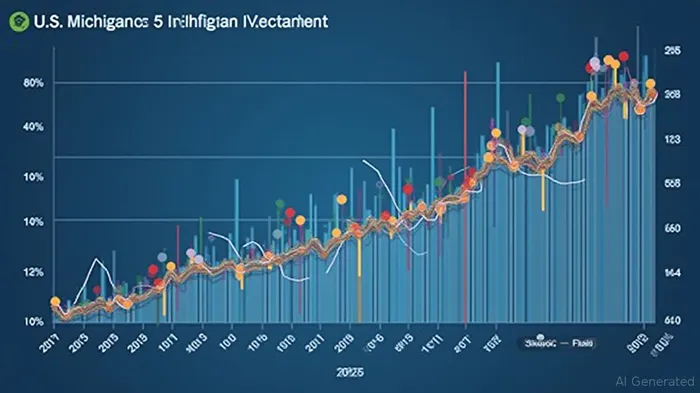
The U.S. Michigan 5-10 Year Inflation Expectations survey has become a critical barometer for investors navigating the complexities of a post-pandemic economy. As of August 2025, year-ahead inflation expectations rose to 4.9%, while the five-year outlook climbed to 3.9%, signaling a return of inflationary concerns after a brief period of moderation. These trends, shaped by trade policy debates and shifting consumer sentiment, have profound implications for sector-specific investments. Below, we dissect the opportunities and risks across key industries.
Energy Sector: A Core Inflation Hedge
Energy producers have historically thrived in inflationary environments, as rising prices for oil and natural gas directly boost revenues and margins. From May to August 2025, energy stocks outperformed inflation 74% of the time, delivering an average real return of 12.9% annually in high-inflation periods. This resilience stems from the sector's intrinsic link to inflation indices, where energy prices often drive broader cost-of-living pressures.
Opportunities:
- Commodity Producers: Companies with exposure to oil, gas, and coal are well-positioned to capitalize on higher prices.
- Energy Infrastructure: Pipelines and utilities benefit from stable cash flows and inflation-linked contracts.
Risks:
- Regulatory Shifts: Green energy transitions or carbon taxes could dampen long-term demand.
- Volatility: Short-term price swings tied to geopolitical events may create noise in returns.
Financials: Leveraging Rate Hikes
Banks and insurance firms gain from rising interest rates, which expand net interest margins and stimulate loan growth. With the Federal Reserve likely to maintain a hawkish stance amid elevated inflation expectations, financials861076-- are poised for a rebound. U.S. financial services firms currently trade at attractive valuations, offering a compelling entry point for investors.
Opportunities:
- Regional Banks: Smaller institutions with high loan-to-deposit ratios can benefit disproportionately from rate hikes.
- Insurance Companies: Fixed-income portfolios held by insurers may see higher yields as bond prices adjust.
Risks:
- Credit Risk: A potential economic slowdown could increase loan defaults.
- Competition: Fintech disruption may erode traditional banking margins.
Equity REITs: Partial Inflation Protection
Equity REITs, which own and operate income-generating real estate, offer a dual advantage: rental income can be adjusted upward with inflation, and property values tend to appreciate in rising price environments. Historically, equity REITs have outperformed inflation 66% of the time, with an average real return of 4.7% annually.
Opportunities:
- Industrial REITs: E-commerce growth and supply chain shifts support long-term demand for warehouse space.
- Residential REITs: Housing shortages and demographic trends drive rental inflation.
Risks:
- Interest Rate Sensitivity: Higher rates may increase borrowing costs for REITs with variable debt.
- Occupancy Rates: Economic downturns could reduce tenant demand.
Technology and Growth Stocks: A High-Risk Bet
High-valuation tech stocks, which rely on discounted future cash flows, face headwinds in rising inflation and interest rate environments. As of August 2025, the sector underperformed due to higher borrowing costs and reduced investor appetite for speculative growth. While innovation remains robust, valuations are increasingly vulnerable to macroeconomic shifts.
Opportunities:
- Defensive Tech: Companies with recurring revenue models (e.g., SaaS) may retain value.
- AI and Automation: Long-term growth potential remains intact, though near-term volatility is likely.
Risks:
- Rate Sensitivity: Higher discount rates erode the present value of future earnings.
- Margin Compression: Input costs for semiconductors and cloud services may rise.
Fixed Income and Mortgage REITs: Navigating the Storm
Fixed income portfolios face a dual challenge: rising inflation erodes bond prices, while higher yields attract new buyers. Short-duration bonds and inflation-linked securities (e.g., TIPS) are better positioned to weather this environment. Conversely, mortgage REITs, which hold fixed-rate mortgages, are at risk as inflation reduces the real value of their assets.
Opportunities:
- Short-Duration Bonds: These minimize price volatility in a rising rate environment.
- High-Yield Corporate Debt: Energy and commodity-linked bonds offer inflation protection.
Risks:
- Mortgage REITs: Vulnerable to rate hikes and declining asset values.
- Credit Downgrades: Inflation-driven defaults could impact bondholders.
Conclusion: A Strategic Approach to Inflation
The U.S. inflation landscape in 2025 is marked by volatility and uncertainty. Investors must balance sector-specific risks and opportunities, favoring inflation-resistant assets like energy, financials, and equity REITs while cautiously approaching high-valuation tech and mortgage REITs. A diversified portfolio, weighted toward value-oriented strategies and short-duration fixed income, offers the best path to navigating this dynamic environment.
As the Federal Reserve continues to grapple with inflation, staying attuned to the Michigan survey's signals will remain critical. The key is to adapt swiftly to shifting expectations, leveraging data-driven insights to position for both near-term stability and long-term growth.

Stay ahead of the market.
Get curated U.S. market news, insights and key dates delivered to your inbox.






Comments
No comments yet