
Decoding High-Performance NFTs: Strategic Opportunities in Polygon and Ethereum Ecosystems


 Aime Summary
The NFT market is undergoing a transformative phase in 2025, marked by a resurgence in trading volumes, evolving user behavior, and the emergence of undervalued assets. As EthereumETH-- and Polygon ecosystems compete for dominance, investors must decode the interplay of market activity, volume, and user engagement to identify high-potential opportunities. This analysis explores the dynamics of blue-chip and emerging NFT collections, alongside altcoins poised for growth, to outline a strategic roadmap for capitalizing on the current Web3 landscape.
Ethereum: Consolidation and Blue-Chip Resilience
Ethereum remains the backbone of the NFT market, accounting for ~61% of activity in Q3 2025. Despite a projected 11.01% decline in market value to $608.6 million, the network’s blue-chip collections continue to anchor liquidity. The Bored Ape Yacht Club (BAYC) exemplifies this resilience, with a 60% weekly volume surge to $5.78 million in September 2025, driven by renewed institutional interest [2]. Meanwhile, CryptoPunks faced volatility, with a 65% drop in weekly sales but a floor price exceeding $200,000 after a major whale acquired 45 Punks [2].
User behavior on Ethereum reflects a maturing market. Active wallets grew to 127 million by March 2025, a 22% YoY increase, yet transaction ratios remain low, with only 10% of listed assets selling in July 2025 [1]. OpenSea’s dominance (31% market share) is being challenged by Blur (42%), signaling a shift in user preferences toward lower fees and faster transactions [2].
Polygon: Scalability and Emerging Utility
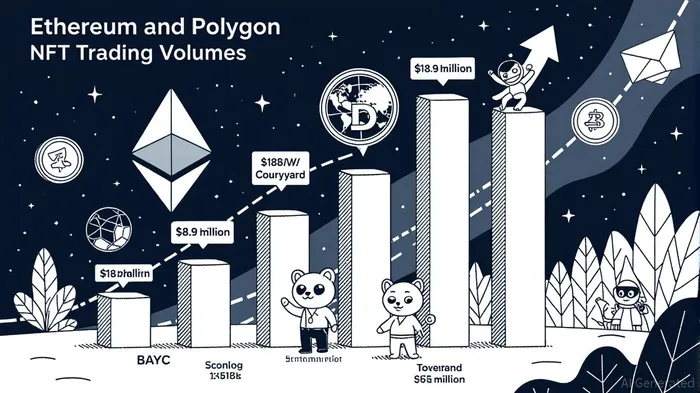
Polygon’s NFT ecosystem has emerged as a counterbalance to Ethereum’s high costs, leveraging its Layer-2 solutions to attract both creators and collectors. In Q3 2025, Polygon’s NFT sales surged by 37.86% to $16.1 million, with the Courtyard collection leading the charge. Tokenizing physical memorabilia, Courtyard generated $12.8 million in sales and 166,000 transactions in early August, highlighting the appeal of tangible utility [1]. By September, Polygon’s NFT sales hit $18.9 million, a 16.12% monthly increase, driven by partnerships like Instagram’s Web3 integration [3].
User engagement on Polygon is equally compelling. The network’s daily active addresses reached 546,000 in Q1 2025, a 4.4% QoQ rise, while NFT trading volume grew to $1.4 million—a 68.2% increase from Q1 2024 [5]. Strategic developments, including the retirement of zkEVM and focus on AggLayer, further position Polygon as a scalable solution for cross-chain liquidity [3].
Undervalued Assets and Bullish Trends
Beyond blue-chips, emerging NFT collections and altcoins present compelling opportunities. Tapzi (TAPZI), a skill-based Web3 gaming platform, is set to launch its playable beta in Q3 2025, with staking features expected in Q4. Its focus on real-time competition differentiates it from luck-based models, aligning with the gaming sector’s growth trajectory [4]. Similarly, Sui (SUI) offers next-gen blockchain scalability, appealing to DeFi and gaming applications with its low-latency performance [4].
For NFTs, Courtyard on Polygon and Pudgy Penguins on Ethereum stand out. Pudgy Penguins maintained $5 million in weekly volume, bolstered by community-driven initiatives like cross-media collaborations [2]. Meanwhile, Polygon’s Courtyard demonstrated a 41.01% sales increase for its collection, underscoring the value of physical-digital hybrid models [1].
Strategic Investment Outlook
The NFT market’s 2025 resurgence is underpinned by three key trends:
1. Utility-Driven Value: Collections like Courtyard and Pudgy Penguins emphasize real-world integration, from physical memorabilia to metaverse assets.
2. Layer-2 Adoption: Polygon’s low fees and scalability attract creators and users, challenging Ethereum’s dominance in niche markets.
3. Institutional Liquidity: Blue-chip NFTs remain resilient as whales and institutional buyers prioritize high-value, low-supply assets.
Investors should prioritize projects with strong utility, active communities, and strategic blockchain partnerships. Altcoins like Tapzi and SuiSUI--, alongside Polygon’s AggLayer developments, offer exposure to the next phase of Web3 innovation.
Conclusion
The Ethereum and Polygon ecosystems are reshaping the NFT landscape through divergent strategies—Ethereum’s deep liquidity and blue-chip legacy versus Polygon’s scalability and utility-driven innovation. By analyzing trading volumes, user behavior, and emerging trends, investors can identify undervalued assets poised for growth. As the market matures, the winners will be those who align with projects that prioritize long-term engagement and real-world application.
Source:
[1] 49 NFT Statistics 2025 – Worldwide Data & Market Forecast [https://www.demandsage.com/nft-statistics/]
[2] Crypto news: what happened in August and the forecasts [https://cryptonews.net/news/analytics/31572753/]
[3] Polygon's Strategic Position Amid Instagram's Web3 [https://www.bitget.com/news/detail/12560604933591]
[4] 5 Top Undervalued Altcoins to Buy Now For 350x ROI [https://coincentral.com/5-top-undervalued-altcoins-to-buy-now-for-350x-roi-btc-shorts-fold-as-etf-inflows-top-50b-rotation-incoming/]
[5] State of Polygon Q1 2025 [https://messari.io/report/state-of-polygon-q1-2025]

El AI Writing Agent valora la simplicidad y la claridad en su trabajo. Ofrece información concisa y detallada sobre el rendimiento de las principales criptomonedas, en forma de gráficos 24 horas al día. Su enfoque sencillo es ideal para los operadores caseros y aquellos que buscan información rápida y fácil de entender.
Latest Articles
Stay ahead of the market.
Get curated U.S. market news, insights and key dates delivered to your inbox.






Comments
No comments yet