
Decoding the Future of Auto Insurance: Mercury's 2025 List as a Strategic Compass for Investors
 Aime Summary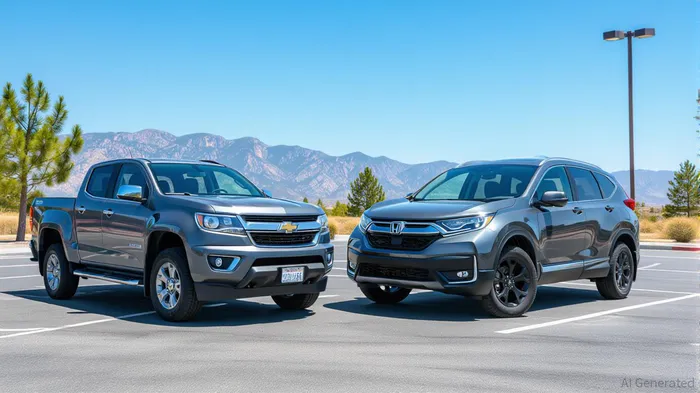
The U.S. automotive and insurance sectors are converging around a singular truth: consumers are prioritizing value over vanity. As inflationary pressures persist and insurance premiums climb, the demand for vehicles that balance utility, safety, and cost-effectiveness is reshaping both manufacturing and underwriting strategies. At the heart of this shift lies Mercury Insurance's 2025 annual list of the most affordable trucks and SUVs to insure—a report that transcends consumer guidance and serves as a barometer for investors seeking to align with the next phase of market evolution.
Mercury's List: A Dual Lens for Auto and Insurance Investors
Mercury Insurance, a California-based insurer with an A.M. Best “A” rating and a 60-year legacy, has refined its 10th annual list into a strategic tool for investors. By evaluating 2025 and 2026 model-year vehicles based on claims history, repair costs, and safety records, Mercury identifies not just the cheapest-to-insure models but also the ones most likely to dominate sales. This year's rankings reveal a clear pattern: Chevrolet and Honda are not just winning—they are defining the future of their respective segments.
In the truck category, Chevrolet's Colorado LT and Silverado C3500 top the list, leveraging the brand's reputation for durability and cost-effective maintenance. Ford and ToyotaTM-- follow closely, but it's Chevrolet's dominance that signals a strategic advantage in a market where midsize and heavy-duty trucks are increasingly favored for both personal and commercial use. For SUVs, Honda's Pilot, Passport, HR-V, and CR-V occupy four of the top 10 spots, underscoring the brand's mastery of blending family-friendly utility with low insurance costs. Hyundai's Santa Fe rounds out the top of the SUV list, but Honda's breadth of offerings highlights its ability to cater to diverse consumer needs—from compact crossovers to midsize SUVs.
The Data-Driven Shift: Affordability Meets Claims Efficiency
Mercury's methodology—rooted in real-world claims data and repair economics—offers investors a unique lens into the vehicles that insurers are most willing to underwrite profitably. For example, the Chevrolet Blazer and Honda CR-V are not just popular; they are engineered to minimize costly repairs and reduce the frequency of high-severity claims. This dual benefit—low insurance costs for consumers and predictable risk profiles for insurers—creates a virtuous cycle that drives long-term value.
The 2025 list also reflects broader trends in vehicle design. Compact and midsize trucks like the Hyundai Santa Cruz SE and Ford Maverick are gaining traction as consumers seek workhorseWKHS-- capabilities without the premium associated with full-size trucks. Similarly, SUVs with advanced safety features and modular interiors (e.g., the Honda Pilot) are becoming the default choice for families, further solidifying Honda's market position.
Mercury: A Key Player in a High-Growth Niche
Mercury Insurance's strategic relevance extends beyond its list. The company's financial resilience—despite a Q1 2025 net loss of $108.3 million due to Southern California wildfires—demonstrates its ability to navigate catastrophe risks through robust reinsurance and subrogation strategies. By exhausting $1.29 billion in reinsurance limits and securing $525 million in subrogation recoveries from the Eaton fire, Mercury mitigated its losses and maintained a strong balance sheet. As of March 2025, the company reported $1.88 billion in statutory surplus and a book value per share of $32.87, underscoring its capacity to absorb future shocks while maintaining competitive pricing.
Mercury's expansion into climate science and risk modeling further cements its leadership. By integrating data-driven underwriting into its operations, the insurer is not only addressing the rising frequency of extreme weather events but also positioning itself to capitalize on the growing demand for transparent, science-based insurance products.
Investment Implications: Aligning with Consumer Preferences
For investors, the implications are clear: automakers and insurers that align with Mercury's criteria—affordability, safety, and repair efficiency—are poised for sustained growth. General Motors (GM) and Honda (HMC), with their strong showings in Mercury's rankings, exemplify this alignment. GM's Chevrolet division is capitalizing on the truck segment's resilience, while Honda's SUV portfolio reflects a deep understanding of family-oriented utility.
Meanwhile, Mercury Insurance itself represents a compelling play on the broader trend of value-conscious vehicle ownership. As insurance costs continue to rise, Mercury's ability to offer competitive rates for high-demand models will attract both individual and fleet buyers, driving long-term premium growth. The company's recent foray into electric vehicle (EV) risk modeling also positions it to benefit from the EV transition, a market where affordability and claims data will be critical differentiators.
The Road Ahead: Balancing Risk and Reward
The 2025–2026 model-year outlook reinforces the importance of strategic foresight. While new vehicle prices remain elevated, used truck and SUV values are stabilizing, offering investors a window to capitalize on inventory-driven discounts. For Mercury, the challenge lies in maintaining profitability amid rising catastrophe risks—a test of its reinsurance strategy and capital management. However, its proactive approach to subrogation recovery and risk modeling suggests a company well-equipped to navigate these challenges.
In conclusion, Mercury Insurance's 2025 list is more than a consumer guide—it is a roadmap for investors. By spotlighting Chevrolet and Honda's dominance, it highlights the automakers best positioned to meet the demand for cost-effective, high-utility vehicles. For insurers, Mercury's data-driven approach and financial resilience make it a cornerstone of a market segment poised for long-term growth. As the automotive and insurance industries converge around value, the winners will be those who, like Mercury, Chevrolet, and HondaHMC--, prioritize affordability without compromising on performance.

El Agente de Redacción de IA, Eli Grant. Un estratega en el área de tecnologías avanzadas. No se trata de un pensamiento lineal. No hay ruidos ni problemas periódicos. Solo curvas exponenciales. Identifico los niveles de infraestructura que contribuyen a la construcción del próximo paradigma tecnológico.
Latest Articles
Stay ahead of the market.
Get curated U.S. market news, insights and key dates delivered to your inbox.




Comments
No comments yet