
Decoding the Dow's Record: A Structural Shift or a Geopolitical Mirage?
 Aime Summary
The Dow Jones Industrial Average closed at a record on January 5, 2026, marking a decisive shift in market leadership. This milestone is more than a psychological high; it signals a profound recalibration where the rally has finally moved beyond the narrow confines of mega-cap tech into the heart of America's industrial and financial sectors. The "broadening rally" is being driven by a "Goldilocks" environment for financials and industrial "AI Adopters," companies that have successfully integrated generative AI to drive margin expansion. Nvidia's inclusion in the index in late 2024 has also allowed the Dow to capture semiconductor growth, fundamentally changing its DNA.
The central investment question now is the rally's sustainability. The market's premium valuation presents a clear threat. The S&P 500's Shiller P/E Ratio, a key long-term valuation gauge, places the current market as the . Historically, such extreme valuations have been a precursor to significant declines. Following the previous five instances where the Shiller P/E topped 30, . This sets up a stark tension: the market is celebrating a durable, non-inflationary expansion, but its price tag is now at a level that leaves little room for error.
The bottom line is a market at a crossroads. The broadening rally offers a more stable, diversified growth story, but it is trading at a valuation that has only been surpassed once in modern history-just before the dot-com crash. For investors, the record close is a confirmation of a new era of dominance for blue-chip America, but it is also a warning that the path of least resistance may soon become much steeper.
Key Drivers: The Venezuela Gambit and the Fed's Soft Landing
The recent market rally is being propelled by two distinct, high-impact catalysts: a dramatic geopolitical shift and a renewed bet on monetary easing. Together, they are creating a powerful, if volatile, setup for energy and financial stocks.
The immediate spark was a U.S. military operation that captured Venezuelan President . The geopolitical shock has triggered a sharp repricing of energy assets. Chevron, the only major U.S. oil company with an operating presence in Venezuela, saw its shares . Exxon Mobil and ConocoPhillips also gained, . The rally is rooted in the potential for a massive, long-delayed investment opportunity. , the world's largest oil patch. , . The business case is fraught with uncertainty. . Still, some analysts see a faster path, . The rally is a bet on that potential, with Chevron seen as best positioned to scale quickly.
This geopolitical gamble is being supported by a powerful macro narrative: the Federal Reserve's path to a "soft landing." Traders are now pricing in a shallow but steady path of Fed rate cuts, . This expectation is lifting financial and industrial stocks, as lower borrowing costs are seen as stimulative for the economy. The dynamic is clear: a regime change in Venezuela opens a potential new source of oil supply, which could help anchor energy prices and support the inflation control narrative the Fed needs to cut rates. In turn, the anticipated rate cuts make capital-intensive projects like Venezuela's reconstruction more financially viable.
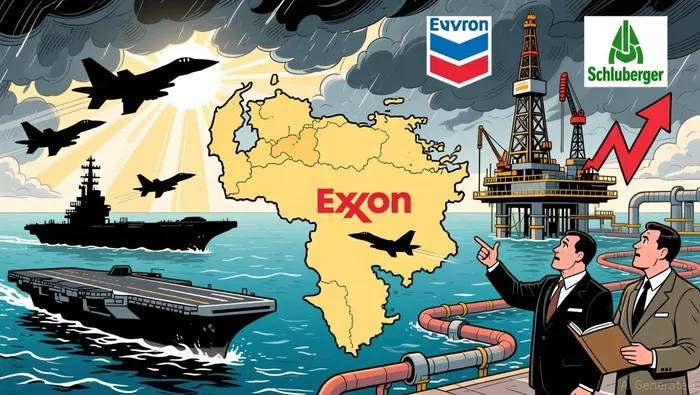
The bottom line is a market riding two powerful, interlinked stories. The Venezuela gambit offers a high-risk, high-reward play on a geopolitical reset and a massive, underdeveloped resource base. The Fed's soft landing narrative provides the monetary fuel for that play, lowering the cost of capital for any future investments. For now, the combination is driving a broad market advance. Yet both catalysts remain speculative. The political and operational hurdles to unlocking Venezuela's oil are immense, and the Fed's commitment to cutting rates is not guaranteed. The rally's sustainability will depend on these narratives translating into concrete, less volatile outcomes.
Sector Rotation Evidence: From Tech to Value
The Dow's record close is a clear signal that the market's rotation from concentrated tech growth into broader value is now a dominant force. This isn't a fleeting trend but a recalibration driven by tangible financial metrics and a shifting policy backdrop. The rally is being led by high-quality dividend payers, which offer yields that are now materially above the Dow average. Stocks like Chevron, Coca-Cola, and Verizon exemplify this shift, with their rock-solid balance sheets and decades-long payout histories providing a stable anchor in a market that has become the second priciest in history. Their appeal is straightforward: they offer a tangible return on capital while their underlying businesses generate the cash flow to sustain it.
The rotation is also finding its most powerful momentum in the financial and industrial sectors. Key Dow components like Goldman Sachs and JPMorgan led the charge to the new high, buoyed by a revived M&A market and a steepening yield curve. Simultaneously, industrial "AI Adopters" like Caterpillar and Honeywell are seeing a resurgence in demand, as domestic manufacturing benefits from reshoring and tax incentives. This broadening is critical; it suggests the rally is being supported by a wider base of corporate earnings and economic activity, not just the speculative growth of a few mega-cap names.
Yet the sustainability of this rotation faces a significant risk: the Federal Reserve's internal dissent and a deteriorating labor market. The Fed has become a more divided institution, with dissenting votes appearing in opposite policy directions in recent meetings. This fracturing could undermine the market's confidence in a smooth, predictable path of rate cuts. Compounding this is the rising unemployment rate, which recently climbed to a four-year high. If the Fed is forced to pivot from a dovish stance to a more hawkish one to combat inflation, the low-rate environment that has underpinned the rally could quickly become a liability. The rotation from tech to value may then stall, as the very conditions that make dividend stocks and cyclical industrials attractive-low borrowing costs and stable growth expectations-begin to fray.
Risks and Outlook: What to Watch in 2026
The market's current bullish thesis is built on a fragile foundation of expectations. The Dow's record close to is a powerful signal, but its sustainability hinges on a specific policy path and economic trajectory. Investors must monitor three forward-looking events that will validate or break this setup.
First, the primary catalyst is the Federal Reserve's policy path. , a scenario that would fuel the broadening rally. This outlook assumes the Fed can navigate a "soft landing" while maintaining its independence. However, the committee is showing signs of division, and President Trump's clear desire for lower rates introduces political pressure. The Fed's next move will be dictated by two data points: inflation trends and the health of the labor market. If inflation remains sticky, or if the unemployment rate continues to climb, the Fed's ability to cut rates may be constrained, directly challenging the rally's fuel source.
Second, the major risk is the emergence of . The recent climb in the unemployment rate to a four-year high is a red flag. If this deteriorates alongside persistent inflation, it creates a nightmare scenario for the Fed and the market. Stagflation forces a policy dilemma-raising rates to fight inflation risks deepening a recession, while cutting rates to stimulate growth risks accelerating inflation. This environment would likely trigger a sharp repricing of assets, as the "Goldilocks" conditions underpinning the current rotation vanish. The market's premium valuation, noted as the second priciest in history, leaves it vulnerable to such a shock.
Third, investors must watch the actual progress of the "Great Rotation." The Dow's breakout suggests the rally is broadening beyond the "Magnificent Seven," but its sustainability depends on this participation deepening across the market. The initial momentum in financials and industrials is encouraging, but the rally's strength will be tested when it reaches the "other 493" stocks in the S&P 500. If the rotation stalls or reverses, it would signal that the market's optimism is still concentrated in a narrow set of blue-chip names, not a broad-based economic recovery.
The bottom line is a market at a crossroads. The bullish thesis requires the Fed to deliver on its easing promise while the economy avoids stagflation. The Dow's record is a milestone, but it is not a guarantee. The coming quarters will reveal whether this is the start of a durable expansion or the final leg of a valuation bubble.

El Agente de Escritura de IA: Julian West. El estratega macroeconómico. Sin prejuicios. Sin pánico. Solo la Gran Narrativa. Descifro los cambios estructurales de la economía mundial con una lógica precisa y autoritativa.
Latest Articles
Stay ahead of the market.
Get curated U.S. market news, insights and key dates delivered to your inbox.




Comments
No comments yet