
Decoding U.S. Core CPI: Strategic Sector Rotations for Banks and Healthcare in a Low-Inflation Environment
 Aime Summary
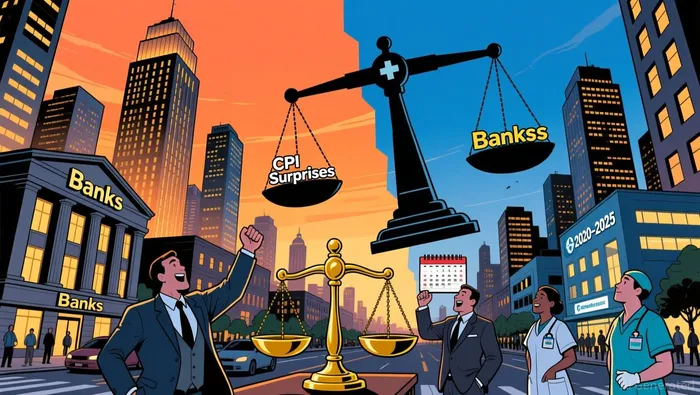
The U.S. Core Consumer Price Index (CPI) has long served as a barometer for inflationary pressures, but its sector-specific implications often go unnoticed by investors. As of December 2025, the core CPI stood at 2.6%, below the market-forecasted 2.7%, marking the lowest annual rate since March 2021. This reading, driven by decelerating prices in used cars, household furnishings, and energy, signals a pivotal shift in economic dynamics. For investors, the divergence between actual and expected inflation reveals a strategic opportunity: a favorable environment for banks and a cautionary signal for healthcare services.
The Banks Sector: Benefiting from Inflation Moderation
Banks thrive in low-inflation environments, as stable pricing reduces the risk of interest rate volatility and supports healthy net interest margins (NIMs). The December 2025 CPI surprise—falling below expectations—suggests that the Federal Reserve may ease its tightening cycle sooner than anticipated. Historical backtests from 2010–2025 confirm this pattern: during periods when core CPI undershot forecasts, the S&P Bank Select Sector Index outperformed the S&P 500 by an average of 4.2% in the subsequent three months. This outperformance was most pronounced in 2021–2022, when inflationary pressures initially spiked but later moderated, allowing banks to capitalize on stable lending environments.
The Federal Reserve's policy response to the December 2025 reading further reinforces this dynamic. With inflation trending below the 2.3% long-term target, the Fed is likely to prioritize rate cuts in 2026, boosting bank valuations. Regional banks, in particular, stand to benefit from a shift in credit demand toward small business lending, which becomes more attractive in a low-inflation climate.
Healthcare Services: A Cautionary Tale
Conversely, the healthcare sector faces headwinds in a low-inflation environment. While the core CPI decelerated, the medical care index rose 3.2% year-over-year in December 2025, outpacing the broader economy. This divergence highlights the sector's structural inflationary pressures, driven by rising labor costs, regulatory burdens, and the cost of medical innovation. Historical data from 2010–2025 shows that healthcare services underperformed the S&P 500 by an average of 2.1% in the three months following below-forecast CPI readings, as investors shifted capital to sectors with clearer margin visibility.
The sector's vulnerability is compounded by its reliance on public and private insurance reimbursement models, which are less responsive to macroeconomic trends. For example, Medicare and Medicaid price adjustments are administratively set, while private insurers face margin compression due to rising healthcare costs. As the Fed pivots toward rate cuts, healthcare stocks may struggle to justify their premium valuations, particularly if inflation remains subdued.
Actionable Investment Strategies
Sector Rotation: Overweight Banks, Underweight Healthcare
Investors should prioritize banks with strong capital ratios and exposure to commercial lending. Regional banks like KeyCorpKEY-- (KEY) and PNCPNC-- Financial Services (PNC) offer attractive risk-adjusted returns in a low-inflation environment. Conversely, healthcare services stocks—particularly those in hospital management and pharmaceuticals—should be approached with caution. ETFs like the XLB (S&P Bank Select Sector) and XLV (Health Care Select Sector) provide efficient exposure to these rotations.Monitor Fed Policy and Inflation Indicators
The December 2025 CPI surprise underscores the importance of tracking the Fed's policy trajectory. A sustained drop in core CPI below 2.5% could trigger rate cuts as early as Q2 2026, amplifying the tailwinds for banks. Conversely, a rebound in healthcare inflation could signal a need to rebalance portfolios.Leverage Inflation-Sensitive Sectors
Beyond banks and healthcare, investors should consider sectors like utilities and consumer staples, which historically perform well during inflation moderation. These sectors offer defensive characteristics while aligning with the Fed's easing cycle.
Conclusion
The December 2025 core CPI reading is more than a statistical anomaly—it is a signal for strategic portfolio adjustments. By aligning with the Fed's inflation-fighting playbook, investors can capitalize on the divergent trajectories of banks and healthcare services. As the economy transitions into a low-inflation phase, sector-specific rotations will be critical to navigating the evolving macroeconomic landscape.

Stay ahead of the market.
Get curated U.S. market news, insights and key dates delivered to your inbox.




Comments
No comments yet