
Decoding Consumer Sentiment: Strategic Sector Rotation in a Shifting Economic Landscape
 Aime Summary
The U.S. consumer, long the backbone of economic growth, is undergoing a profound shift in behavior. The University of Michigan's Consumer Expectations Index, a critical barometer of household optimism, has plummeted to 49.0 in November 2025—a six-month low and a stark departure from its 76.9 peak in November 2024. This decline, driven by inflationary pressures, policy uncertainty, and a prolonged government shutdown, has created a bifurcated landscape for two key sectors: Consumer Finance and Consumer Staples. For investors, understanding this divergence is essential to navigating the next phase of market rotation.
The Divergence: Finance Thrives, Staples Struggle
The Consumer Finance sector, represented by lenders and credit providers, has paradoxically benefited from the erosion of consumer confidence. As households stretch their budgets, demand for personal loans, credit cards, and other financial services has surged. The sector's performance aligns with historical patterns: when the Michigan index dips below 50, financial institutionsFISI-- capitalize on higher interest spreads and increased debt accumulation. For instance, in August 2025, as the index hit 49.0, credit card delinquencies rose, and mall foot traffic declined—yet the Consumer Finance ETF (XLF) saw inflows as investors anticipated continued demand for financing solutions.
Conversely, the Consumer Staples sector—encompassing food, beverages, and household goods—has struggled. The Consumer Staples Select Sector SPDR Fund (XLP) has underperformed the S&P 500 for 12 consecutive months, reflecting a consumer base prioritizing cost-cutting over brand loyalty. Inflation in essential goods, exacerbated by tariffs and supply chain disruptions, has forced households to shift spending toward discount retailers like Walmart and Costco, while premium brands like Coca-Cola and Procter & Gamble face declining sales. This trend mirrors the 2008 financial crisis and the early 2020 pandemic, when consumers retreated to essentials during economic uncertainty.
Historical Thresholds and Strategic Rotation
The Michigan index's thresholds serve as actionable signals for sector rotation. When the index falls below 50, defensive allocations to Consumer Staples typically outperform. For example, in September 2025, as the index dropped to 55—a five-month low—capital flowed into XLPXLP-- while luxury brands like Tesla and Nike saw reduced demand. Conversely, when the index rebounds above 50, cyclical sectors like Consumer Finance regain traction. In June 2025, a 10.5-point surge in the index triggered a 3.2% intraday gain in XLFXLF--, underscoring its sensitivity to optimism.
A critical red flag emerges when the index declines by more than 30% year-over-year. In November 2025, the 36.3% drop to 49.0 signaled a deepening pessimism, reinforcing the need for a defensive tilt. Such thresholds are amplified when inflation expectations exceed 4%, as seen in November 2025, when consumers priced in a more inflationary future. These dynamics highlight the importance of monitoring both the index and inflation expectations to time sector rotations effectively.
Actionable Strategies for Investors
- Defensive Allocation Below 50: If the Michigan index remains below 50, overweight Consumer Staples (XLP) and utilities while underweighting high-beta sectors like consumer finance. The inelastic demand for essentials provides a buffer against macroeconomic volatility.
- Cyclical Re-entry Above 50: When the index stabilizes above 50, consider increasing exposure to Consumer Finance (XLF) and Energy (XLE), which benefit from improved credit utilization and a weaker dollar.
- Inflation-Linked Adjustments: Monitor year-ahead inflation expectations. If they exceed 4%, prioritize inflation-protected assets and discount retailers, as seen in 2025.
The Road Ahead
The Federal Reserve's September 2025 rate cut (25 basis points) aimed to stimulate spending, but its impact on Consumer Finance remains uncertain. While lower rates may boost loan demand, prolonged inflation and policy uncertainty could delay a full recovery. Investors should remain agile, using the Michigan index as a leading indicator to adjust sector allocations.
In a world where consumer sentiment drives 70% of U.S. GDP, the interplay between Consumer Finance and Consumer Staples will remain a defining feature of market dynamics. By decoding the signals embedded in the Michigan data, investors can position themselves to thrive in both stormy and sunny economic climates.
As the index continues to trend downward, the next few months will test the resilience of both sectors—and the adaptability of investors. The key lies in balancing growth opportunities with defensive resilience, guided by the pulse of the consumer.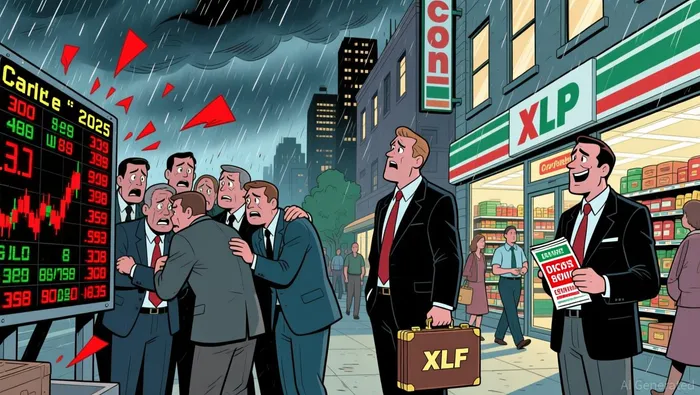

Stay ahead of the market.
Get curated U.S. market news, insights and key dates delivered to your inbox.




Comments
No comments yet