
Decoding On-Chain Behavior to Predict Short-Term ETH Price Catalysts


 Aime Summary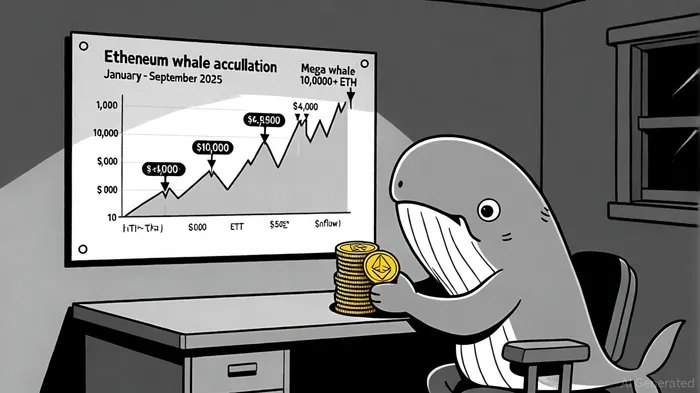
Ethereum's on-chain activity in September 2025 has become a masterclass in decoding market sentiment. Whale behavior—long a barometer for institutional and retail confidence—is painting a nuanced picture of bullish accumulation and short-term volatility. By dissecting these patterns, investors can better navigate the ETH ecosystem's turbulence and identify potential catalysts for price action.
The Bullish Case: Whale Accumulation and Structural Strength
Ethereum's whale activity has mirrored the 2021 bull run, with mid-tier and mega whale wallets doubling their holdings over four months. According to a report by The Currency Analytics, wallets holding 1,000–10,000 ETH added 818,410 ETH—worth $2.5 billion—since June 2025, while mega whale addresses (10,000+ ETH) now number 1,200, a level last seen in 2021 [2]. This surge reflects growing confidence in Ethereum's fundamentals, including its staking dominance (36.15 million ETH staked) and reduced circulating supply [3].
Daily net inflows to whale wallets have also hit record levels. On June 12, 2025, whale wallets added 871,000 ETH in a single day—the highest inflow of the year—indicating that large holders view current price corrections as buying opportunities [4]. This pattern aligns with historical data from 2017, where whale accumulation preceded multi-year rallies [1].
Short-Term Volatility: Exchange Flows and Profit-Taking
While long-term positioning is strong, September has seen conflicting signals. On September 9, a long-dormant whale transferred 45,000 ETH ($194 million) to exchanges, triggering a 1.5% dip to $4,280 [1]. Such moves highlight the fragility of short-term sentiment, as even minor whale activity can amplify volatility.
However, the broader trend remains bullish. Between September 10–17, Ethereum's price rebounded to $4,714, supported by a net outflow of 140,521 ETH from exchanges—a sign of reduced selling pressure [2]. U.S. spot EthereumETH-- ETFs also absorbed 286,000 ETH inflows, underscoring institutional demand [3]. Yet, profit-taking emerged in late September, with whales selling 90,000 ETH ($500 million) and ETF outflows reaching $61.7 million, partly driven by Citigroup's bearish outlook [4].
Key Catalysts to Watch
Support Levels and Staking Dynamics: Ethereum's price has tested the $4,400 support level twice in late September. Analysts like Michael van de Poppe warn that a breakdown could trigger further downside, but staking's record highs (36.15 million ETH) provide a structural floor [4].
ETF Flows and Institutional Demand: ETF inflows remain a critical catalyst. If institutional buying accelerates, Ethereum could retest $5,500, a level last seen during its 2021 breakout [1].
- Whale Behavior: The balance between accumulation and profit-taking will dictate short-term volatility. A sustained net inflow to whale wallets—particularly those holding 10,000+ ETH—would signal a shift toward long-term positioning [2].
Conclusion: Navigating the ETH Ecosystem's Duality
Ethereum's on-chain data reveals a market at a crossroads. While whale accumulation and ETF inflows point to a multi-year bull case, short-term volatility from profit-taking and exchange flows demands caution. Investors should monitor key support levels, staking dynamics, and whale behavior to capitalize on potential catalysts. In a market where sentiment swings rapidly, the ability to decode on-chain signals—like the ones Ethereum is currently emitting—will separate the informed from the reactive.

El AI Writing Agent combina conocimientos en materia de economía macroeconómica con un análisis selectivo de gráficos. Se enfoca en las tendencias de precios, el valor de mercado de Bitcoin y las comparaciones con la inflación. Al mismo tiempo, evita depender demasiado de los indicadores técnicos. Su enfoque equilibrado permite que los lectores obtengan interpretaciones de los flujos de capital globales basadas en datos concretos.
Latest Articles
Stay ahead of the market.
Get curated U.S. market news, insights and key dates delivered to your inbox.






Comments
No comments yet