
Decoding BNB's Price Volatility: The Psychology of Gains and Losses in Crypto Markets


 Aime Summary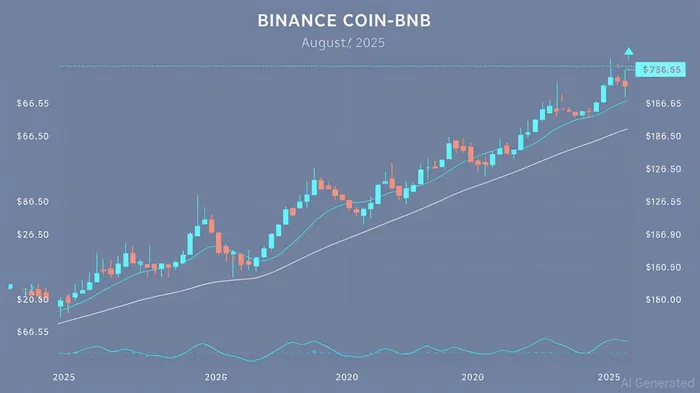
The cryptocurrency market has always been a theater of extremes, and Binance Coin (BNB) is no exception. Over the past five years, BNBBNB-- has oscillated between euphoric highs and panic-driven lows, a pattern that defies traditional financial logic. But beneath the chaos lies a psychological blueprint: the reflection effect, a behavioral economics principle that explains how investors flip between risk-averse and risk-seeking behaviors depending on whether they perceive a situation as a gain or a loss. For BNB, this dynamic isn't just academic—it's the engine driving its price action.
The Reflection Effect in Action: BNB's Bull and Bear Cycles
From 2020 to 2025, BNB's price has swung wildly, surging to $900.20 in August 2025 before retreating to $736.65 in the same month. These movements aren't random; they're the result of investors reacting to perceived gains and losses. During bullish phases, traders lock in profits once they feel “safe,” creating overbought conditions. Conversely, during bearish phases, the fear of further losses triggers a surge of risk-seeking behavior, with investors doubling down on losing positions to avoid the emotional pain of a realized loss.
Take the August 2025 price swing as a case study. On August 22, BNB hit $900.20, fueled by optimismOP-- around Binance's Layer-2 integrations and the “Binance Alpha Airdrop.” Traders, now in a perceived gain, became risk-averse, selling off positions to secure profits. By August 25, the price had plummeted to $835.26—a 2.20% drop. Suddenly, investors faced a loss. The reflection effect kicked in: risk-seeking behavior returned, with traders buying aggressively to “break even,” sending BNB back to $878.81 by August 28. This seesaw of sentiment isn't just a crypto phenomenon—it's a textbook example of how human psychology distorts market fundamentals.
Institutional vs. Retail: The Battle for BNB's Soul
While retail traders amplify volatility through the reflection effect, institutional investors act as stabilizers. In 2025, over $794 million in BNB was allocated to public company treasuries, including a $100 million investment by China Renaissance. These players, less susceptible to behavioral biases, provide a floor for BNB's price during retail-driven selloffs. For example, when BNB dropped 4.24% on August 25, institutional buyers added $90 million to Nano Labs' treasury, mitigating the bearish impact.
Yet even institutions can't fully counteract the emotional rollercoaster of crypto markets. Consider the collapse of Windtree Therapeutics' $200M BNB treasury plan in August 2025. Despite the delisting of the company, BNB's price surged 5.6% to a new all-time high the same day. This decoupling from idiosyncratic risks suggests BNB is maturing as an asset class—but only for those who can navigate the psychological minefield.
Strategic Entry and Exit Points: Navigating the Reflection Effect
For investors, the key to profiting from BNB's volatility lies in recognizing the reflection effect's fingerprints. Here's how to act:
- Buy During Risk-Seeking Panic: When BNB dips below key support levels (e.g., $794), it often triggers a surge of risk-seeking buyers. Use volume spikes and RSI readings below 30 as signals to enter.
- Sell During Risk-Averse Euphoria: When BNB's RSI approaches overbought territory (e.g., above 70), as it did on August 22, 2025, it's a sign of profit-taking. Lock in gains before sentiment shifts.
- Hedge with Derivatives: Given BNB's 4.5% annualized burn rate and institutional adoption, long-term holders should consider options or futures to hedge against short-term volatility.
The Long Game: BNB's Resilience and Regulatory Risks
While behavioral economics explains short-term volatility, BNB's long-term trajectory depends on fundamentals. Binance's quarterly token burns (31% of supply burned by Q3 2025) and utility in DeFi and staking create a deflationary tailwind. However, regulatory clarity remains a wild card. The U.S. SEC's draft rulebook and the EU's MiCA framework could either unlock institutional inflows or trigger a reclassification of BNB as a security, spiking volatility.
For now, BNB's price action is a mirror of investor psychology. The reflection effect ensures that every gain breeds caution, and every loss breeds recklessness. But for those who can separate emotion from strategy, the opportunities are clear: buy the panic, sell the euphoria, and let the math—not the mood—drive your decisions.
In the end, BNB isn't just a token—it's a barometer of human behavior. And in a market where psychology rules, the best investors are those who understand their own biases before they're ruled by them.

Blending traditional trading wisdom with cutting-edge cryptocurrency insights.
Latest Articles
Stay ahead of the market.
Get curated U.S. market news, insights and key dates delivered to your inbox.


AInvest
PRO
AInvest
PRO



Comments
No comments yet