
Decoding the U.S. Baker Hughes Rig Count: A Strategic Compass for Energy Sector Investors
 Aime Summary
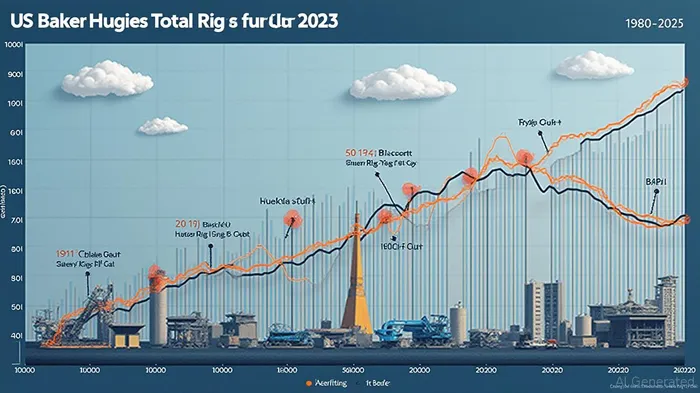
The U.S. Baker HughesBKR-- Total Rig Count remains one of the most closely watched metrics in the energy sector—a barometer of drilling activity, a precursor to production trends, and a lens through which investors can glimpse the future of oil and gas markets. As of July 25, 2025, the count stood at 542 rigs, a 0.37% decline from the prior week and a 7.51% drop compared to July 2024. This data point, while seemingly small, carries significant implications for energy investors navigating a market defined by efficiency gains, shifting commodity dynamics, and macroeconomic uncertainty.
The Rig Count as a Leading Indicator
The rig count has historically served as a leading indicator of energy sector performance. Since 1944, it has mirrored the ebb and flow of oil and gas prices, technological advancements, and investor sentiment. For instance, in the early 2010s, the rig count shifted dramatically from natural gas to oil as the crude-to-natural gas price ratio surged from 9 to over 30. This redistribution of rigs directly correlated with the energy sector's stock performance, as oil-focused exploration and production (E&P) companies saw valuations rise in tandem with drilling activity.
Conversely, periods of rig count contraction—such as the 2016 low of 404 rigs—coincided with energy sector underperformance in the S&P 500, with the sector posting losses in seven of ten years from 2012 to 2021. The rig count's predictive power lies in its ability to signal shifts in capital allocation, production efficiency, and market fundamentals. When rigs decline, it often reflects reduced demand for drilling services, lower production expectations, and a reallocation of capital to other sectors or shareholder returns.
Current Trends and Market Implications
The recent rig count decline underscores a sector in transition. While U.S. crude output is projected to rise to 13.7 million barrels per day in 2025 (per the EIA), this growth is being driven by efficiency gains—longer laterals, higher completion quality, and improved well productivity—rather than a surge in active rigs. This decoupling of rig counts from production is a structural shift, reflecting the industry's adaptation to lower capital intensity.
However, the rig count's downward trajectory raises concerns. The 542 rigs as of July 2025 mark a 12-week decline in 13 weeks, with oil rigs falling to 415—a level last seen in September 2021. This trend is exacerbated by soft crude prices ($68.39/barrel as of July 25) and economic uncertainties, which have prompted E&Ps to prioritize free cash flow over aggressive drilling. Meanwhile, natural gas rigs have shown resilience, rising to 122 due to strong export demand and higher spot prices ($3.50/MMBtu at Henry Hub).
Investment Strategies for a Rig-Count-Driven Market
For investors, the rig count offers actionable insights into sector positioning. Here are three strategic considerations:
Balance Exposure to Energy Stocks and Commodities
The rig count's correlation with oil prices means that energy stocks and physical commodities often diverge in performance. For example, during periods of stable oil prices, energy stocks may underperform due to earnings compression, while commodities benefit from price stability. Investors should consider a hedged approach: pairing long positions in energy E&Ps (e.g., Pioneer Natural Resources, ConocoPhillips) with short-term crude futures or ETFs (e.g., USO, UNG) to capitalize on price movements.Monitor Basin-Level Rig Activity
Not all basins are created equal. The Permian Basin, which accounts for 48% of U.S. drilling activity, saw a 3-rig decline in July 2025, while gas-heavy regions like Marcellus and Haynesville added rigs. Investors should allocate capital to basins with structural advantages—such as low breakeven costs (Permian) or export-driven demand (Haynesville)—rather than relying on broad sector indices.Position for Midstream and Services Sectors
While E&Ps are directly tied to rig counts, midstream (pipeline, storage) and oilfield services (drilling, completion) companies face more nuanced dynamics. A declining rig count pressures services firms but may benefit midstream operators through higher utilization rates. Investors should evaluate these sub-sectors using metrics like utilization rates (for midstream) and rig count trends (for services).
The Path Forward
The rig count's predictive power lies in its ability to signal both short-term volatility and long-term structural shifts. For 2025–2027, analysts project the U.S. oil rig count to stabilize around 440–460 rigs, contingent on the depletion of DUC wells and new drilling cycles. Investors who recognize these patterns early can position portfolios to capitalize on rebounds in drilling activity, particularly in basins with strong cost profiles and export access.
In a market defined by efficiency and moderation, the rig count remains an indispensable tool. By aligning investment strategies with its rhythms, investors can navigate the energy sector's complexities with clarity—and perhaps even anticipation.


Stay ahead of the market.
Get curated U.S. market news, insights and key dates delivered to your inbox.




Comments
No comments yet