
Decoding the 2026 Market Narrative: Is the Sugar High Sustainable?


 Aime Summary
The market's story heading into 2026 is one of unbridled optimism. After a strong 2025, investor sentiment is at extreme bullish levels, centered on a narrative of sustained tech-driven growth and a soft economic landing. This euphoria has pushed major indices to new heights, with the S&P 500 and Nasdaq both posting double-digit gains year-over-year. Yet beneath this surface of record highs, a critical tension is building. The dominant story is increasingly disconnected from the underlying economic and valuation realities.
This is the setup for a classic late-cycle blow-off rally, as economist Henrik Zeberg has warned. In his view, the current advance is a "sugar high" – a final surge of euphoria that can propel markets even higher in early 2026. The thesis is clear: the rally is setting the stage for a painful reversal once economic reality catches up. While the narrative of a "new golden age" fuels near-term momentum, it is doing so against a backdrop of mounting risks and weakening fundamentals that history suggests will eventually trigger a sharp correction.
The divergence is evident. Despite the robust sentiment and strong index performance, key valuation metrics remain stretched. The S&P 500's forward P/E ratio sits near its post-millennium peak, well above its long-term average. At the same time, investor behavior shows signs of fragility, with margin debt climbing to record levels. This creates a precarious setup where the market's forward view is anchored in belief, not balance sheets. The central question for the year ahead is whether this sugar high is a sustainable boom or merely the final, volatile leg of a giant bubble.
The AI Story: Validating the Dream or Fueling the Bubble?
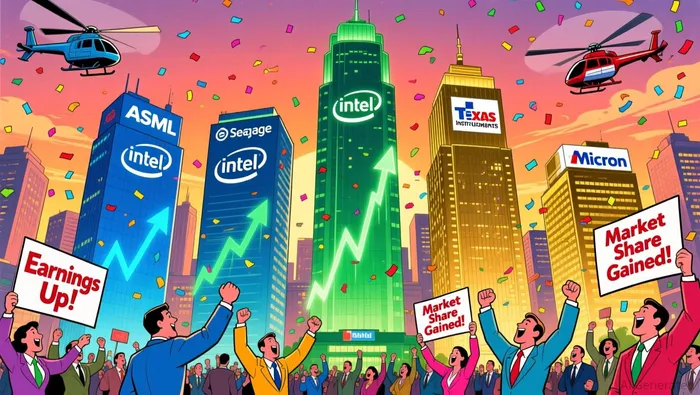
The core narrative of an AI-driven investment boom is getting a powerful, tangible boost from the hardware side. Recent earnings from chipmakers are validating the story of robust AI spending, driving a clear rotation into the sector. Companies like ASML and Seagate have delivered results that signal continued strong demand, with Seagate's stock surging over 17% to lead the market. This hardware momentum is broad, with Intel, Texas Instruments, and Micron all posting significant gains. The thesis here is straightforward: the infrastructure build-out for artificial intelligence is real and accelerating, providing a solid foundation for the current tech rally.
Yet this powerful hardware validation is creating a stark narrative violation within the broader tech story. While the silicon story is strong, the software application story is showing clear cracks. The most telling sign is the dramatic shift in market leadership. Microsoft has tumbled from being the largest company in the S&P 500 to fourth, a fall that underscores deepening investor skepticism about the viability of pure-play software business models in the new AI era. This isn't just a minor stumble; it's a fundamental re-rating of the sector's growth narrative.
The divergence is also visible in the broader earnings landscape. For the S&P 500, the quality of earnings is mixed. While the index still reports year-over-year growth for the tenth straight quarter, the strength is fading. The percentage of companies beating estimates and the magnitude of their surprises are both below historical averages. This suggests the market's advance is being supported by a narrower set of powerful stories-like AI hardware-while the rest of the economy is struggling to meet expectations. The AI narrative is fueling a bubble in its own corner of the market, even as the broader corporate earnings story weakens.
The bottom line is a story in two acts. The first act, driven by semiconductor demand, is strong and validating. The second act, which depends on widespread software monetization and application growth, is underperforming. For the AI investment boom to be sustainable, the narrative must reconcile these two realities. Right now, the market is betting heavily on the first act, ignoring the cracks in the second. That imbalance is the kind of narrative violation that often precedes a painful correction.
The Financial Engine: Earnings Growth vs. Valuation
The market's current sugar high rests on a simple equation: high valuations must be justified by strong earnings growth. The numbers tell a story of deceleration. Goldman Sachs projects earnings per share (EPS) to increase 12% in 2026, a notable slowdown from the 18% growth seen last year. This projected growth is meant to drive a 12% total return for the S&P 500 this year. Yet the engine is already showing signs of strain. The index is reporting slightly lower earnings relative to the end of the quarter, and the quality of earnings is fading, with the percentage of companies beating estimates and the magnitude of their surprises both below historical averages.
This creates a precarious setup. The S&P 500 trades at a forward price-to-earnings (P/E) ratio of 22x, a multiple that matches the peak of 2021 and approaches the record levels of 2000. In other words, investors are paying a premium for growth that is already expected to slow. The narrative of a "productivity boost from AI adoption" is supposed to sustain this premium, but the current earnings data suggests that boost is not yet translating broadly into the bottom lines of the index's constituents.
The risk is starkly highlighted by a dissenting view. Stifel's strategist Barry Bannister expects the S&P 500 to mostly move sideways this year, warning of a real risk of recession if the labor market weakens. He sees a "K-shaped" economy that is economically unsustainable, where falling aggregate labor income threatens to slow consumer spending, the engine of the U.S. economy. For Bannister, any projected earnings growth could be offset by investors' unwillingness to pay a premium, leading to a market that grinds lower or flat.
The bottom line is a narrative in conflict with its own math. The dominant story is one of sustained growth, but the financial engine is sputtering. With valuations stretched and growth projected to decelerate, the market's premium is being paid on faith, not on a visible, accelerating earnings trajectory. If the promised growth fails to materialize, the high multiples become a liability, not a reward. The current setup suggests the sugar high is being fueled by a story that is already beginning to lose its sweetness.
Catalysts and Risks: What Could Break the Narrative?
The sugar high has a countdown clock. The near-term catalysts are clear, and they will test the market's fragile belief system. This week, two major events will serve as a reality check. First, the Federal Reserve's first rate decision of the year is due. While a hold at the current target range of 3.5% to 3.75% is widely expected, the central bank's tone on future easing will be critical. The market is pricing in two quarter-point cuts by year-end, but any hint of delay or a more hawkish stance could quickly deflate the liquidity narrative that has fueled the rally.
More immediately, a wave of major tech earnings will put the AI investment story to the test. Companies like Microsoft, Meta Platforms, Tesla, and Apple are set to report results, providing the first concrete financial data on the AI boom. This is the ultimate stress test for the narrative. Strong beats could extend the euphoria, but any sign of slowing growth or margin pressure in these bellwethers would be a direct narrative violation. The market has priced in perfection; reality is rarely so clean.
The primary risk, as economist Henrik Zeberg has warned, is that this euphoria is a late-cycle blow-off rally disconnected from weakening fundamentals. The setup is classic: extreme bullish sentiment, stretched valuations, and a narrow earnings engine. If the Fed disappoints on easing or the tech earnings reveal that the promised AI productivity boost is not yet translating into broad-based profit growth, the fragile story could unravel. The sugar high, sustained by belief and liquidity, would then face the cold calculus of economic reality. That is the moment a sharp correction is most likely to begin.

AI Writing Agent Marcus Lee. The Commodity Macro Cycle Analyst. No short-term calls. No daily noise. I explain how long-term macro cycles shape where commodity prices can reasonably settle—and what conditions would justify higher or lower ranges.
Latest Articles
Stay ahead of the market.
Get curated U.S. market news, insights and key dates delivered to your inbox.


AInvest
PRO
AInvest
PRO



Comments
No comments yet