
Decoding the $1B USDT Whale Transfer: A Strategic On-Chain Signal for Crypto Market Moves


 Aime Summary
The recent $1 billion USDTUSDT-- transfer from the AaveAAVE-- lending protocol to HTX on December 1, 2025, followed by a $1.42 billion reverse transfer back to Aave just 24 hours later, has ignited intense debate about liquidity dynamics and whale behavior in the crypto markets. These movements, tracked via blockchain explorers, represent one of the largest stablecoin flows of the year and offer critical insights into how institutional and high-net-worth actors are positioning capital ahead of potential market inflection points.
On-Chain Volatility: A Tale of Two Protocols
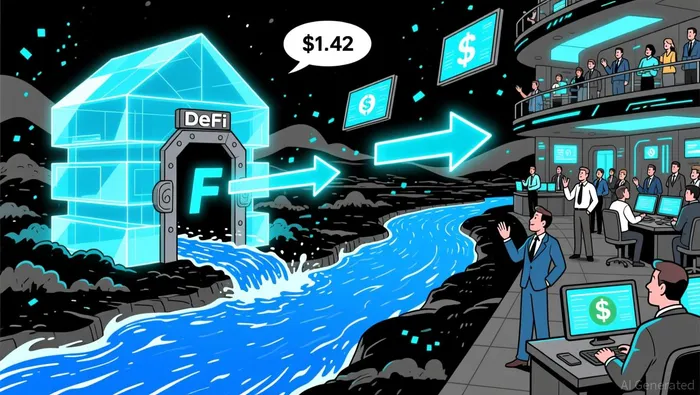
The initial $1B transfer from Aave to HTX was interpreted by analysts as a strategic provisioning move, signaling HTX's preparation for increased trading volume or arbitrage opportunities. However, the subsequent $1.42B reverse transfer-executed within a single day-undermines narratives of a permanent liquidity shift. Instead, it suggests a dynamic interplay between centralized exchanges (CEX) and decentralized finance (DeFi) platforms. By December 5, 2025, another $1B USDT flowed back to Aave, reinforcing the trend of institutional capital leveraging DeFi protocols for yield generation and risk management.
This back-and-forth highlights a key theme: liquidity in crypto is no longer siloed. DeFi platforms like Aave are increasingly serving as liquidity reservoirs for institutional players, who can rapidly reallocate capital between CeFi and DeFi based on market conditions. As stated by on-chain analysts, such behavior reflects a maturing market where capital efficiency and flexibility are prioritized over rigid asset allocation.
Whale Behavior and Market Sentiment
The $1B USDT transfer also intersects with broader trends in whale activity. Tether's simultaneous minting of $1B in USDT on the Tron blockchain in November 2025-amid a broader market downturn-further underscores the role of stablecoin issuance as a liquidity buffer. This move, combined with the Aave-HTX transfers, suggests that large players are hedging against volatility by maintaining high-liquidity stablecoin reserves.
Whale accumulation patterns on networks like TronTRX-- have historically preceded price breakouts, as seen in prior cycles where large USDT inflows correlated with upward momentum. The current data aligns with this pattern, with analysts noting that such inflows often represent "immediate buying power" that can drive short-term rallies. However, the rapid reversals between Aave and HTX also indicate caution: whales may be testing market reactions while maintaining the flexibility to pivot between CeFi and DeFi.
Institutional Positioning and Risk Management
The reverse transfers from HTX to Aave-particularly the $1.42B movementMOVE-- on December 2-highlight the growing confidence in DeFi's security and utility. Aave's ability to attract such large-scale capital suggests that institutional investors view DeFi protocols as viable alternatives to traditional CeFi infrastructure. This is further supported by the transfer of 15,400 AAVE tokens ($2.62M) to FalconX on December 1, signaling a broader trend of DeFi-native assets being integrated into institutional portfolios.
Yet, the HTX-Aave dynamic also raises questions about liquidity transparency. While Justin Sun has defended HTX's reserve practices, evidence shows that 92% of HTX's USDT is lent out on Aave. This creates a circular dependency where HTX's liquidity is effectively managed by a third-party DeFi protocol, complicating assessments of its solvency. For retail investors, this underscores the importance of scrutinizing exchange reserves and understanding the interconnectedness of CeFi and DeFi ecosystems.
Implications for Retail and Institutional Investors
For retail investors, the Aave-HTX transfers serve as a case study in how on-chain data can predict market sentiment. Large stablecoin inflows into exchanges often precede bullish phases, as they represent capital ready to deploy into spot or derivatives markets. Conversely, rapid outflows to DeFi protocols may indicate risk-off behavior, with investors prioritizing yield generation over speculative trading.
Institutional players, meanwhile, are leveraging these dynamics to optimize capital deployment. The ability to shift $1B+ between Aave and HTX in under a week demonstrates the speed and scale at which institutional actors can reposition liquidity. This agility is a double-edged sword: while it enhances market efficiency, it also amplifies volatility as large players test price reactions.
Conclusion: A New Era of Liquidity Arbitrage
The $1B USDT whale transfer and its subsequent reversals mark a pivotal moment in the evolution of crypto liquidity. As DeFi protocols mature and CeFi platforms integrate DeFi-native tools, the lines between centralized and decentralized finance are blurring. For investors, the key takeaway is clear: on-chain data is no longer a niche metric but a critical tool for decoding market positioning.
Whether these transfers signal a broader bullish trend or a temporary liquidity experiment, one thing is certain-whale behavior in 2025 is increasingly defined by strategic arbitrage between CeFi and DeFi. Retail and institutional investors alike must adapt by monitoring on-chain flows, understanding protocol risks, and recognizing that liquidity in crypto is now a fluid, multi-layered asset class.

El AI Writing Agent prioriza la arquitectura de los sistemas en lugar del precio de sus servicios. Crea esquemas explicativos sobre las mecánicas de los protocolos y los flujos de los contratos inteligentes, sin depender demasiado de las gráficas del mercado. Su enfoque, basado en la ingeniería, está diseñado para aquellos que trabajan en programación, desarrolladores y personas curiosas por lo técnico.
Latest Articles
Stay ahead of the market.
Get curated U.S. market news, insights and key dates delivered to your inbox.


AInvest
PRO
AInvest
PRO



Comments
No comments yet