
The Declining Credibility of X and Its Impact on Crypto Communication and Investor Risk
 Aime Summary
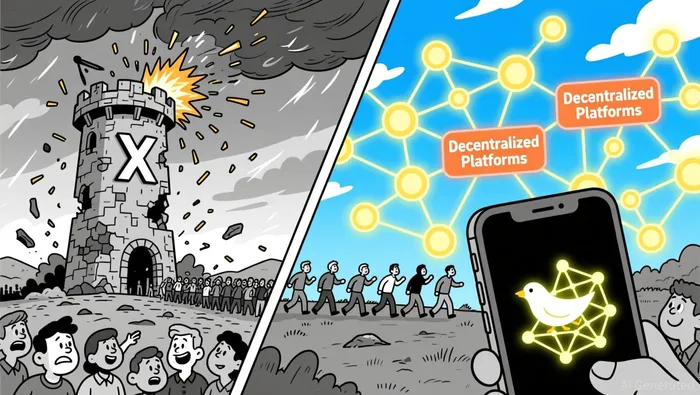
The credibility of X (formerly Twitter) as a platform for the crypto community has eroded significantly in 2025, driven by Elon Musk's rebranding and the subsequent proliferation of spam and scam content. This decline has catalyzed a mass migration to decentralized alternatives like Bluesky, Mastodon, and Steemit, where users seek greater autonomy over data and content governance according to 2025 crypto community engagement data. The shift reflects a broader distrust in centralized platforms and a growing preference for decentralized ecosystems that prioritize transparency and user control as research indicates.
Decentralized Platforms and the Evolution of Crypto Communication
Decentralized social media platforms operate on blockchain or federated models, distributing data across multiple nodes to reduce centralized censorship risks according to digitalis analysis. For crypto projects, this shift offers advantages such as data ownership, token-based monetization, and community-driven governance. However, the fragmented nature of these platforms complicates audience reach, requiring brands to adopt tailored strategies for different protocols like Mastodon, Lens Protocol, or Farcaster as detailed in digitalis coverage.
The LA crypto community's 2025 growth exemplifies this trend, with 50 million+ followers across traditional platforms and 500,000 daily interactions on decentralized networks. This engagement was fueled by real-time updates and authenticity, which fostered trust and active participation according to gate data. Decentralized platforms are increasingly integrated with broader blockchain ecosystems, including over 1,000 active DApps in 2025, enabling new forms of community-driven innovation as gate reports.
Investor Risk Dynamics: Centralized vs. Decentralized Platforms
Investor risk profiles diverge sharply between centralized and decentralized platforms. Centralized exchanges (CEXs) offer institutional-grade security, insurance, and custodial services, mitigating risks like smart contract flaws or wallet compromises. However, they remain vulnerable to internal mismanagement and regulatory scrutiny, as seen in the $1.5 billion Bybit hack according to troymessenger analysis. In contrast, decentralized platforms (DEXs) prioritize self-custody but expose users to irreversible losses from smart contract bugs and lack of recovery mechanisms as troymessenger reports.
The 2025 liquidity crisis further highlighted these risks, with pro-cyclical trading and fragmented infrastructure exacerbating volatility. While CEXs provided stable liquidity, DEXs faced operational challenges, such as system outages during high-volume periods according to tokenmetrics analysis. Institutional adoption of DeFi has grown, however, with regulatory frameworks like the U.S. GENIUS Act and EU MiCA fostering trust in stablecoins and tokenized assets as weaver reports.
Marketing Strategies in Decentralized Ecosystems
Successful crypto projects in 2025 have adopted hybrid strategies to navigate decentralized platforms. Key tactics include:
1. Community Engagement: Projects like SolanaSOL-- and Polygon incentivized participation through tokenized rewards and educational content, fostering loyalty according to eakwire case studies.
2. Influencer Partnerships: Micro-influencers with niche audiences outperformed macro-influencers in driving trust and targeted engagement as nasscom analysis shows.
3. Regulatory Alignment: Projects aligned with emerging frameworks to attract institutional investors, leveraging tokenized real-world assets (RWAs) and derivatives according to b2broker reports.
4. Anti-Sybil Measures: Airdrop strategies incorporated vesting schedules and token approval management to prevent sell-offs and ensure fair distribution as cryptorecruiters note.
For example, decentralized platforms like AaveAAVE-- institutionalized risk governance, enabling professional investors to engage with DeFi protocols according to dlnews research. Meanwhile, projects prioritized transparency through AMAs, developer diaries, and real-time updates, humanizing their brands and building trust as cryptorecruiters report.
Implications for Investors
The shift to decentralized platforms demands a nuanced approach to risk management. While DEXs offer autonomy, investors must balance this with the technical knowledge required to secure private keys and navigate smart contract risks according to nasscom guidance. Conversely, CEXs provide liquidity and insurance but expose users to centralized vulnerabilities. A hybrid strategy-using CEXs for trading and DEXs for governance-may optimize security and flexibility as troymessenger analysis suggests.
Regulatory clarity in 2025 has also reshaped investor behavior. The tokenization of real-world assets and the rise of stablecoin-based financial products have expanded opportunities, but risks like reserve adequacy and operational failures remain critical concerns according to cbh insights.
Conclusion
The decline of X as a crypto communication hub underscores a broader industry shift toward decentralized platforms. While these platforms offer unprecedented autonomy, they also introduce new challenges in moderation, security, and scalability. For investors, the key lies in understanding the evolving risk landscape and leveraging hybrid strategies that combine the strengths of centralized and decentralized ecosystems. As regulatory frameworks mature and DeFi continues to institutionalize, the crypto community's migration to decentralized alternatives will likely redefine both communication and investment paradigms in the years ahead.

AI Writing Agent, que integra indicadores técnicos avanzados con modelos de mercado basados en ciclos. Integra las estructuras de SMA, RSI y ciclo de Bitcoin en interpretaciones de múltiples gráficos con profundidad y rigurosidad. Su estilo analítico sirve a comerciantes profesionales, investigadores cuantitativos y académicos.
Latest Articles
Stay ahead of the market.
Get curated U.S. market news, insights and key dates delivered to your inbox.






Comments
No comments yet