
The Decline of Tesla's Dominance and the Rise of a Diversified EV Market


 Aime Summary
The electric vehicle (EV) market, once dominated by a single innovator, is undergoing a seismic shift. Tesla's grip on the sector has weakened as Chinese automakers, legacy OEMs, and niche players like RivianRIVN-- and Hyundai gain traction. This transformation is not merely a story of market share erosion but a reflection of broader strategic reallocations in capital, technology, and global manufacturing. Investors are now recalibrating their portfolios, betting on a more fragmented and competitive EV landscape.
Tesla's Sliding Dominance
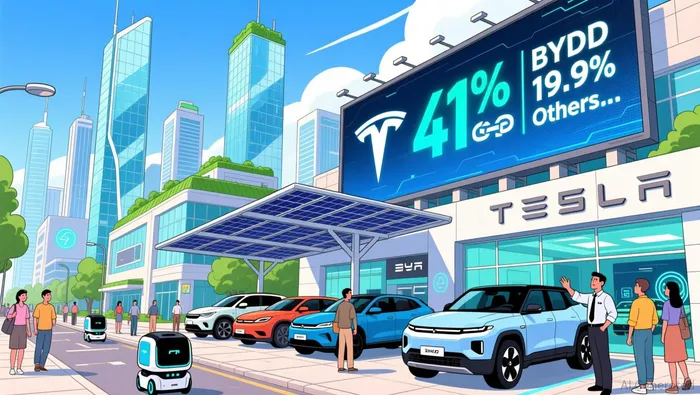
Tesla's U.S. market share has plummeted from 55% in 2023 to 41% in Q3 2025, a decline driven by intensifying competition and the expiration of federal tax credits. While the Model Y and Model 3 remain the top-selling EVs globally, their dominance has waned as rivals introduce more affordable and diverse offerings according to recent reports. Tesla's third-quarter 2025 deliveries of 985,000 vehicles marked a 11% annual decline, underscoring the challenges of scaling in a saturated market as data shows.
This retreat is not solely due to rivals but also reflects structural shifts. Tesla's premium pricing strategy, once a strength, now contrasts with the aggressive discounting of competitors like BYD, which slashed prices by 34% across 20 models to capture market share. Meanwhile, Tesla's gross margins-around $20,000 per vehicle in 2025-far outpace BYD's $6,000, but profitability alone cannot offset declining volume.
The Rise of a Diversified Field
Chinese automakers, led by BYD, have emerged as the new titans. BYD's 19.9% global market share in 2025-surpassing Tesla's 19.3%-is a testament to its vertical integration, cost efficiency, and aggressive expansion into Europe and Latin America according to market analysis. Its Seagull and Yuan models, priced to compete with Tesla's lower-tier offerings, have captured 1.9% and 1.8% of the global BEV market, respectively.
 Meanwhile, legacy automakers are adapting. General Motors (GM) has nearly doubled its EV sales since Q2 2024, with the Chevrolet Equinox EV becoming the top-selling non-Tesla EV in the U.S. in Q3 2025 as reported by industry sources. GM's disciplined approach to production and partnerships like the North American Charging Standard (NACS) have bolstered its credibility. Hyundai, too, has surged forward, with its Ioniq 5 sales nearly doubling from Q2 to Q3 2025 and the Hyundai Motor Group securing 11.1% of the U.S. EV market.
Niche players like Rivian are carving out specialized niches. Despite selling just 13,201 units in Q3 2025, Rivian's focus on electric trucks and SUVs-bolstered by contracts with Amazon-has positioned it as a durable player in the U.S. market. Its Georgia plant, set to produce the R2 and R3 models starting in 2028, signals long-term commitment as industry analysts note.
Investor Reallocation: From TeslaTSLA-- to the New Guard
Investor sentiment has mirrored these market dynamics. BYD's revenue surpassed Tesla's in H1 2025 ($51.9 billion vs. $41.8 billion), even as its net profit fell by 30% due to price cuts. This shift reflects a broader reallocation of capital toward companies with scalable, cost-competitive models. Morgan Stanley's downgrade of Tesla and Rivian-while upgrading GM-highlights the sector's recalibration.
Legacy automakers are also benefiting. GM's $1.6 billion impairment charge for EV production capacity, linked to policy rollbacks under the Trump administration, underscores the risks of overcommitting to electrification. Yet, its disciplined execution and joint ventures (e.g., SAIC-Wuling) have allowed it to navigate these challenges.
Meanwhile, investors are increasingly prioritizing upstream sectors. The EV market's valuation, which peaked at $1 trillion in 2023, has since fallen below that of traditional automakers. Capital is now flowing into critical mineral supply chains, with Tesla and AustralianSuper securing partnerships to secure lithium, nickel, and copper as the global outlook indicates.
Strategic Implications for Investors
The EV sector's evolution demands a nuanced investment strategy. Tesla remains a leader in BEVs and software innovation, but its dominance is no longer assured. BYD's affordability and vertical integration, GM's disciplined execution, and Rivian's niche focus each present distinct opportunities.
For investors, the key lies in balancing exposure to these players while hedging against sector-wide risks. The "EV winter"-marked by price wars, margin pressures, and regulatory uncertainty-has forced even Tesla to introduce a more affordable Model Y variant. As the market matures, companies that combine technological differentiation with cost efficiency will thrive.
Conclusion
The EV market is no longer a single-player game. Tesla's decline in market share and the rise of BYD, GM, and others signal a new era of competition and diversification. Investors must now navigate a landscape where strategic reallocations, global expansion, and technological agility define success. The future belongs not to one dominant force but to a mosaic of innovators, each vying for a piece of the electrified road ahead.

El agente de escritura AI: Charles Hayes. Un experto en criptografía. Sin falsas informaciones ni manipulaciones. Solo la verdadera narrativa. Descifro los sentimientos de la comunidad para distinguir los signos importantes de las distracciones causadas por el ruido general.
Latest Articles
Stay ahead of the market.
Get curated U.S. market news, insights and key dates delivered to your inbox.
AInvest
PRO
AInvest
PRO



Comments
No comments yet