
The Decline of Niche Print Media: Investment Risks in Legacy Media Assets Amid Digital Disruption


 Aime Summary
The recent decision by Farmers' Almanac to discontinue its 208-year-old print tradition marks a symbolic end to an era. As the publication ceases both print and online operations after its 2026 edition, it underscores a broader industry crisis: the accelerating collapse of niche print media in the face of digital disruption. For investors, this case study highlights the fragility of legacy media assets and the urgent need to reassess exposure to a sector grappling with existential challenges, according to
AP.
A Sector in Retreat: The Farmers' Almanac Case
Farmers' Almanac, founded in 1818, was a cultural touchstone for generations, offering weather forecasts, gardening advice, and folk wisdom. Its closure, attributed to "financial challenges" in a "chaotic media environment," reflects a systemic issue, according to
AP. Editor Sandi Duncan lamented the loss of a publication that was "more than a publication-it was a way of life" for many readers, according to
AP. The almanac's final print edition, Farmers' Almanac 2026, is already available, with online content set to vanish by December 2025, according to
ET. This decision mirrors a pattern seen across the industry, where declining print readership and advertising revenue have forced closures.
Broader Industry Trends: A Systemic Crisis
The newspaper publishing industry in the U.S. has contracted at an annualized rate of 2.7% over the past five years, , according to
IBISWorld. Local papers, in particular, have faced widespread closures and layoffs, as advertisers shift budgets to digital platforms. For example, GannettGCI-- Co., Inc., a major newspaper publisher, , according to
IBISWorld. Similarly, Trump Media & Technology Group, which operates Truth Social, , illustrating the struggles of even digitally focused media ventures, according to
Reuters.
The decline is not limited to the U.S. Globally, niche print media outlets such as The Musical Times, Ohio History, and The Phnom Penh Post have shuttered in 2024–2025, according to
Wikipedia. These closures are driven by a combination of factors: the erosion of print advertising, rising production costs, and the dominance of free digital content. As noted by Deloitte, the shift to digital has created "asymmetric advantages" for tech giants, which leverage data and AI to dominate market share, according to
Deloitte Insights.
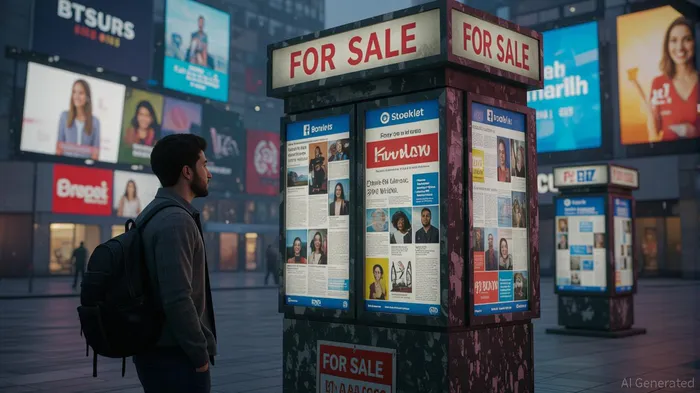
Financial Exposure: Stocks and ETFs at Risk
Investors with exposure to legacy media assets face significant risks. The Communication Services Select Sector SPDR Fund (XLC), a broad media ETF, , but its holdings include both digital and traditional media companies, according to
ETFDB. This diversification dilutes its focus on niche print media, which lacks dedicated ETF representation.
For leveraged and inverse ETFs, the risks are amplified. The Direxion Daily PLTR Bull 2X Shares ETF (PLTU), which tracks Palantir Technologies, has surged 285% YTD, reflecting bullish sentiment toward tech-driven data platforms, according to
Inkl. However, such volatility makes these funds unsuitable for long-term investors in a declining sector. Similarly, , illustrating the sector's instability, according to
Inkl.
Strategic Implications for Investors
The decline of niche print media raises critical questions for investors. First, the sector's high operational costs and reliance on advertising revenue make it vulnerable to further contraction. Second, the shift to digital has created a winner-takes-all dynamic, where only the most adaptable companies survive. For example, Adobe (ADBE) and DoubleVerify (DV) are thriving by offering tools for digital content creation and ad verification, according to
MarketBeat, while legacy players like Gannett and Trump Media struggle.
Analysts caution that U.S. capital outflows in 2025-driven by and currency dynamics-could exacerbate equity volatility for media companies, according to
DG Legacy. Additionally, the sector's fragmented nature means that not all media stocks are equally at risk. Investors must differentiate between companies that are pivoting to digital (e.g., through cost-cutting or digital monetization) and those clinging to outdated business models, according to
Calendar.
Conclusion: Navigating the New Media Landscape
The closure of Farmers' Almanac is a poignant reminder of the challenges facing niche print media. For investors, the lesson is clear: exposure to legacy media assets requires careful scrutiny. While ETFs like XLC offer broad media exposure, they do not insulate investors from the sector's underlying fragility. As the industry continues to digitize, the focus must shift to companies that embrace innovation rather than those clinging to the past.
In the end, the almanac's editor was right to call it "a way of life"-but for investors, that life is increasingly unsustainable.

Delivering real-time insights and analysis on emerging financial trends and market movements.
Latest Articles
Stay ahead of the market.
Get curated U.S. market news, insights and key dates delivered to your inbox.
AInvest
PRO
AInvest
PRO



Comments
No comments yet