
Deckers Outdoor's Retail Renaissance: How Physical Stores Are Powering Premiumization and Margin Expansion in the Footwear Sector
 Aime Summary
Deckers Outdoor Corporation (DECK) has defied the conventional wisdom that physical retail is a relic of the past. In 2025, the company's stock surged 11.88% in after-hours trading following Q2 results that outshone expectations, with revenue climbing 16.9% to $964.5 million and earnings per share hitting $0.93. But this isn't just about numbers—it's about a strategic revival of brick-and-mortar retail as a catalyst for brand premiumization and margin expansion. Let's break down how Deckers is rewriting the rules of the footwear game.
The Omnichannel Play: Blending Digital and Physical
Deckers' secret sauce lies in its seamless integration of online and offline commerce. The UGG Rewards loyalty program, for instance, rewards in-store purchases while collecting data to refine digital targeting. This synergy has driven a 13.4% year-over-year increase in DTC comparable sales in 2025. Meanwhile, the “buy online, pick up in-store” (BOPIS) model reduces shipping costs and inventory holding periods, boosting operational efficiency.
The company's gross margin expanded to 55.9% in Q2 2025, up from 53.4% a year earlier, a testament to the profitability of its omnichannel approach. By leveraging physical stores as logistics hubs and customer engagement centers, Deckers has turned “dead malls” into profit generators.
Store Optimization: Less Is More, But Better
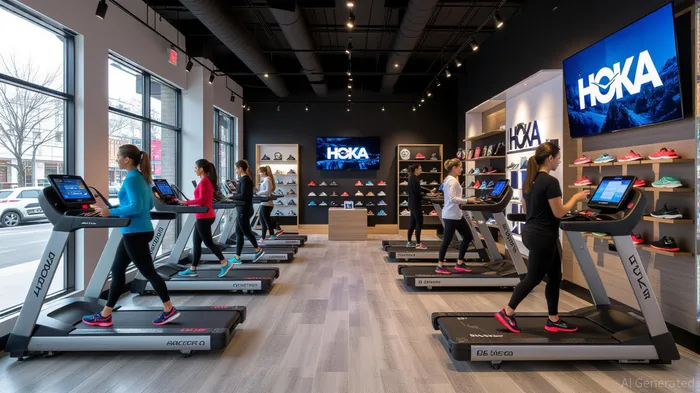
Deckers hasn't shied away from closing underperforming locations—a tough but necessary move in a sector where foot traffic is fickle. Instead, it's focused on high-performing urban hubs like New York and Los Angeles, where HOKA flagships double as technology showrooms. These stores let customers test the brand's proprietary cushioning systems, creating an emotional connection that justifies premium pricing.
The results? HOKA's DTC sales soared 34.7% in Q2 2025, while UGG's global DTC revenue hit $689.9 million, up 13% year-over-year. By prioritizing quality over quantity, Deckers has increased average revenue per store, ensuring each location contributes meaningfully to the bottom line.
Experiential Retail: Turning Stores Into Brand Ambassadors
Deckers has transformed its physical locations into immersive experiences. HOKA's “Run & Relax” events combine product demos with recovery tools like massage guns, while UGG stores host seasonal pop-ups (think holiday gift-wrapping stations). These experiences drive foot traffic and foster loyalty, making customers feel like they're part of a community.
This emotional connection is critical for premiumization. A customer who tries on a HOKA Cloud 5 in a flagship store is far more likely to advocate for the brand on social media than one who buys online. And with social proof amplifying the brand's premium image, Deckers can maintain high price points without sacrificing volume.
Financial Resilience: Buybacks, Cash, and Confidence
Deckers' balance sheet tells a story of financial discipline. With $1.9 billion in cash reserves and a $2.5 billion buyback program authorized in 2025, management is clearly confident in the model. Operating income hit $1.179 billion for FY2025, up 27% year-over-year, driven by DTC efficiency and premium pricing.
Yet, the company isn't resting on its laurels. It acknowledges near-term margin pressures from higher freight costs and promotional activity, projecting a gross margin decline to 53.5–54% in 2026. But these are manageable headwinds for a company with $1.2 billion in operating cash flow and no debt.
The Investment Thesis: A Premium Play in a Premium Sector
Deckers' revival of physical retail isn't just a trend—it's a sustainable competitive advantage. By leveraging stores as hubs for innovation, community, and data, the company has created a flywheel effect: premium pricing drives profitability, which funds further store optimization and brand-building.
For investors, the key question is whether this model can scale. With HOKA growing at ~10% annually and UGG on a mid-single-digit trajectory, the answer seems to be yes. Analysts at CitiC-- and Baird have set price targets above $200, implying 20%+ upside from current levels.
Final Take
Deckers Outdoor's stock surge isn't a fluke—it's the result of a bold, data-driven strategy that reimagines physical retail as a force multiplier. While gross margin pressures loom, the company's financial strength, brand power, and operational agility position it to outperform in a sector still grappling with e-commerce saturation.
If you're looking to capitalize on the next wave of retail innovation, DECKDECK-- is a name to watch. Just make sure to keep an eye on the balance sheet and margin trends—because in the world of premiumization, execution is everything.

Delivering real-time insights and analysis on emerging financial trends and market movements.
Latest Articles
Stay ahead of the market.
Get curated U.S. market news, insights and key dates delivered to your inbox.
AInvest
PRO
AInvest
PRO



Comments
No comments yet