
Deckers' Earnings Surge: A Strategic Bet on Niche Footwear and Consumer Resilience
 Aime Summary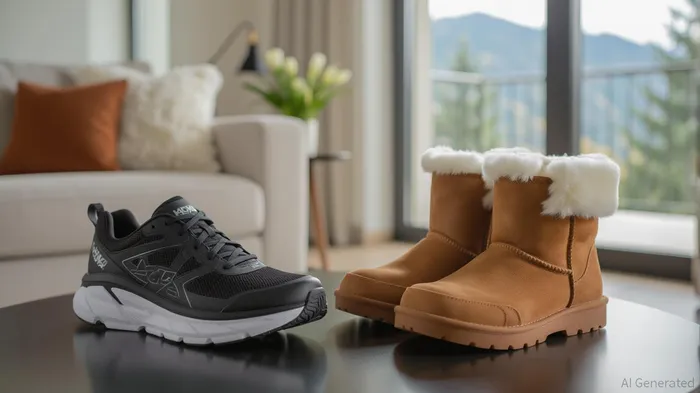
Deckers Brands has become a standout story in the premium footwear sector, driven by the meteoric growth of its two flagship brands, Hoka and Ugg. In Q2 2025, Hoka delivered a staggering 34.7% year-over-year sales increase to $570.9 million, while Ugg grew 13% to $689.9 million. Together, these brands accounted for 88% of Deckers' total revenue, a testament to their dominance in high-margin, lifestyle-driven markets. But this surge isn't just a product of strong sales—it's a reflection of a broader shift in consumer behavior and brand-led innovation.
The Power of Niche Dominance
Deckers' success lies in its ability to dominate two distinct yet complementary niches: performance-driven running shoes (Hoka) and premium lifestyle footwear (Ugg). Hoka's focus on cushioning and biomechanics has created a loyal following among runners, while Ugg's iconic sheepskin boots have evolved into a year-round lifestyle brand. This dual-engine strategy allows Deckers to tap into both functional and emotional consumer needs, creating a moat that competitors struggle to replicate.
Hoka's international expansion is particularly noteworthy. Sales in Europe and China grew by nearly 50% in Q2 2025, driven by demand for its high-performance, comfort-focused designs. Meanwhile, Ugg's DTC sales surged 17% on a constant currency basis, underscoring the strength of its direct-to-consumer model. By prioritizing DTC, Deckers maintains tighter control over customer relationships and brand messaging, a strategy that has boosted gross margins to 55.9%—a 250-basis-point improvement from the prior year.
Resilience Amid Economic Uncertainty
The broader premium niche footwear market is thriving despite macroeconomic headwinds. Consumers are increasingly prioritizing quality over quantity, with demand for sustainable, personalized, and high-margin products remaining robust. Deckers has capitalized on this trend by leveraging its pricing power and brand equity to offset rising costs. For example, a 20% tariff on Vietnam-sourced goods was mitigated through strategic price increases and supply chain diversification, with no meaningful impact on demand. This pricing power is a hallmark of premium brands and a critical factor in maintaining profitability during inflationary periods.
Deckers' financial discipline further strengthens its position. With $1.72 billion in cash reserves and no debt, the company is well-positioned to navigate short-term disruptions while investing in long-term growth. Its recent $183 million stock buyback and $2.5 billion buyback authorization signal confidence in its intrinsic value, while its updated full-year guidance—$4.8 billion in revenue and $5.15–$5.25 in EPS—reflects optimism about sustained demand.
A Broader Macro Trend: Brand Equity in High-Margin Sectors
Deckers' performance is not an isolated case but part of a larger trend: the rise of premium niche brands in resilient consumer sectors. Companies like LululemonLULU--, AllbirdsBIRD--, and even TeslaRACE-- have demonstrated that strong brand equity and category leadership can drive growth even in uncertain economies. The key differentiator? The ability to create emotional connections while delivering functional value.
For instance, Hoka's focus on “ultra-comfort” aligns with the growing demand for ergonomic, performance-driven footwear, while Ugg's repositioning as a year-round lifestyle brand taps into the athleisure and casualwear boom. These strategies are reinforced by sustainability initiatives—such as Hoka's use of sugarcane-based soles and Ugg's eco-conscious collaborations—which resonate with younger, values-driven consumers.
Why This Signals a Compelling Investment Opportunity
Deckers' outperformance highlights why investors should consider brand-led, high-margin consumer plays. Unlike commoditized footwear segments, niche premium brands benefit from pricing power, customer loyalty, and scalable DTC models. Deckers' ability to balance heritage (Ugg) with innovation (Hoka) creates a dual growth engine that is rare in the sector.
Moreover, the company's international expansion into underpenetrated markets—such as China and Europe—offers significant upside. Ugg's brand awareness in these regions has already reached 30%, and Hoka's global awareness is similarly strong. As these markets mature, the potential for revenue growth is substantial.
Risks and Considerations
While the outlook is bullish, investors should remain mindful of risks. Shifting consumer preferences, supply chain disruptions, and intensifying competition from global rivals like NikeNKE-- and Adidas could challenge Deckers' dominance. However, the company's strong brand equity, financial flexibility, and agile supply chain mitigate these risks.
Conclusion: A Long-Term Play on Consumer Resilience
Deckers Brands has demonstrated that strategic category dominance and brand equity can thrive even in a volatile economic environment. Its dual focus on performance and lifestyle footwear, combined with a disciplined financial strategy, positions it as a compelling long-term investment. For investors seeking exposure to resilient, high-margin consumer plays, Deckers offers a rare combination of growth potential and operational excellence.
As the premium niche footwear market continues to expand, Deckers' ability to innovate, adapt, and maintain pricing power will likely keep it at the forefront of this trend. In a world where consumers increasingly value quality, sustainability, and brand identity, Deckers is not just surviving—it's leading the charge.

Stay ahead of the market.
Get curated U.S. market news, insights and key dates delivered to your inbox.


AInvest
PRO
AInvest
PRO



Comments
No comments yet