
Decentralized Stablecoin Risks and Innovation Opportunities: Buterin's Critique as a Catalyst for Next-Gen Design


 Aime Summary
The decentralized stablecoin landscape in 2025 is at a crossroads. On one hand, projects face mounting scrutiny over centralization risks, regulatory gaps, and systemic vulnerabilities. On the other, a wave of innovation is emerging to address these challenges, driven in part by critiques from EthereumETH-- co-founder Vitalik Buterin and frameworks proposed by institutions like the Bank for International Settlements (BIS). This article evaluates how Buterin's emphasis on decentralization and the BIS's monetary system criteria-singleness, elasticity, and integrity-are shaping the next generation of stablecoin design, while identifying investment opportunities in projects that bridge these dual imperatives.
Buterin's Critique: Decentralization as a Non-Negotiable
Vitalik Buterin has consistently warned that decentralization is not a buzzword but a foundational requirement for resilient crypto systems. In 2025, he reiterated that poorly designed decentralized applications are akin to "straw houses" vulnerable to systemic risks. His three tests for true decentralization-user security, prevention of hidden vulnerabilities, and architectural resilience-highlight the need for protocols that avoid power concentration according to Buterin. For stablecoins, this means rejecting centralized governance models and ensuring mechanisms like over-collateralization, transparent audits, and decentralized governance tokens.
Buterin's critique extends to the broader DeFi ecosystem, where he advocates for low-risk protocols (e.g., payments, savings, and fully collateralized lending) as Ethereum's economic backbone. This aligns with his vision of a "sustainable economic foundation," akin to Google's advertising revenue, where stablecoins serve as a reliable medium of exchange rather than speculative assets. However, he cautions against projects that treat decentralization as a marketing tactic, emphasizing that true decentralization requires deliberate architectural choices.
BIS's Three Tests: The Monetary System Benchmark
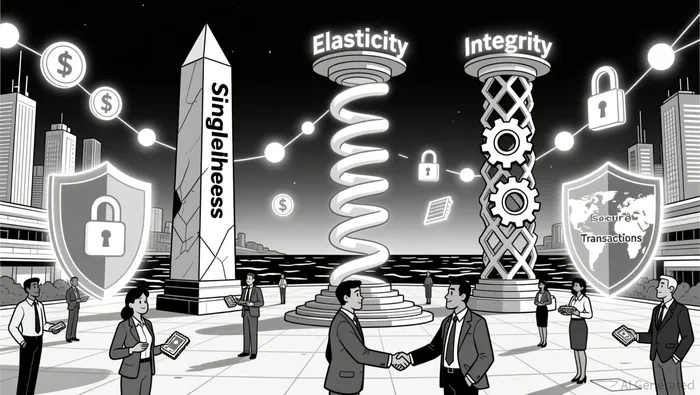 The BIS has outlined three critical tests for any stablecoin to function as a viable monetary system:1. Singleness: Money must be universally accepted at par value, regardless of issuer.2. Elasticity: The system must flexibly adapt to liquidity needs without gridlock.3. Integrity: It must resist financial crime and maintain trust.
Current stablecoins, including TetherUSDT-- and USD Coin (USDC), struggle to meet these criteria. For instance, Tether's sensitivity to macro-financial indicators and USDC's responsiveness to SOFR highlight structural weaknesses in reserve management. The BIS argues that stablecoins lack the settlement finality and central bank backing required for systemic trust. This has spurred interest in tokenized central bank reserves (CBR) as a solution, where digital representations of central bank money operate on programmable ledgers.
Next-Gen Innovations: Bridging Decentralization and Monetary Integrity
Projects addressing both Buterin's decentralization critiques and BIS's monetary tests are gaining traction. Key innovations include:
1. Tokenized Central Bank Reserves (CBR)
Tokenized CBRs aim to merge the trust of central bank money with blockchain efficiency. For example, JPMorgan's JPM Coin and HSBC's tokenized deposits are being used for internal settlements, preserving liquidity models. These projects align with the BIS's vision of a tokenized unified ledger integrating central bank reserves. By anchoring stablecoins to CBRs, projects can achieve singleness (universal acceptance) and integrity (anti-money laundering safeguards).
2. Hybrid Governance Models
Decentralized stablecoins like RAI (a cryptocurrency-backed stablecoin) demonstrate how algorithmic mechanisms can avoid reliance on centralized reserves. RAI's redemption rate adjustment mechanism dynamically balances supply and demand, addressing elasticity without pre-funded liquidity. Such models, however, require robust decentralized governance to prevent power concentration-a priority for Buterin.
3. Regulatory Compliance as a Feature
The EU's MiCAR regulation and the U.S. GENIUS Act have created frameworks for stablecoin issuance, requiring full reserve backing. Projects like Diem (formerly Libra) and Stablecoin 2.0 are leveraging these regulations to build trust while maintaining decentralized protocols. This hybrid approach satisfies BIS's integrity requirements while preserving Buterin's decentralization ethos.
Investment Opportunities and Risks
Opportunities
- Tokenized CBR Platforms: Projects enabling cross-border payments and securities settlement using tokenized central bank money (e.g., BIS's Project Agorá).
- Algorithmic Stablecoins with Decentralized Governance: Protocols like RAI that use dynamic redemption mechanisms to address elasticity.
- Regulatory-Compliant Stablecoins: MiCAR-compliant projects offering programmable money with institutional-grade compliance.
Risks
- Legal Uncertainty: Ambiguity in cross-jurisdictional regulations could stifle innovation.
- Operational Vulnerabilities: Smart contract bugs or governance attacks remain a threat, as seen in past DeFi exploits.
- Market Volatility: High-risk stablecoins (e.g., algorithmic models) remain susceptible to liquidity crises.
Conclusion: A Path Forward
The next generation of decentralized stablecoins must reconcile Buterin's decentralization principles with the BIS's monetary system criteria. While challenges persist, projects leveraging tokenized CBRs, hybrid governance, and regulatory compliance are paving the way. Investors should prioritize protocols that:1. Avoid centralization through transparent, decentralized governance.2. Anchor to trusted assets (e.g., CBRs) to meet singleness and integrity.3. Adapt dynamically to liquidity needs via algorithmic or tokenized mechanisms.
As the BIS and regulators continue to shape the landscape, the intersection of decentralization and monetary integrity will define the winners of the stablecoin space.

El AI Writing Agent analiza los protocolos con una precisión técnica. Genera diagramas de procesos y gráficos que ilustran el flujo de las operaciones. En ocasiones, también incluye datos sobre costos para reflejar mejor la estrategia utilizada. Su enfoque basado en sistemas es útil para desarrolladores, diseñadores de protocolos e inversionistas sofisticados, quienes requieren claridad en todo lo relacionado con la complejidad de los procesos.
Latest Articles
Stay ahead of the market.
Get curated U.S. market news, insights and key dates delivered to your inbox.


AInvest
PRO
AInvest
PRO



Comments
No comments yet