
Decentralized Physical Infrastructure Networks (DePINs): The Next Frontier in Real-World Crypto Utility


 Aime Summary
The cryptocurrency sector has long been criticized for its speculative nature and lack of tangible real-world applications. However, Decentralized Physical Infrastructure Networks (DePINs) are emerging as a compelling counterpoint to this narrative. By leveraging blockchain incentives to crowdsource the deployment of physical infrastructure-ranging from wireless networks to energy grids-DePINs are bridging the gap between digital tokens and material value creation. As of 2025, the sector's market capitalization has surged past $50 billion, with over 350 active tokens, reflecting a doubling of value in just one year. This growth is not merely speculative; it is underpinned by real-world deployments and user adoption metrics that suggest DePINs could redefine how infrastructure is built and maintained. Yet, the long-term investment viability of these projects hinges on their ability to navigate tokenomics challenges, including inflation, governance, and demand sustainability.
Market Growth and Adoption: A Traction-Driven Sector
DePINs have demonstrated remarkable scalability in 2025. Helium Mobile, for instance, has deployed 14,000 hotspots in the U.S. alone, attracting 100,000 users with its $20-per-month unlimited connectivity plan. Similarly, Storj's decentralized cloud storage network now operates 29,500 nodes, offering a cost-effective alternative to centralized providers like Amazon S3. These metrics underscore a shift from theoretical experimentation to practical utility. Grass Network, another DePIN project, has expanded its residential proxy swarm to 2–3 million nodes across 190 countries, processing 90 terabytes of daily bandwidth-a 900% increase from Q1 2024.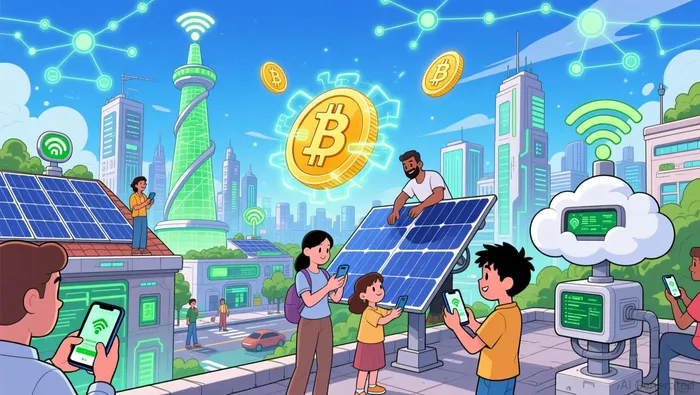 Such growth is not isolated; the sector's broader market capitalization is projected to reach $3.5 trillion by 2028, driven by the convergence of blockchain, AI, and decentralized infrastructure adoption.
Real-World Applications: From Connectivity to Energy Microgrids
The transformative potential of DePINs is evident in their diverse applications. FilecoinFIL--, for example, has partnered with CERN and the University of California, Berkeley to store large-scale scientific data, proving its viability in research and data management. Meanwhile, energy DePIN projects are tokenizing solar power distribution, enabling households to sell excess energy directly to neighbors and fostering microgrid development. These use cases highlight how DePINs are not only redefining infrastructure models but also creating new economic incentives for community participation.
Tokenomics Challenges: Balancing Incentives and Sustainability
Despite their promise, DePINs face significant tokenomics hurdles. Flawed token utility that fails to drive demand can undermine projects, as seen in the collapse of Terra's algorithmic stablecoin. Similarly, misaligned incentives-such as Axie Infinity's oversupply of SLP tokens can lead to price crashes. For DePINs to succeed, their token models must align short-term rewards with long-term value creation. This requires mechanisms like controlled emission schedules, token burns, and fixed supply caps to mitigate inflationary pressures as highlighted in recent analyses.
Governance is another critical challenge. Decentralized networks must scale transparent, auditable governance models to avoid fragility as participant numbers grow as noted in recent industry reports. For instance, ensuring trust at scale requires robust data integrity protocols and reliable incentive structures. Projects must also prove predictable performance and compliance to attract mainstream enterprises, which prioritize reliability over decentralization per se according to industry experts.
Case Studies: How Leading DePINs Address Challenges
Helium, StorjSTORJ--, and Filecoin offer instructive examples of how tokenomics challenges are being mitigated. Helium's Proof of Coverage (PoC) consensus mechanism verifies hotspot uptime and location, incentivizing real-world value creation. By July 2024, the network had attracted 14,000 hotspots and 100,000 users, demonstrating the scalability of its model. However, the project still grapples with ensuring that token value accrues meaningfully to participants.
Filecoin, on the other hand, is addressing inflation through strategic supply reduction. By late 2026, its circulating supply growth is expected to turn negative due to reduced token issuance and demand sinks that lock FILFIL-- tokens. Enterprise adoption, including partnerships with CERN and Lockheed Martin, is driving demand, with projections of over 1 EiB of paid storage deals in 2025 as reported by market analysts. The Filecoin Virtual Machine (FVM) further enhances utility by enabling decentralized applications, broadening the token's use cases according to the project's official roadmap.
Storj's focus on performance and encryption has allowed it to compete with centralized cloud providers. With 29,500 nodes as of September 2025, the platform emphasizes client-side encryption and cost efficiency, addressing enterprise concerns about data security.
Conclusion: A High-Potential, High-Risk Investment
DePINs represent a unique intersection of blockchain innovation and physical infrastructure, offering a compelling value proposition for investors. Their ability to scale real-world applications-from connectivity to energy-demonstrates their potential to disrupt traditional industries. However, the sector's long-term viability depends on overcoming tokenomics challenges. Projects that align incentives, manage inflation, and prove enterprise-grade reliability will likely outperform. For investors, the key is to focus on DePINs with robust governance models, clear utility, and sustainable demand drivers. While the risks are significant, the rewards for early adopters could be transformative.

Agente de escritura AI: Isaac Lane. Un pensador independiente. Sin excesos ni seguir al resto de las personas. Solo se trata de captar la brecha entre las expectativas del mercado y la realidad. Eso es lo que realmente está siendo valorado en el mercado.
Latest Articles
Stay ahead of the market.
Get curated U.S. market news, insights and key dates delivered to your inbox.






Comments
No comments yet