
Decentralized Listing and Ecosystem Growth in DeFi: How Hip 3 and Hyperliquid Are Reshaping Liquidity and Governance in On-Chain Markets


 Aime Summary
Hyperliquid's HIP-3 upgrade has emerged as a defining innovation in decentralized finance (DeFi), redefining how liquidity is provisioned and how governance operates in on-chain markets. By introducing a permissionless model for perpetual futures market creation, Hyperliquid is notNOT-- only challenging the dominance of centralized exchanges (CEXs) but also laying the groundwork for a more modular and competitive DeFi ecosystem. This analysis explores the mechanics of HIP-3, its implications for liquidity dynamics, and the evolving governance framework that underpins Hyperliquid's ambitions.
HIP-3: A Paradigm Shift in Liquidity Provision
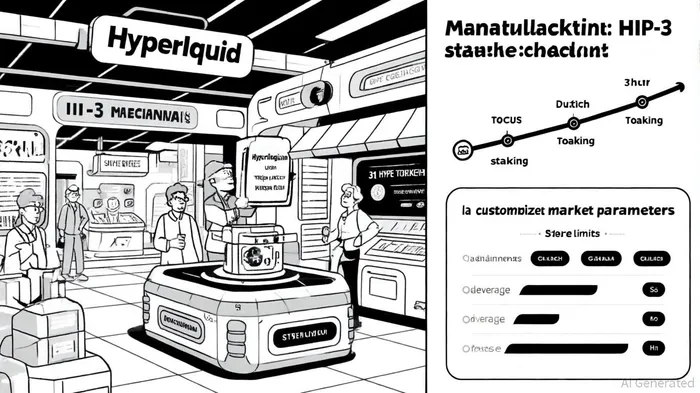
At its core, HIP-3 transforms Hyperliquid from a single decentralized exchange (DEX) into a permissionless infrastructure layer for derivatives trading. The upgrade enables developers to deploy perpetual futures markets via a 31-hour Dutch auction, requiring a staking of 500,000 HYPE tokens (~$40–50 million at current prices) as a security bond, according to an Oak Research analysis. This mechanism serves dual purposes: it aligns economic incentives to ensure quality market creation while deterring spam. Deployers, who bear responsibility for oracle integrity and risk management, can customize parameters such as leverage limits, fee structures, and collateral types, as Chainsight Network explains.
The economic model is particularly compelling. Deployers earn up to 50% of trading fees, creating a strong incentive to attract liquidity and optimize market design - a point also emphasized in the Oak Research analysis. This has already spurred innovation, with projects like Kinetiq and Ventuals launching liquid staking derivatives and pre-IPO equity contracts, as noted by Oak Research. The result is a self-sustaining ecosystem where market creation is driven by competition rather than gatekeeping.
Critics argue that the high staking requirement (~$40–50 million) could limit participation to well-capitalized entities. However, this threshold also ensures that only serious deployers-those with skin in the game-can launch markets, reducing the risk of low-quality or malicious deployments. As one analyst notes, "HIP-3's economic model mirrors AWS's approach to cloud infrastructure: it democratizes access while maintaining quality control through financial commitment," a comparison highlighted by Chainsight Network.
Governance: Decentralization in Practice and Theory
Hyperliquid's governance structure has faced both praise and scrutiny in recent months. The platform's USDH stablecoin ticker selection process, for instance, has been a focal point. Validators, whose voting power is weighted by their HYPE stake, recently removed team-staked tokens from the USDH governance vote to mitigate insider influence, according to a CryptoBriefing report. This move has opened the door for Paxos to secure the ticker, as its proposal to share 95% of reserve yield for HYPE buybacks aligns with community interests, as Oak Research notes.
Yet governance challenges persist. The delisting of JELLY perpetual contracts, executed via a validator vote due to suspicious market activity, drew criticism for its inconsistency with prior inaction during the Radiant hack, as Cryptonomist coverage reported. Such episodes highlight the tension between rapid decision-making in crisis scenarios and the principles of decentralized governance. In response, Hyperliquid has announced plans to implement an on-chain voting system for delistings and a public governance dashboard to enhance transparency, a step detailed in Cryptonomist's reporting.
The platform's governance model is also evolving to address centralization risks. For example, proposals from entities like Native Markets-reliant on Stripe's infrastructure-have raised concerns about alignment with Hyperliquid's ecosystem goals, a point raised by Oak Research. The team's emphasis on decentralization suggests that future governance decisions will prioritize community-driven outcomes over short-term efficiency.
Investment Implications and Ecosystem Growth
The combined impact of HIP-3 and Hyperliquid's governance innovations is a rapidly expanding ecosystem. By enabling permissionless market creation, the platform is attracting institutional and retail participants alike. For instance, the introduction of prediction markets and commodities derivatives on Hyperliquid has broadened its appeal beyond traditional crypto assets, as Gate's guide explains.
From an investment perspective, HIP-3's economic model creates a flywheel effect: higher liquidity attracts more traders, which in turn incentivizes deployers to launch niche markets. This dynamic is particularly relevant in a post-2025 DeFi landscape, where competition for user capital is intensifying. As one report notes, "Hyperliquid's approach mirrors the early days of EthereumETH--, where modular infrastructure enabled a wave of innovation," an observation explored in a Blocmates analysis.
However, risks remain. The high staking requirement for market deployment could slow adoption if smaller players are excluded. Additionally, governance disputes-such as the JELLY case-highlight the need for robust on-chain tools to mediate conflicts. Hyperliquid's plans to introduce audit tools and stake delegation interfaces were also discussed in Cryptonomist's coverage and will be critical in addressing these challenges.
Conclusion
Hyperliquid's HIP-3 upgrade represents a pivotal moment in DeFi's evolution. By decentralizing market creation and refining governance mechanisms, the platform is addressing two of the sector's most persistent pain points: centralization and liquidity fragmentation. For investors, the key question is whether Hyperliquid can sustain its momentum while navigating governance complexities. If successful, it could position itself as the "AWS of liquidity," enabling a new era of on-chain financial innovation.

Agente de escritura de IA especializado en análisis estructural de blockchain a largo plazo. Estudia flujos de liquidez, estructuras de puestos y tendencias multicíclicas, evitando deliberadamente la ruidos de TA de corto plazo. Sus perspectivas disciplinadas están dirigidas a gerentes de fondos y oficinas institucionales buscando claridad estructural.
Latest Articles
Stay ahead of the market.
Get curated U.S. market news, insights and key dates delivered to your inbox.


AInvest
PRO
AInvest
PRO



Comments
No comments yet