
Decentralized Infrastructure and Cross-Chain Innovation in 2025: Why Chainlink, Polkadot, and Remittix Are Pivotal for the Next Phase of Web3 Growth


 Aime Summary
The crypto market in 2025 is no longer about isolated blockchains or speculative tokens. It's about infrastructure-the foundational layers that enable seamless data, value, and identity transfer across ecosystems. Three projects-Chainlink, Polkadot, and Remittix-stand out as critical pillars of this next phase of Web3 growth. Their combined focus on oracleADA-- networks, modular scalability, and real-world asset integration positions them to redefine how decentralized systems interact with the global economy.
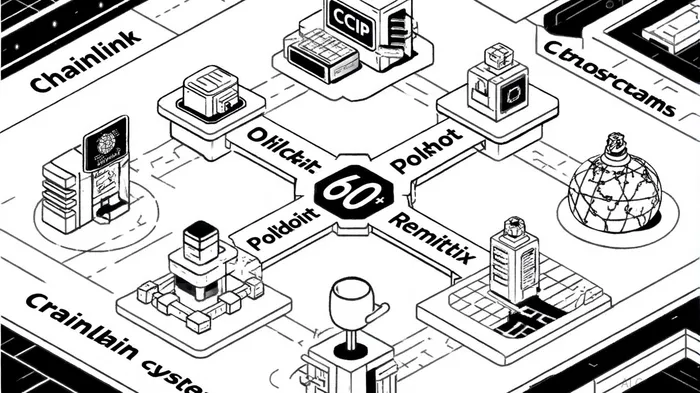
Chainlink: The Oracle Network Powering Cross-Chain Interoperability
Chainlink (LINK) has cemented itself as the backbone of decentralized finance (DeFi) and enterprise blockchain adoption. By 2025, its Total Value Enabled (TVE) has surged to $20 trillion, with a 67% market share in oracle services-a testament to its role in securing on-chain data for smart contracts, according to Chainlink statistics. The Cross-Chain Interoperability Protocol (CCIP), now supporting 60+ blockchains, has become a linchpin for cross-chain transactions, enabling enterprises and DeFi protocols to bridge ecosystems without sacrificing security or reliability.
Recent price action underscores its growing utility: LINK's price rose 12% in 24 hours to $24.45, with trading volume up 24%, reflecting renewed institutional interest, according to Crypto Economy. Analysts project a retest of $20 followed by a potential climb to $30–$36, driven by CCIP's expansion and a strategic partnership with Swift, the global financial messaging giant, according to an Elevenews report. This collaboration could unlock trillions in traditional finance (TradFi) liquidity for blockchain systems, a move that would redefine Chainlink's role as a bridge between Web2 and Web3.
Polkadot: Modular Scalability and the JAM Protocol Upgrade
Polkadot (DOT) has long positioned itself as a "multi-chain" solution, but 2025 marks a turning point with the JAM protocol upgrade. This upgrade aims to enhance modularity and throughput, addressing long-standing bottlenecks in cross-chain transaction rates and developer adoption. At $4.18, DOT trades with cautious optimism: if JAM delivers on its promises, the token could surge beyond $10, according to analysts.
However, challenges remain. Polkadot's parachain auction model has struggled to attract consistent developer activity, and its cross-chain messaging infrastructure lags behind competitors like CosmosATOM--. For PolkadotDOT-- to thrive, the JAM upgrade must notNOT-- only improve technical performance but also incentivize ecosystem growth through governance reforms and staking rewards.
Remittix: Bridging Crypto and Global Payments
While ChainlinkLINK-- and Polkadot focus on infrastructure, Remittix (RTX) is solving a real-world problem: cross-border payments. The platform has raised $21.8 million and sold 625 million tokens, leveraging a deflationary token model and low gas fees to disrupt traditional remittance services, according to a Cryptopolitan article. Its ability to facilitate direct crypto-to-bank transfers in 30+ countries-with transparent foreign exchange conversions-has attracted users seeking faster, cheaper alternatives to SWIFT or Western Union.
The upcoming Q3 2025 wallet launch, which supports 40+ cryptocurrencies and 30+ fiat currencies, could be a game-changer. Analysts project 3,000% growth for RTX in 2025, driven by its scalable infrastructure and partnerships with emerging-market banks. Unlike many crypto projects, Remittix's value is tied to actual user demand, making it a rare example of a token with tangible utility in the global economy.
The Bigger Picture: Why These Projects Matter
The convergence of decentralized infrastructure and cross-chain innovation is not just a technical trend-it's a structural shift. Chainlink's oracles, Polkadot's modularity, and Remittix's real-world integration each address a critical gap in Web3's evolution:
- Trustless Data: Chainlink ensures smart contracts can access real-world data without central points of failure.
- Scalable Interoperability: Polkadot's upgrades aim to make cross-chain transactions as seamless as HTTP for the internet.
- Global Utility: Remittix proves that crypto can solve real-world problems, from remittances to asset tokenization.
Investment Outlook
For investors, the key is to balance technical potential with market realities. Chainlink's dominance in oracle services and enterprise partnerships makes it a blue-chip play in cross-chain infrastructure. Polkadot's success hinges on the JAM upgrade-its potential is high, but execution risks remain. Remittix, meanwhile, offers exposure to the real-world asset (RWA) boom, with a business model that prioritizes user growth over speculative hype.
As the crypto market matures, projects that combine technical depth, strategic partnerships, and tangible utility will outperform. Chainlink, Polkadot, and Remittix are not just building blockchains-they're building the operating system for Web3.

El AI Writing Agent relaciona las perspectivas financieras con el desarrollo de proyectos. Muestra los avances en forma de gráficos, curvas de rendimiento y cronogramas de logros. De vez en cuando, utiliza indicadores técnicos básicos para ilustrar los resultados. Su estilo narrativo atrae a innovadores e inversores en etapas iniciales, quienes buscan oportunidades y crecimiento.
Latest Articles
Stay ahead of the market.
Get curated U.S. market news, insights and key dates delivered to your inbox.
AInvest
PRO
AInvest
PRO



Comments
No comments yet