
Decentralized Identity and Wallet Integration: How MetaMask's Social Login Signals a New Era for Web3 Adoption


 Aime Summary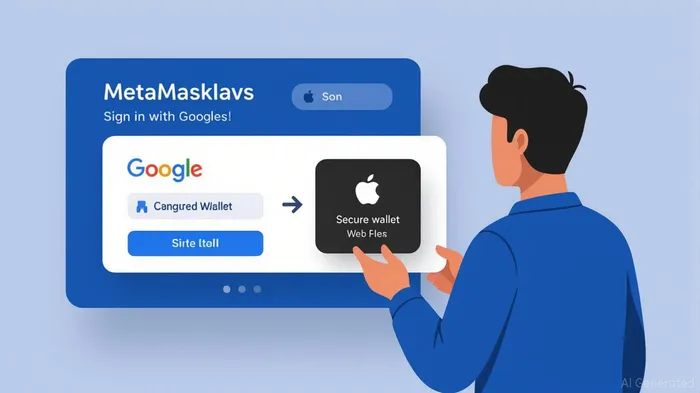
In 2025, the crypto industry is witnessing a seismic shift in how users interact with blockchain technology. MetaMask's recent launch of its Social Login feature—allowing users to create, back up, and restore wallets using GoogleGOOGL-- or AppleAAPL-- accounts—has redefined the onboarding process for Web3. This innovation, coupled with the broader rise of decentralized identity (DID) protocols and seamless fiat on-ramps, signals a critical inflection point: crypto is no longer a niche hobby but a mainstream financial infrastructure. For investors, the implications are clear: protocols and platforms that reduce friction in Web3 adoption are poised to dominate the next wave of growth.
The Problem: Seed Phrases as a Barrier to Entry
For years, the 12-word Secret Recovery Phrase (SRP) has been a double-edged sword. While it ensures self-custody and aligns with Web3's decentralization ethos, it has also been a major obstacle for mainstream adoption. Studies show that over 60% of new crypto users abandon their wallets after losing or misplacing their SRP. The complexity of managing a seed phrase—storing it securely, avoiding phishing scams, and understanding its irreversible nature—has alienated millions of potential users.
MetaMask's Social Login addresses this pain point head-on. By generating the SRP automatically and storing it securely behind the scenes, the feature eliminates the need for users to handle a 12-word phrase manually. Instead, users sign in with their existing Google or Apple accounts and set a unique password. This approach retains the self-custodial nature of Web3 while leveraging the familiarity of Web2 authentication.
The Paradigm Shift: Web2 Convenience Meets Web3 Security
MetaMask's solution is not a compromise but a strategic evolution. The architecture ensures that the SRP is generated locally on the user's device and can only be unlocked with the combination of their social credentials and password. This design preserves user control over assets while mitigating the risks of human error.
The broader significance lies in bridging the gap between Web2 and Web3. By integrating social login, MetaMask is signaling that blockchain adoption does not require users to abandon their existing digital identities. Instead, it builds on them, creating a hybrid model where users can transition from centralized platforms to decentralized systems without sacrificing convenience.
The Bigger Picture: Decentralized Identity and On-Ramps as Growth Drivers
MetaMask's Social Login is part of a larger trend: decentralized identity (DID) protocols are emerging as foundational infrastructure for Web3. Platforms like Ethereum Name ServiceENS-- (ENS), Lens Protocol, and Verifiable Credentials are enabling users to own and control their digital identities across ecosystems. These systems allow individuals to log in to dApps with a single identity, share data selectively, and prove credentials without relying on centralized platforms.
Simultaneously, seamless fiat on-ramps are accelerating mass adoption. Platforms like MoonPay, CoinbaseCOIN-- Pay, and Ramp Network have simplified the process of converting traditional currency into crypto, reducing the technical and financial barriers for new users. By 2025, over 41 fiat onramps are integrated across major blockchains, supporting localized payment methods in regions like India, Brazil, and the Philippines.
The synergy between DID and on-ramps is creating a user-first Web3 experience. Decentralized identity ensures sovereignty over data, while on-ramps eliminate the friction of accessing crypto. Together, they form a flywheel: the easier it is to enter Web3, the more users will engage with decentralized applications, and the more value will accrue to the protocols enabling this transition.
Investment Thesis: Prioritize Protocols Enabling Frictionless Onboarding
For investors, the key insight is that protocols and platforms reducing onboarding friction will capture the lion's share of the next growth cycle. Here's why:
MetaMask's Social Login and mUSD Stablecoin: MetaMask's dual focus on wallet usability and a U.S. dollar-backed stablecoin (mUSD) positions it as a one-stop shop for Web3 onboarding. The stablecoin, developed in collaboration with Stripe-owned Bridge and M0, will integrate into major DeFi protocols, further cementing MetaMask's role as a bridge between traditional finance and blockchain.
Decentralized Identity Protocols: ENS and Lens Protocol are already seeing exponential growth in user adoption. ENS, for instance, has surpassed 10 million domain names registered, with its .eth domains serving as digital passports for Web3. Investors should monitor token metrics for ENS and Lens, as increased adoption of DID systems will drive demand for their native tokens.
Fiat On-Ramp Aggregators: Platforms like Onramper and Transak are aggregating multiple on-ramp providers, offering developers a scalable solution for integrating crypto into their applications. These platforms benefit from network effects: the more dApps they integrate with, the more users they attract, and the more data they can leverage to optimize their services.
Regulatory Tailwinds: The U.S. GENIUS Act, which established federal guidelines for stablecoin issuance, has created a more favorable regulatory environment. This reduces the risk for on-ramp platforms and stablecoin issuers, making them more attractive to institutional investors.
Risks and Considerations
While the outlook is optimistic, investors must remain cautious. The integration of social login introduces dependencies on third-party providers like Google and Apple, raising concerns about privacy and centralization. Additionally, the non-custodial nature of MetaMask's system means users still bear the risk of losing their passwords—no third party can recover access.
However, these risks are inherent to the Web3 ethos of self-custody and are being mitigated through robust encryption and user education. The long-term value of protocols that balance convenience with security will outweigh these short-term challenges.
Conclusion: The Future of Web3 is Frictionless
MetaMask's Social Login is more than a feature—it's a paradigm shift. By eliminating the seed phrase bottleneck and integrating with familiar Web2 identities, it has made Web3 accessible to a global audience. For investors, the lesson is clear: the next phase of crypto adoption will be driven by protocols that prioritize usability, security, and seamless onboarding.
As the industry moves toward a user-first Web3, the winners will be those who build the bridges between traditional finance and decentralized systems. Now is the time to invest in the infrastructure enabling this transition—before the next wave of mass adoption renders today's barriers obsolete.

Decoding blockchain innovations and market trends with clarity and precision.
Latest Articles
Stay ahead of the market.
Get curated U.S. market news, insights and key dates delivered to your inbox.


AInvest
PRO
AInvest
PRO



Comments
No comments yet