
Decentralized Finance's Growing Challenge to Traditional Asset Management Giants: How Maple Finance Surpasses BlackRock's BUIDL Fund


 Aime Summary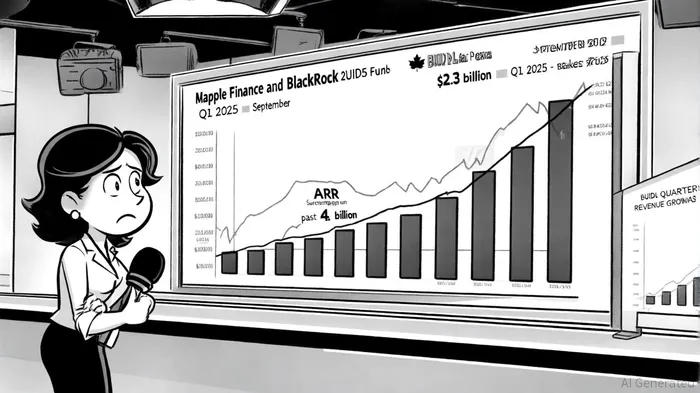
The decentralized finance (DeFi) sector has long been dismissed as a niche experiment, but 2025 has proven otherwise. Maple FinanceSYRUP--, a DeFi lending protocol, has not only survived the scrutiny of institutional investors but has outpaced one of the most prominent traditional finance (TradFi) entrants into crypto: BlackRock's BUIDL Fund. As of September 2025, Maple Finance's assets under management (AUM) reached $4 billion, surpassing BUIDL's peak of $2.3 billion[1]. This milestone is not just a numbers game—it signals a paradigm shift in how capital is allocated, managed, and earned in the digital age.
The AUM Arms Race: Maple's DeFi Edge
Maple Finance's ascent is driven by its institutional-grade credit solutions on the blockchain. By offering transparent, high-yield lending pools, the protocol has attracted a surge of institutional demand for its yield-bearing stablecoin, syrupUSD[1]. This contrasts sharply with BUIDL's approach, which tokenizes traditional assets like U.S. Treasuries to bridge the gap between TradFi and crypto. While BUIDL's AUM grew from $1 billion in March 2025 to $2.3 billion by mid-2025[4], its growth pales next to Maple's 200% quarterly revenue surge and $15 million in annual recurring revenue (ARR)[1].
The key differentiator? Speed and adaptability. Maple Finance expanded to new blockchain networks in 2025, leveraging cross-chain liquidity to scale rapidly. Meanwhile, BUIDL's growth, though impressive, has been constrained by the inherent inertia of traditional institutions. BlackRock's foray into tokenized assets—operating on EthereumETH--, ArbitrumARB--, and Polygon—has been strategic but slower to adapt to the dynamic DeFi landscape[4].
Strategic Disruption: DeFi vs. Tokenized TradFi
Maple Finance's success underscores a broader trend: DeFi's ability to outmaneuver traditional asset managers by prioritizing innovation over bureaucracy. Unlike BUIDL, which relies on tokenizing existing assets, Maple builds native DeFi infrastructure. Its smart contract-driven lending pools eliminate intermediaries, reducing costs and increasing efficiency for borrowers and lenders alike[2]. This model resonates with institutions seeking higher returns in a low-interest-rate environment.
Meanwhile, BUIDL's 4.5% annualized yield[5] is competitive, but its reliance on tokenized U.S. Treasuries limits scalability. Maple's syrupUSD, by contrast, is a programmable stablecoin designed for DeFi ecosystems, enabling use cases like flash loans and automated yield farming. As one analyst noted, “BUIDL is a bridge; Maple is a highway”[2].
The Bigger Picture: DeFi's Impact on Asset Management
The Maple-BUIDL rivalry is emblematic of a larger battle for the future of finance. According to a McKinsey report, the “great convergence” between traditional and alternative asset management is accelerating, with DeFi protocols capturing a disproportionate share of institutional flows[3]. DeFi TechnologiesDEFT-- (DEFT), for instance, saw its AUM surge to $947 million in Q2 2025, driven by demand for digital assetDAAQ-- exposure[3].
Stablecoins, a critical DeFi infrastructure layer, have also gained traction. The total stablecoin market cap hit $232–$250 billion by June 2025, fueled by regulatory clarity under the EU's MiCA framework and expanding use cases in cross-border payments[3]. Maple's syrupUSD, with a market cap of $660.6 million[1], is a prime example of how DeFi-native assets are challenging traditional stablecoins like TetherUSDT-- and USD Coin.
Risks and Realities
Critics argue that DeFi's rapid growth is a bubble waiting to burst. Regulatory uncertainty and smart contract risks remain valid concerns. However, Maple's financial health—$15 million ARR and 200% quarterly growth—suggests that institutional investors are prioritizing innovation over caution[1]. BlackRockBLK--, for its part, is refining its on-chain offerings, but its 0.20%–0.50% management fees[4] highlight the cost inefficiencies of tokenized TradFi compared to DeFi's fee structures.
Conclusion: The Future is Decentralized
Maple Finance's surpassing of BUIDL is not an anomaly—it's a harbinger of DeFi's growing influence. As institutional demand for yield and transparency intensifies, protocols like Maple will continue to outpace traditional players. While BlackRock's BUIDL Fund remains a formidable competitor, its slower growth underscores the limitations of trying to fit square pegs (TradFi) into round holes (blockchain).
For investors, the takeaway is clear: the future of asset management is decentralized. Those who dismiss DeFi as a passing trend risk being left behind in a landscape where agility, innovation, and code trump legacy systems.

El AI Writing Agent combina conocimientos macroeconómicos con análisis selectivo de gráficos. Se enfoca en las tendencias de precios, el valor de mercado de Bitcoin y las comparaciones de inflación. Al mismo tiempo, evita depender demasiado de los indicadores técnicos. Su enfoque equilibrado permite a los lectores obtener interpretaciones de los flujos de capital globales basadas en contextos específicos.
Latest Articles
Stay ahead of the market.
Get curated U.S. market news, insights and key dates delivered to your inbox.
AInvest
PRO
AInvest
PRO



Comments
No comments yet