
AInvest Newsletter
Daily stocks & crypto headlines, free to your inbox
 Aime Summary
The DeFi market has surged to a $351 billion valuation by 2025, driven by cross-chain interoperability, institutional adoption, and real-world asset (RWA) integration, according to a
. Yet, this growth is inextricably tied to the political and regulatory frameworks shaping each region. As governments recalibrate their approaches to crypto, investors must navigate a fragmented landscape where policy decisions determine not just compliance but also the viability of entire markets.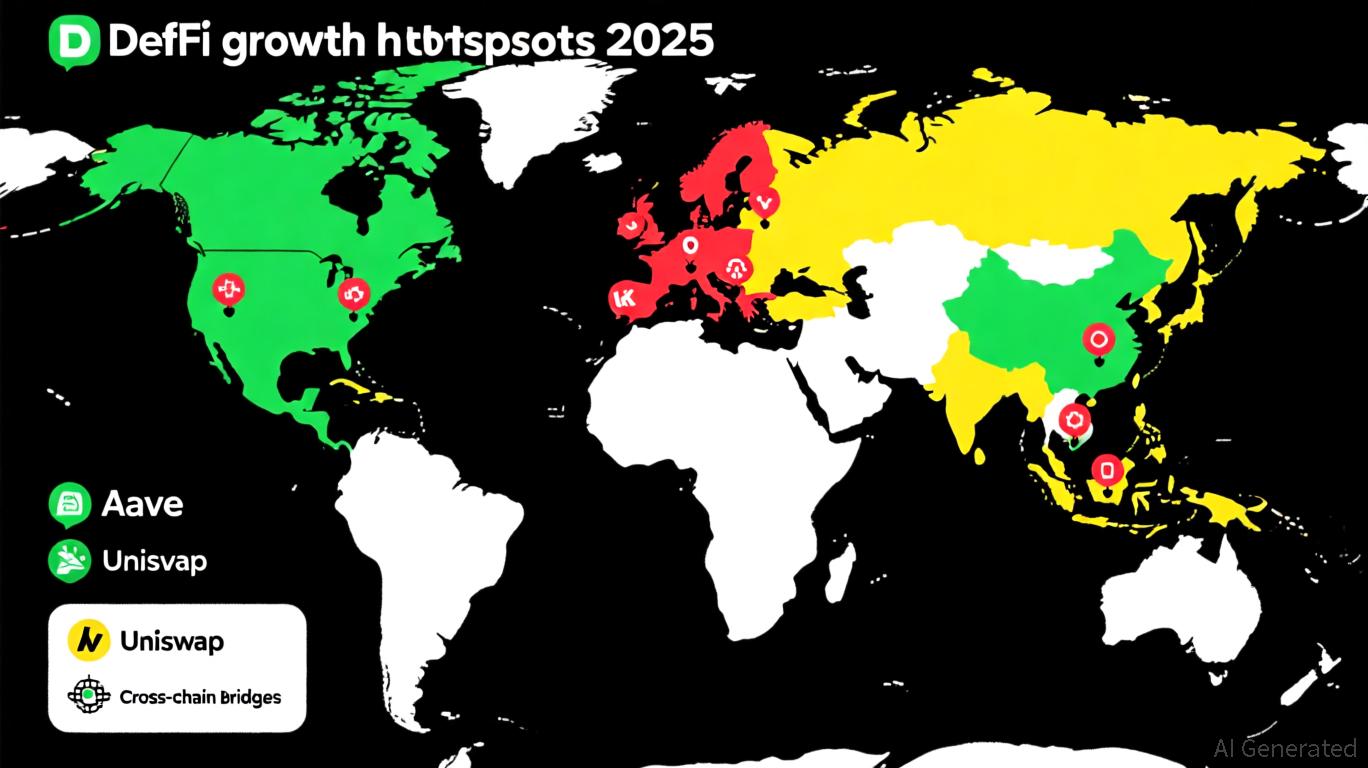
The Trump administration's pro-crypto agenda has transformed the U.S. into a DeFi innovation hub. The Digital Asset Market CLARITY Act, passed in July 2025, mandates dual SEC/CFTC registration for exchanges but also provides a clear compliance pathway for DeFi protocols, according to
. This regulatory clarity has spurred institutional interest, with and launching tokenized treasury products and real-estate platforms, as noted in .For investors, the U.S. offers opportunities in lending protocols (Aave, Compound) and liquid staking (Lido Finance), which now holds $30.8 billion in TVL, according to
. The Strategic Reserve Plan, aimed at stabilizing the dollar's crypto exposure, further legitimizes DeFi as a systemic financial tool, as Coruzant notes. However, risks persist: aggressive enforcement actions by the SEC could disrupt protocols lacking dual registration, according to .The European Union's Markets in Crypto-Assets (MiCA) regulation remains a double-edged sword for DeFi. While it mandates AML compliance and operational standards for crypto-asset service providers, its application to decentralized protocols remains ambiguous, as Quick Market Pitch observes. Discussions on MiCA 2.0 suggest potential licensing requirements for DeFi apps, which could stifle innovation but also create a more predictable environment for institutional players, according to a PwC report.
Investors in the EU should focus on cross-chain infrastructure and RWA tokenization, where demand for compliance-friendly solutions is rising, as Coruzant reports. However, the region's emphasis on systemic risk mitigation means slower adoption of cutting-edge protocols compared to the U.S. or Asia.
Hong Kong and Singapore have emerged as DeFi powerhouses by balancing innovation with consumer protection. Hong Kong's Stablecoins Bill and Singapore's licensing regimes allow DeFi protocols to operate within transparent frameworks, attracting global capital, according to a PwC report. These markets are particularly ripe for decentralized stablecoins and cross-chain bridges, which address the "last-mile" problem in cross-border transactions, as Wholesale Investor documents.
The Asia Pacific region's $351 billion DeFi boom is further fueled by institutional adoption, with BlackRock allocating $10 billion to tokenized treasuries, as CABCD notes. However, investors must monitor regulatory sandboxes for sudden policy shifts, as seen in China's periodic crackdowns on crypto activity.
Under the Labour government, the UK is positioning itself as a crypto-friendly alternative to the EU. New rules for staking services and crypto governance aim to attract DeFi businesses while maintaining financial stability, according to Quick Market Pitch. This structured approach appeals to investors seeking a middle ground between U.S. innovation and EU caution.
Opportunities in the UK include yield aggregators and decentralized exchanges (Uniswap V3, with $5.7B TVL), which benefit from the country's agile regulatory environment, as Quick Market Pitch observes. Yet, the UK's post-Brexit isolation in global financial markets could limit its long-term influence.
Sub-Saharan Africa and Latin America represent untapped DeFi potential, driven by financial inclusion and low-cost Layer-2 solutions. In Africa, RWA integration has created a $17.5 billion lending market with 7.8% average yields, Coruzant reports. Meanwhile, Latin America's 90% reduction in gas fees via Layer-2 scaling makes DeFi accessible to millions unbanked users, as Coruzant also notes.
Investors here must prioritize protocols with localized governance models and robust AML frameworks to navigate regulatory uncertainty.
DeFi's 2025 boom is a product of both technological progress and political will. As regulatory landscapes diverge, investors must align their strategies with regions that balance innovation with oversight. The winners will be those who anticipate policy shifts and invest in protocols that adapt to the new normal-where DeFi is no longer a fringe experiment but a cornerstone of global finance.

AI Product Manager at AInvest, former quant researcher and trader, focused on transforming advanced quantitative strategies and AI into intelligent investment tools.

Dec.22 2025

Dec.21 2025

Dec.16 2025
Dec.14 2025

Dec.11 2025
Daily stocks & crypto headlines, free to your inbox





Comments
No comments yet