
Decentralized Exchanges Hit Record as Bessent Targets 80% US AI Compute Share by 2028
 Aime Summary
- Treasury Secretary Scott Bessent projects US dominance in global AI computing power, targeting 80% share by 2028 driven by favorable regulatory and tax policies, positioning NvidiaNVDA-- as the primary beneficiary of accelerated domestic data-center buildout.
- SEBI's Demat 2.0 infrastructure enables simultaneous settlement of securities and payments on central bank digital rails, reducing reconciliation friction for institutional investors.
- VARA and SecuritizeSECZ-- have signed an MoU to advance regulated tokenized markets, leveraging Dubai's legal framework and Securitize's institutional-grade onchain infrastructure.
The global financial landscape is currently navigating a convergence of massive technological infrastructure shifts and regulatory modernization efforts. At the core of these developments is a strategic push to secure American dominance in artificial intelligence computing power, which is expected to reshape equity valuations and industrial productivity. Simultaneously, financial infrastructure is undergoing significant upgrades, with major markets introducing systems designed to reduce settlement friction and enhance the liquidity of tokenized assets.
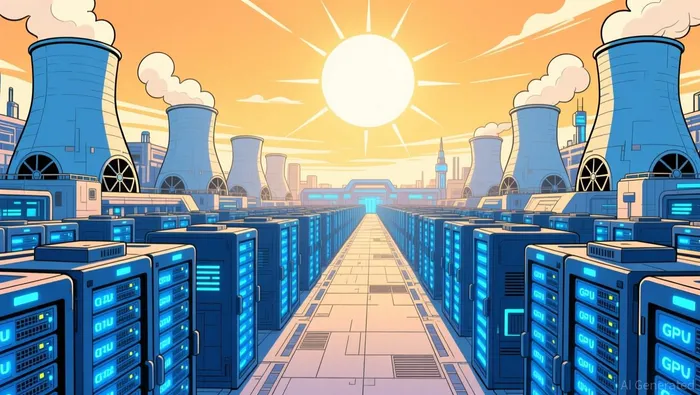
Treasury Secretary Scott Bessent recently characterized the US-China artificial intelligence competition as an existential struggle, warning that an American defeat would undermine other national efforts. Speaking at the Charlotte City Club, Bessent outlined a strategy to increase US computing power share from approximately 60% in 2025 to 80% by 2028. This ambitious target is supported by the Trump administration’s regulatory, tax, and energy policies designed to accelerate domestic infrastructure construction.
Nvidia (NASDAQ:NVDA) has emerged as the primary equity proxy for this compute-capacity thesis. The company’s data-center segment, which generated approximately $39 billion in its most recent quarter, serves as a direct financial measure of the 80% compute target. Accelerated domestic data-center construction translates directly into increased GPU demand, reinforcing Nvidia’s revenue and margin trajectory. Investors will seek confirmation of these trends during Nvidia’s fiscal third-quarter earnings report in November 2026.
Bessent also highlighted that AI adoption is shifting from a tech-sector narrative to a cross-market earnings driver. Established industrial and pharmaceutical companies are increasingly embedding machine intelligence into manufacturing tolerances, drug development timelines, and logistics networks. CEOs from Medtronic, Deere & Co., 3M, and Eli Lilly participated in a private-sector G20 session, citing their ecosystems as evidence that AI productivity gains extend beyond Silicon Valley.
On the domestic policy front, Bessent championed the 'Trump Accounts' program, which provides $1,000 investment seeds for children born during Trump’s second term. Noting that approximately 38% of US families lack stock market exposure, the initiative aims to give households 'skin in the game,' with over 7 million children already enrolled. Corporate adoption is accelerating to support this goal, with Goldman Sachs and Delta Air Lines announcing they will match the $1,000 federal seed contribution for eligible employees.
In parallel with these US policy shifts, significant advancements are occurring in global financial market infrastructure. SEBI's proposed Demat 2.0 system aims to modernize bond market infrastructure by allowing securities settlement and payment settlement to occur on the same digital rail, specifically central bank money. This approach targets the reduction of reconciliation delays, which industry experts identify as the primary source of friction in bond markets.
The pilot features REC, a regular issuer with an AAA-rated credit profile, to test the ecosystem across issuance, allotment, holding, settlement, and servicing. However, experts caution that this is a controlled pilot open to a select group of investors, featuring lock-in periods and no open secondary market yet. The true test of the infrastructure's value will be whether it translates into greater investor participation and secondary market liquidity.
In the digital assets space, the Virtual Assets Regulatory Authority (VARA) in Dubai and Securitize have entered a Memorandum of Understanding to advance regulated tokenized markets. This partnership leverages VARA's role in establishing Dubai's advanced legal framework for virtual assets, alongside Securitize's leading onchain infrastructure. Securitize, which manages approximately $5 billion in assets under management, operates regulated digital-securities infrastructure in both the U.S. and EU.
The collaboration focuses on supporting financial institutions exploring tokenization to modernize capital markets. Jurisdictions that combine regulatory certainty with institutional-grade infrastructure are expected to be best positioned for this evolution. The agreement reinforces Dubai's position as a leading global center for capital markets, facilitating a borderless economy through secure and compliant tokenized asset solutions.
How Will The US Compute Share Expansion Impact Nvidia?
The projected increase in US global computing power share to 80% by 2028 positions Nvidia as a central beneficiary of this trend. The company’s data-center segment, which generated roughly $39 billion in its most recent quarter, serves as the key financial metric for tracking the 80% compute target. While Nvidia does not publicly isolate revenue from US hyperscalers, the policy-driven acceleration of domestic data-center construction directly translates to increased GPU demand. This dynamic reinforces the company’s revenue and margin trajectory, making its fiscal third-quarter earnings in November 2026 a critical validation point for the thesis.
What Are The Implications Of SEBI's Demat 2.0 Pilot?
SEBI's Demat 2.0 system aims to reduce operational friction in bond markets by enabling simultaneous settlement of securities and payments on central bank digital rails. The immediate benefits for institutional investors include faster settlement, lower operational friction, and improved transparency across the bond lifecycle. The system utilizes existing trading infrastructure rather than creating a separate tokenized exchange, with coupon and redemption payments potentially automated through smart contracts. However, the pilot remains a controlled test with lock-in periods, meaning the broader market impact on liquidity will depend on future scaling and cybersecurity management.
How Does Dubai's Tokenization Strategy Differ From US Markets?
Dubai's approach to tokenized markets combines regulatory certainty with institutional-grade infrastructure through the partnership between VARA and Securitize. This collaboration leverages VARA's legal framework, which protects investors and sets international governance standards, alongside Securitize's ability to manage billions in assets. Unlike purely speculative digital asset markets, this initiative focuses on regulated tokenization to modernize capital markets, attracting top-tier asset managers like BlackRock, Apollo, and KKR. Jurisdictions that successfully integrate these elements are expected to lead the global evolution toward borderless, compliant asset solutions.

Blending traditional trading wisdom with cutting-edge cryptocurrency insights.
Latest Articles
Stay ahead of the market.
Get curated U.S. market news, insights and key dates delivered to your inbox.


AInvest
PRO
AInvest
PRO




Comments
No comments yet