
Which Decentralized Crypto Project Offers the Most Sustainable Growth in 2025?


 Aime Summary
In the rapidly evolving crypto landscape of 2025, investors are increasingly prioritizing projects that balance innovation with institutional credibility. While EthereumETH-- (ETH) and HederaHBAR-- (HBAR) remain dominant players, a new contender—BlockDAG—has emerged with a compelling value proposition. This article examines how BlockDAG's $383 million fundraising, audited infrastructure, and adoption metrics position it as a superior long-term investment compared to the short-term volatility of ETH and HBARHBAR--.
The BlockDAG Model: A New Paradigm for Scalability and Security
BlockDAG's hybrid Directed Acyclic Graph (DAG) and Proof-of-Work (PoW) architecture represents a breakthrough in blockchain scalability. With a transaction throughput of 15,000 TPS, it outperforms Ethereum's 30–45 TPS and rivals Solana's speed. This technical edge is critical for real-world applications, from decentralized finance (DeFi) to enterprise-grade solutions.
The project's $383 million presale, conducted through a gamified “Buyer Battles” model, has attracted both retail and institutional investors. Early participants in Batch 1 achieved a 2,660% return on investment, while the current presale price of $0.0276 (Batch 29) offers a projected 35x ROI if the token reaches its $1 launch price. This structured approach to capital raising, combined with a 50 billion BDAG token supply (70% allocated to community incentives), underscores a commitment to decentralization and long-term sustainability.
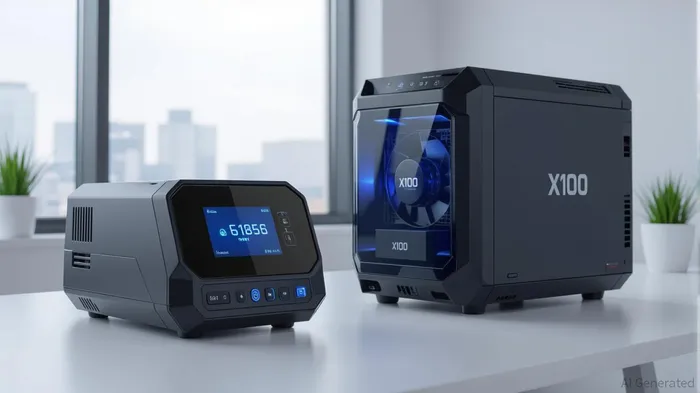
BlockDAG's infrastructure has been rigorously audited by Halborn and CertiK, two of the industry's most respected security firms. This institutional-grade validation, coupled with partnerships with global entities like Inter Milan and confirmed listings on CoinbaseCOIN-- and Gemini, reinforces its credibility. The project has also shipped 19,400 mining devices, including the X1 mobile miner and X100 industrial miner, ensuring a decentralized network from day one.
Ethereum's Dominance and Limitations
Ethereum remains the gold standard for smart contract platforms, with its Ethereum 2.0 upgrades enhancing scalability and energy efficiency. However, its energy consumption and transaction fees remain barriers for enterprise adoption. Despite a robust developer ecosystem and growing DeFi/NFT activity, Ethereum's market fundamentals are increasingly challenged by newer, more efficient architectures.
Institutional confidence in Ethereum is strong, evidenced by its inclusion in major investment products and growing TVL. Yet, its reliance on a Proof-of-Stake (PoS) model, while energy-efficient, introduces centralization risks. The platform's dominance is also threatened by competitors like BlockDAG, which offer faster transaction speeds and lower costs.
Hedera's Institutional Momentum and Technical Risks
Hedera (HBAR) has gained traction through its inclusion in Grayscale's Smart Contract Platform Fund (GSC), replacing PolkadotDOT-- (DOT) in July 2025. This 5.8% allocation, alongside Ethereum and SolanaSOL--, signals institutional recognition of its hashgraph consensus technology. Hedera's 500,000+ TPS and energy-efficient model are compelling, but its price volatility and reliance on a council of corporate entities (Google, IBMIBM--, etcETC--.) raise questions about decentralization.
HBAR's TVL grew by 37% in Q4 2024, reaching $169.8 million, but its market fundamentals remain speculative. The token's price has fluctuated between $0.15 and $0.375 in 2025, reflecting short-term investor sentiment rather than long-term utility. While Hedera's enterprise partnerships are valuable, its focus on niche use cases (e.g., supply chain management) limits its broader adoption potential.
Why BlockDAG Outperforms in Sustainability
BlockDAG's strengths lie in its balanced approach to innovation, security, and community engagement. Unlike Ethereum's energy-intensive PoW or Hedera's corporate governance, BlockDAG's hybrid model ensures scalability without compromising decentralization. Its audited infrastructure and real-world adoption (2.5 million X1 app users, 19,400 mining devices sold) provide a tangible foundation for growth.
The project's tokenomics further enhance its appeal. With 70% of tokens allocated to miners, ecosystem development, and liquidity pools, BlockDAG incentivizes long-term participation. This contrasts with Ethereum's PoS model, which prioritizes stakers, and Hedera's council-driven governance, which risks centralization.
Investment Implications for 2025
For investors seeking resilience in a volatile market, BlockDAG offers a compelling case. Its presale model, audited security, and hybrid architecture position it to capture market share from both Ethereum and Hedera. While Ethereum's fundamentals remain strong, its energy and scalability challenges make it a less attractive long-term bet. Hedera's institutional momentum is promising, but its volatility and limited use cases hinder its potential.
Actionable Advice:
1. Allocate to BlockDAG's presale while the price remains at $0.0276, as the projected 35x ROI before the mainnet launch is highly attractive.
2. Diversify exposure by holding Ethereum for its established ecosystem but avoid overcommitting to its energy-intensive model.
3. Monitor Hedera's TVL and TVL growth to assess its enterprise adoption, but prioritize projects with broader utility and decentralization.
In conclusion, BlockDAG's combination of technical innovation, institutional validation, and community-driven growth makes it a standout investment in 2025. As the crypto market matures, projects that prioritize sustainability and scalability—like BlockDAG—will outperform those reliant on short-term hype.

Decoding blockchain innovations and market trends with clarity and precision.
Latest Articles
Stay ahead of the market.
Get curated U.S. market news, insights and key dates delivered to your inbox.






Comments
No comments yet