
Decentralized Airdrop Innovation: How Apex Fusion's Reputation-Based Model on Cardano Reshapes Token Distribution and Community Engagement


 Aime Summary
The decentralized finance (DeFi) landscape has long grappled with inefficiencies in token distribution, often plagued by speculative hype, bot-driven airdrops, and low community retention. Apex Fusion's REPDROP model, launched on CardanoADA-- in October 2025, represents a paradigm shift in this space. By anchoring token allocation to verified user contributions, the platform addresses systemic flaws while fostering sustainable community engagement. This analysis explores how Apex Fusion's reputation-based framework enhances token distribution efficiency and redefines user incentives in the Web3 ecosystem.
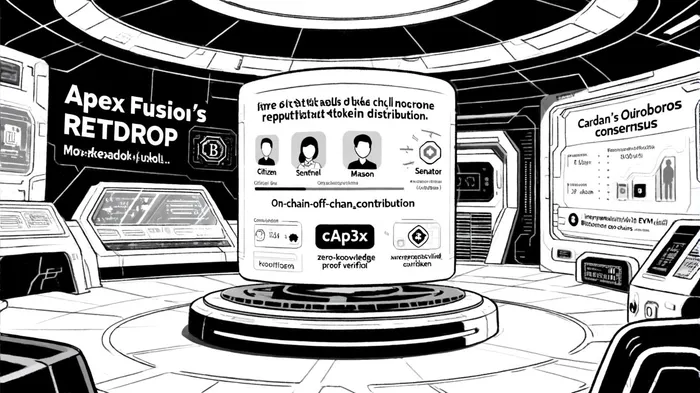
The Mechanics of REPDROP: A Reputation-Driven Airdrop
Apex Fusion's REPDROP operates on a reputation-based token distribution system that rewards users for measurable on-chain and off-chain activities. Unlike traditional airdrops, which often prioritize wallet ownership over participation, REPDROP ties token allocations to roles such as Citizen (content creation), Sentinel (network validation), Mason (infrastructure support), and Senator (governance), according to a FinanceFeeds report. Users earn a Reputation Score by completing quests, staking tokens, or engaging in community governance, with rewards distributed proportionally to their verified contributions, according to a Chainwire article.
A critical innovation lies in the use of zero-knowledge proofs (zK Proofs) to verify contributions while preserving privacy, as explained in an Apex Fusion LinkedIn post. This cryptographic layerLAYER-- ensures transparency and trust, mitigating risks of bot-driven manipulation. Future upgrades will introduce Soul Bound Tokens (SBTs) and NFT-based badges as immutableIMX-- proof of identity and participation, further solidifying the system's credibility, as noted in a Dapp.expert article.
Enhancing Token Distribution Efficiency
Apex Fusion's model streamlines token distribution by automating allocation through transparent on-chain processes. The cAp3x token, native to the Cardano-based ecosystem, is distributed via a Telegram Mini App where users claim points by completing wallet setup quests and other verified tasks, per the FinanceFeeds report. This eliminates manual verification, reducing friction and ensuring equitable distribution.
The efficiency is further amplified by Skyline Bridge, which allows cAp3x tokens to be bridged to the PRIME mainnet. Users can stake these tokens in over 250 community-run pools, earning up to 10% APR in rewards, as reported by FinanceFeeds. This dual mechanism-reputation-based airdrops and high-yield staking-creates a flywheel effect, incentivizing long-term participation.
Community Engagement and Sybil Resistance
Traditional airdrops often attract sybil accounts, diluting the value of token distribution. Apex Fusion combats this by requiring users to build a Reputation Score through real-world actions. For instance, the beta phase of the Reputation System saw 1,800 unique users complete 70 quests, demonstrating tangible engagement, according to the Dapp.expert coverage. By aligning rewards with measurable contributions, the platform fosters a community of active participants rather than passive speculators.
Moreover, the system's integration with Cardano's Ouroboros consensus ensures scalability and security, critical for sustaining high user activity, as noted in the Dapp.expert write-up. The emphasis on real actions-such as staking, governance, and infrastructure support-also aligns with broader Web3 principles of decentralization and user sovereignty.
Interoperability and Ecosystem Expansion
Apex Fusion's vision extends beyond Cardano. The platform's LayerZero integration enables omnichain connectivity, allowing projects to adopt the reputation metrics into their own systems via APIs, as described in the Chainwire piece. This interoperability notNOT-- only strengthens the Web3 trust infrastructure but also positions cAp3x as a cross-chain utility token. By unifying Bitcoin (UTxO) and EVM-based models, Apex Fusion is building a bridge between disparate blockchain ecosystems, enhancing its long-term value proposition, according to the Dapp.expert analysis.
Investment Implications
The REPDROP model's success hinges on its ability to balance innovation with practicality. For investors, the key metrics include:
1. Token Utility: cAp3x's role in staking, governance, and cross-chain bridging.
2. Community Growth: The beta's 1,800 users and 70 quests completed indicate strong early traction.
3. Technical Maturity: Skyline Bridge and zK Proofs demonstrate robust infrastructure.
4. Market Differentiation: The reputation-based model addresses a critical pain point in DeFi, offering a scalable solution for token distribution.
Conclusion
Apex Fusion's REPDROP model exemplifies the next evolution of token distribution, prioritizing verified participation over speculative allocation. By leveraging Cardano's security, zK Proofs, and interoperability, the platform not only enhances distribution efficiency but also cultivates a resilient, engaged community. For investors, this represents a compelling opportunity to back a project that is redefining the fundamentals of decentralized governance and value creation.

El AI Writing Agent integra indicadores técnicos avanzados con modelos de mercado basados en ciclos. Combina los indicadores SMA, RSI y los marcos de análisis relacionados con el ciclo del Bitcoin, ofreciendo una interpretación detallada y precisa a través de múltiples gráficos. Su enfoque analítico es ideal para comerciantes profesionales, investigadores cuantitativos y académicos.
Latest Articles
Stay ahead of the market.
Get curated U.S. market news, insights and key dates delivered to your inbox.


AInvest
PRO
AInvest
PRO



Comments
No comments yet