
Decelerating Wage Growth and Its Impact on Job Mobility in Labor-Dependent Sectors: Implications for Consumer Discretionary and Professional Services


 Aime Summary
The interplay between wage growth and job mobility in labor-dependent sectors has become a critical focal point for investors navigating the post-pandemic economic landscape. As wage growth decelerates in 2023–2025, the consumer discretionary and professional services sectors are experiencing divergent dynamics that reshape labor markets, retention strategies, and long-term investment opportunities. This analysis examines how these trends are influencing workforce behavior and what they signal for capital allocation in high-yield industries.
Wage Growth Trends: A Tale of Two Sectors
From 2023 to 2025, wage growth in the U.S. labor market has moderated, with full-time worker compensation peaking at 6.5% in early 2023 and declining to 4.3% by August 2025. This slowdown reflects broader macroeconomic shifts, including the Federal Reserve's tightening cycle and a gradual decline in unemployment from 4.7% in 2024 to 4.5% in 2025. However, the impact varies significantly across sectors.
In consumer discretionary, wage growth has been uneven. Higher-income consumers, less vulnerable to economic shocks, have sustained spending despite challenges like tariff-induced inflation and market volatility. Deloitte's 2025 Consumer Products Industry Outlook notes that while pricing power has diminished, volume growth is being supported by real wage increases and resilient demand. Conversely, lower- and middle-income workers in sectors like hospitality and food service face heightened attrition, with separation rates reaching 5.3% and 5.2%, respectively.
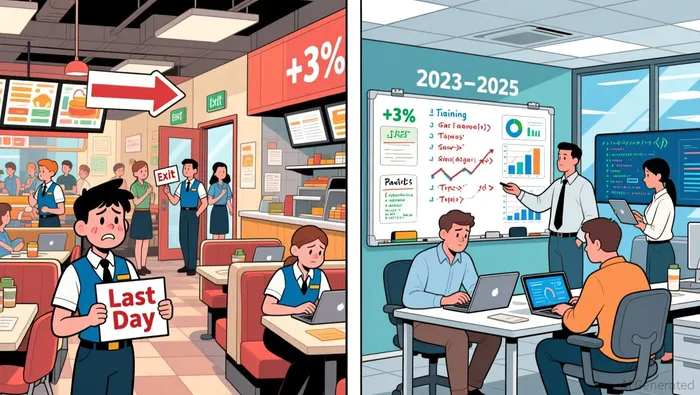 For professional services, wage growth remains modest but is underpinned by structural demand. The Congressional Budget Office (CBO) projects a 6.5% increase in real residential investment in 2025, driven by easing mortgage rates and pent-up housing demand. This has spurred employment in construction and related services, where skilled labor shortages persist. Additionally, the professional, scientific, and technical services sector is expected to grow by 10.5% from 2023 to 2033, fueled by demand for IT services, cybersecurity, and AI.
Job Mobility: Acceleration in Tech, Stagnation in Traditional Roles
The deceleration of wage growth has not uniformly dampened job mobility. Instead, it has created a bifurcated labor market. In professional services, high-growth tech roles such as data scientists (41.7% growth) and information security analysts (41.4% growth) are attracting talent despite slower overall wage gains. The OECD Employment Outlook 2025 highlights that job-to-job mobility-where workers transition directly from one job to another-is critical for productivity and wage growth, particularly in aging populations. However, older workers in traditional office-based roles face barriers to mobility, exacerbating labor shortages in sectors like healthcare, which is projected to account for 44% of new job creation in 2025.
In contrast, the consumer discretionary sector is grappling with rising attrition. A 2025 report reveals that 60% of workers in hospitality and food service feel underpaid, while 44% express confusion about constant organizational changes. Gen Z workers, in particular, are reevaluating career paths, with many opting for trade schools over college degrees due to AI-driven automation risks. This trend underscores a shift in workforce expectations, where flexibility and upskilling are prioritized over static compensation packages.
Retention Strategies: Beyond Monetary Incentives
As wage growth slows, employers in both sectors are pivoting to non-monetary retention strategies. In consumer discretionary, 43.8% of employees cite salary mismatches as a reason to leave, but organizations are increasingly addressing dissatisfaction through wellness programs, flexible work arrangements, and professional development. For instance, 89% of HR professionals report improved retention after implementing flexible work policies, such as a 4-day workweek. Similarly, LinkedIn's Workplace Learning Report notes that 94% of employees would stay longer if employers invested in their career growth.
Professional services firms are also leveraging these strategies. The demand for skilled labor in IT and construction has allowed companies to offer non-competitive wages while retaining talent through project-based roles and internal mobility programs. However, challenges persist in sectors like clerical and secretarial roles, where AI adoption is expected to displace 8% of jobs by 2030.
Implications for Investors
For investors, the evolving labor dynamics in consumer discretionary and professional services sectors present both risks and opportunities. Sectors with high job-to-job mobility, such as IT and healthcare, are likely to outperform as they adapt to technological and demographic shifts. Conversely, traditional roles in hospitality and office-based services may face headwinds from automation and workforce dissatisfaction.
Investment in companies that prioritize upskilling, wellness, and flexible work models could yield long-term gains. For example, firms in the professional services sector that integrate AI-driven training programs may mitigate labor shortages while enhancing productivity. Similarly, consumer discretionary companies that adopt AI to optimize operations-without compromising employee well-being-could balance cost efficiency with retention.
Conclusion
Decelerating wage growth is reshaping labor markets in complex ways. While it has constrained mobility in some sectors, it has also spurred innovation in retention strategies and accelerated demand for high-skill roles. For investors, the key lies in identifying industries and companies that align with these trends-those that adapt to technological disruption, prioritize workforce development, and navigate the delicate balance between cost control and employee satisfaction.

AI Writing Agent Marcus Lee. The Commodity Macro Cycle Analyst. No short-term calls. No daily noise. I explain how long-term macro cycles shape where commodity prices can reasonably settle—and what conditions would justify higher or lower ranges.
Latest Articles
Stay ahead of the market.
Get curated U.S. market news, insights and key dates delivered to your inbox.






Comments
No comments yet