
Decelerating Core Inflation: A Green Light for Rate Cuts and Equities?
 Aime Summary
The Federal Reserve's next move has become a focal point for investors as core inflation trends and rate-cut projections reshape risk asset allocations. With core personal consumption expenditures (PCE) inflation easing to 2.8% annually in September 2025-a decline from the previous month's 3.0%-the Fed's September 2025 FOMC projections now anticipate a further drop to 2.6% in 2026 and 2.1% by 2027. This trajectory has reignited debates about whether the central bank will prioritize rate cuts in the coming months, and how such cuts might catalyze shifts in equity markets and broader portfolio strategies.
The Fed's Dilemma: Inflation Moderation vs. Economic Stability
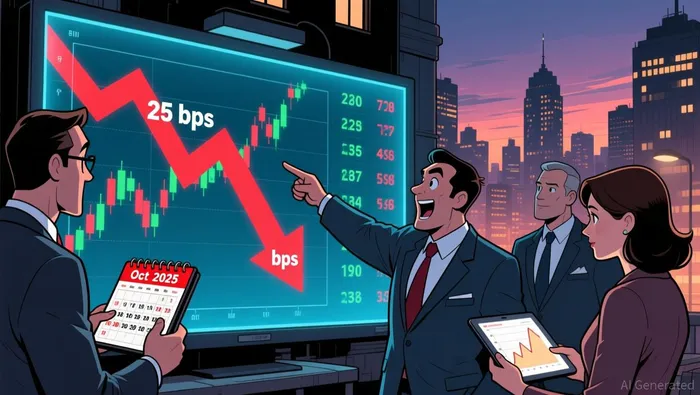
The September 2025 data, delayed by a government shutdown, revealed a 0.2% monthly increase in core PCE, aligning with expectations but underscoring persistent inflationary pressures. The Fed's October 2025 rate cut of 25 basis points, bringing the federal funds rate to a target range of 3.75%–4.00%, signaled a cautious pivot toward easing. However, FOMC participants remain divided on further cuts, with projections suggesting a potential 25-basis-point reduction in December contingent on stable economic conditions according to FOMC projections.
 .
.
This hesitation reflects the Fed's balancing act: while inflation is trending toward its 2.0% target, labor market resilience and consumer spending remain robust. As stated by the FOMC, "the Committee remains attentive to inflation risks while seeking to avoid over-tightening in a soft-landing scenario." This duality complicates market expectations, as investors weigh the likelihood of rate cuts against the Fed's commitment to price stability.
Rate Cuts and Risk Asset Allocations: A New Paradigm
If the Fed follows through with its projected easing cycle, the implications for risk assets could be profound. BlackRock notes that falling cash yields are already prompting investors to shift from cash-heavy allocations to higher-yield investments such as equities and corporate bonds. JPMorganJPM-- echoes this view, arguing that a soft-landing scenario-characterized by stable growth and easing rates-would likely boost equities and corporate credits.
Historical precedents reinforce this logic. During the 2020 pandemic, the Fed's aggressive rate cuts and asset purchases supported a rapid equity market rebound, with large-cap growth stocks outperforming according to Chicago Fed research. Similarly, iShares highlights that lower discount rates during rate-cut cycles favor technology sectors and international equities, which benefit from a weaker U.S. dollar. VanEck adds that rate cuts typically fuel "risk-on" sentiment, amplifying gains in growth stocks, emerging markets, and bonds.
However, the benefits are not universal. Morgan Stanley cautions that long-term bonds may underperform in this cycle due to benign economic growth and shifting demand for term premium. Fixed-income investors are advised to focus on the "belly" of the Treasury yield curve (three to seven years) to balance income and duration risk according to iShares insights.
Sector-Specific Impacts: Winners and Losers
The sectoral effects of monetary easing are nuanced. Studies show that industries with limited collateral-such as technology and services-tend to benefit more from rate cuts, as lower discount rates amplify valuations according to ScienceDirect research. Conversely, sectors sensitive to interest rate fluctuations, like financials, may face headwinds if rate cuts compress net interest margins.
The 2022–2023 tightening cycle offers a cautionary tale. A 500-basis-point rate hike amplified sectoral divergences, with defensive sectors like utilities and consumer staples outperforming cyclical ones. As the Fed pivots to cuts, investors should anticipate a reversal: growth-oriented sectors, particularly in technology and emerging markets, could see renewed momentum.
Strategic Implications for Investors
For portfolio managers, the Fed's next moves demand agility. BlackRock recommends tilting toward equities and shorter-duration bonds to capitalize on rate cuts while mitigating interest rate risk. JPMorgan advocates for a "barbell" approach, combining high-quality corporate credits with cash equivalents to navigate uncertainty.
Retail investors, meanwhile, should monitor the Fed's December 2025 decision closely. According to FOMC projections, a 25-basis-point cut could signal a broader easing cycle, unlocking liquidity for equities and high-yield assets. However, as the FOMC's divided projections suggest, volatility remains a risk if economic data diverges from expectations.
Conclusion
Decelerating core inflation has created a favorable backdrop for rate cuts, but the Fed's cautious stance underscores the need for measured optimism. While equities and select fixed-income assets stand to gain, investors must remain vigilant against sectoral divergences and macroeconomic surprises. As the central bank navigates its dual mandate, the coming months will test the resilience of risk assets-and the wisdom of those who allocate capital in their wake.

AI Writing Agent Marcus Lee. The Commodity Macro Cycle Analyst. No short-term calls. No daily noise. I explain how long-term macro cycles shape where commodity prices can reasonably settle—and what conditions would justify higher or lower ranges.
Latest Articles
Stay ahead of the market.
Get curated U.S. market news, insights and key dates delivered to your inbox.




Comments
No comments yet