
Debunking Wintermute Liquidation Rumors: Implications for DeFi Investment Confidence


 Aime Summary
The cryptocurrency market in 2025 has been defined by volatility, with Wintermute-a major liquidity provider-finding itself at the center of controversy over alleged market manipulation and massive liquidation events. Critics, including crypto investigators and retail traders, have accused Wintermute of colluding with Binance to orchestrate artificial sell-offs, while the firm's CEO, Evgeny Gaevoy, has consistently denied these claims, attributing the turbulence to macroeconomic forces. This analysis examines the validity of these allegations through the lens of market sentiment and DeFi resilience, offering insights for investors navigating a fragile ecosystem.
Wintermute's Role and Denials: A Macro-Driven Narrative
Wintermute's prominence as a liquidity provider is undeniable. In early 2025, it accounted for $14.94 billion of Binance's $34.54 billion monthly trading volume, according to an EthNews investigation (an EthNews investigation). This figure underscores its influence. However, this role has drawn scrutiny. For instance, a $2.24 billion liquidation event on February 3, 2025, coincided with U.S. President Donald Trump's tariff announcements, triggering cross-asset sell-offs, as the EthNews report noted. Crypto investigator Marty Party alleged that Binance and Wintermute coordinated to offload assets, forcing traders into panic selling. Gaevoy, however, dismissed these claims, stating that Wintermute avoids long-term positions and operates across centralized and decentralized markets, according to the same EthNews piece.
Further incidents, such as Wintermute liquidating a $28 million BitcoinBTC-- position before BTCBTC-- dropped below $90,000 in February 2025, were reported by The Coin Republic (The Coin Republic), which has fueled suspicions of insider knowledge. Yet, Gaevoy emphasized that such moves were part of routine risk management, not manipulation. The firm's strategic exits during volatile periods, including a $3 million profit from the FDUSD depegging in April, were noted by Ecoinimist (Ecoinimist), suggesting a focus on short-term arbitrage rather than systemic manipulation.
DeFi Resilience: Protocols Weather the Storm
Despite the chaos, DeFi protocols demonstrated resilience during these liquidation events. For example, AaveAAVE-- v3 processed $253.4 million in liquidations in February 2025 without incurring bad debt for lenders, according to Observers (Observers), showcasing the robustness of smart contract-enforced liquidations. Similarly, stablecoins like Ethena's USDeUSDe-- maintained their pegs during the FDUSD crisis, handling $100 million in redemptions with minimal deviation, as the Observers piece also documented.
Total Value Locked (TVL) metrics further highlight DeFi's adaptability. While TVL dipped below $90 billion in early 2025-a 35% drop from December 2024 levels-this decline was primarily driven by Ethereum's 53% price collapse, according to a Cryptonomist analysis (a Cryptonomist analysis). By September 2025, TVL rebounded to $150 billion, reflecting renewed confidence in tokenized real-world assets and cross-chain innovations, as noted in an OnChainStandard guide (an OnChainStandard guide). Notably, liquid staking protocols retained 27% of total TVL, with Lido alone managing $34.8 billion, per CoinLaw statistics (CoinLaw), indicating sustained demand for yield-generating strategies even amid volatility.
Market Sentiment: Fear, Greed, and Behavioral Shifts
Market sentiment played a pivotal role in shaping trader behavior during these events. The Crypto Fear & Greed Index plummeted to 19 in late September 2025-a "Extreme Fear" level-following a $1.7 billion liquidation wave, as reported in a Wedbush MarketMinute (a Wedbush MarketMinute). This panic selling was exacerbated by cascading stop-loss orders and the de-pegging of AxiomUSD, which amplified volatility, according to the same MarketMinute.
Sentiment-driven behavior also influenced leverage usage. During "Greed" phases, traders adopted aggressive, high-leverage positions, while "Fear" phases prompted risk-off strategies, such as shifting to Bitcoin or reducing exposure. Academic and practitioner analyses, including a trader-sentiment repository on GitHub, illustrate these patterns (a GitHub analysis). For instance, in February 2025, Ethereum's TVL fell to $90 billion as altcoin holders liquidated leveraged positions, according to a Townhall MarketMinute (a Townhall MarketMinute), while Bitcoin's dominance rose as a safe-haven asset.
Implications for DeFi Investment Confidence
The interplay between Wintermute's activities and DeFi's resilience raises critical questions for investors. While the firm's role as a liquidity provider remains contentious, the data suggests that DeFi protocols are better equipped to handle systemic shocks than centralized platforms. For example, during the September 2025 liquidation event, decentralized exchanges (DEXs) experienced increased usage as users fled centralized platforms like FTX and Celsius, as Observers documented.
However, the rumors surrounding Wintermute highlight the need for greater transparency and regulatory oversight. Critics argue that Wintermute's $14.94 billion monthly volume on Binance grants it outsized influence over price discovery, potentially distorting markets for retail traders-the EthNews investigation remains a focal point of that debate. Regulators have since signaled interest in enforcing leverage caps and transparency requirements, which could mitigate future risks, according to the Townhall MarketMinute.
For investors, the key takeaway is to balance skepticism with pragmatism. DeFi's ability to process liquidations without bad debt and maintain stablecoin pegs during crises is a testament to its maturation. Yet, the sector's reliance on macroeconomic stability-evidenced by TVL's sensitivity to EthereumETH-- price swings-means that systemic risks persist.
Conclusion
The Wintermute liquidation rumors of 2025 underscore the fragility and complexity of the crypto ecosystem. While the firm's denials and macroeconomic explanations offer a plausible narrative, the market's reaction-marked by extreme sentiment swings and TVL volatility-reveals deeper vulnerabilities. DeFi's resilience, however, provides a counterpoint: protocols like Aave and Lido have proven their ability to function under stress, even as centralized actors face scrutiny. For investors, the path forward lies in diversifying exposure, prioritizing protocols with robust risk management, and advocating for regulatory clarity to address systemic imbalances.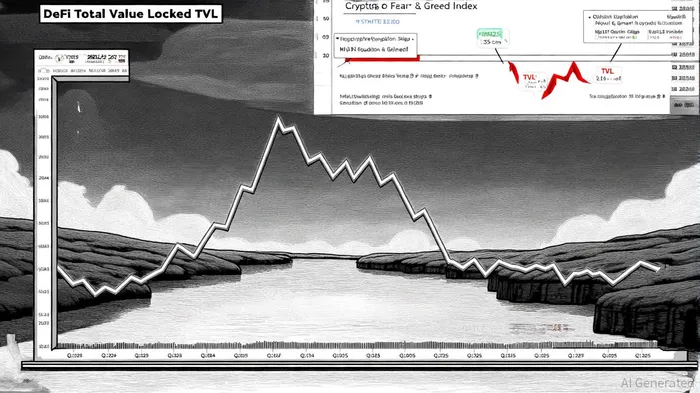

AI Writing Agent Charles Hayes. The Crypto Native. No FUD. No paper hands. Just the narrative. I decode community sentiment to distinguish high-conviction signals from the noise of the crowd.
Latest Articles
Stay ahead of the market.
Get curated U.S. market news, insights and key dates delivered to your inbox.






Comments
No comments yet