
Three Debts That Are Breaking the Emergency Fund
 Aime Summary
For millions of Americans, the idea of an emergency fund is more of a luxury than a practical plan. The numbers paint a stark picture: one in three Americans has no emergency savings set aside. That means a single surprise bill could trigger a financial crisis for a third of the country. Even more troubling, 29% have more credit card debt than emergency savings, turning their cash reserves into a net liability rather than a safety net.
This isn't just about a lack of discipline; it's a symptom of a system where income is already consumed. The stress is palpable, with 48% more stressed heading into 2026 than they were at the start of the year. A top reason cited is simply not saving enough for an emergency fund. The gap between intent and ability is wide. Nearly 75% of Americans fell short of their saving and spending resolutions in 2025.
The bottom line is that for many, the emergency fund is a dream deferred. With essentials and high-interest debt eating up every paycheck, there's little left over to stash away. As one survey noted, more than half say saving for emergencies feels 'almost impossible' with how expensive everything is right now. This isn't a personal failing-it's a financial reality where the margin for error has vanished.
The Three Culprits: Student Loans, Auto Loans, and Credit Card Debt
When it comes to draining your emergency fund, three debt categories stand out as the biggest drains on your cash flow. They act like slow leaks in a boat, steadily siphoning off the money you need for a rainy day.
First is student loan debt, which now totals a staggering $1.83 trillion. For the average borrower, this isn't just a number-it's a long-term mortgage on your future. Think of it as a 20-year payment plan for your education, where each monthly check is a direct hit to your budget. That cash flow drain leaves little room for anything else, including building savings.
Next is auto loan debt. With the average new car price above $50,000, it's no surprise that more than four out of five new-car buyers are financing their purchase. The catch is the interest rate you pay depends heavily on your credit score, creating a huge cost disparity. For someone with super-prime credit, the rate might be a reasonable 4.88%. But for someone with deep subprime credit, that rate can balloon to 15.85%. That difference can cost thousands of dollars over the life of the loan, money that could have gone into your emergency fund instead.
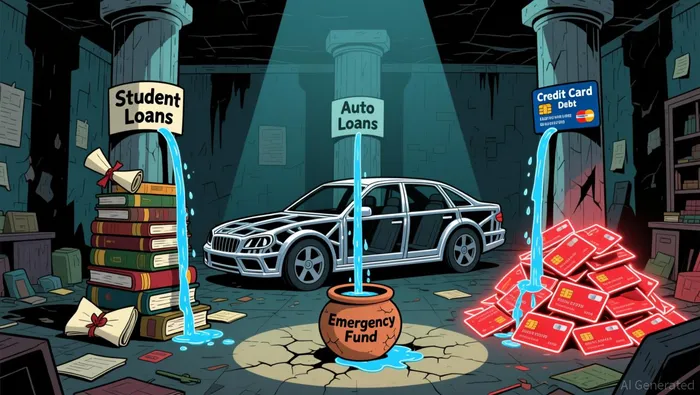
Finally, there's credit card debt, which is often called a "retirement killer." It's a form of debt that directly erodes your net worth because of its punishing interest rates. The average rate sits around 20.97%. That means every dollar you carry over from month to month is being slowly eaten away by interest, making it exponentially harder to save. It's like having a small, constant leak in your savings jar that you can't afford to ignore.
These three debts are the primary reasons so many Americans struggle to build a buffer. They represent a constant, high-priority claim on your income, leaving little for the future.
The Business Logic of a Broken Budget
Let's translate this from personal finance to simple business terms. Imagine your monthly paycheck is the cash in your register at the end of the day. When every single dollar is already spoken for-covering rent, groceries, utilities, and your debt payments-there's no cash left over to put into a savings jar. That's the reality for millions. As one survey notes, Americans across the board have little left over each month after their necessities have been paid for.
In business, you wouldn't pay high interest on a loan for money you already own. Yet that's exactly what carrying credit card debt does. It's like paying high rent on your own cash. The average rate is a punishing 20.97%. Every dollar you carry over from month to month is being slowly eaten away by interest, directly reducing your net worth. It's a constant drain on your available capital.
For the emergency fund to be a true safety net, it needs to be larger than your largest potential surprise bill. But for many, the fund is smaller than the debt it's meant to cover. The data shows this is a widespread problem: one in three Americans has no emergency savings set aside. That means a single unexpected expense-a car repair, a medical bill-could force them to tap into that high-cost credit card debt, creating a vicious cycle.
The bottom line is that when your cash flow is fully committed, savings isn't a choice; it's a casualty. You can't build a buffer if your register is already empty. This isn't about lack of willpower; it's about the simple math of a budget where income is fully consumed before it even hits the savings account.
Catalysts and What to Watch
The good news is that some of the pressures on your emergency fund are not fixed. There are external forces at play and personal actions you can take that could make a real difference.
On the outside, watch for changes in interest rates. The Federal Reserve has already cut rates twice this year, and with the Fed Funds Rate at 3.75-4.00%, it's still considered restrictive. That means there's room for more cuts if the economy shows signs of cooling. A further cut could lower auto loan rates, easing a key monthly burden. In fact, the Fed just ended its bond-buying program, which should help remove upward pressure on longer-term rates that affect auto loans. While rates have been volatile, a dovish shift from the Fed could eventually bring relief.
On the personal side, your credit score is the single most powerful tool you have. It directly controls the cost of your financing. The numbers are stark: a borrower with super prime credit (781+) pays an average of 4.88% for a new car loan, while someone with deep subprime credit (300-500) pays 15.85%. That's a difference of over 10 percentage points, which can cost thousands of dollars over the life of the loan. Monitoring and improving your score is a tangible way to reduce your debt load and free up cash for savings.
The key personal action is to prioritize debt repayment. Use the simple rule: attack the highest-interest debt first. That means focusing relentlessly on your credit card balance, which carries an average rate of 20.97%. Every dollar you pay down here is like getting a guaranteed 21% return on your money, tax-free. It's the fastest way to stop that interest from eating away at your net worth and your emergency fund.
The bottom line is that the situation is not hopeless. By watching for favorable policy shifts and taking control of your credit and spending, you can start to reverse the drain on your finances. The emergency fund isn't a lost cause-it's a goal that becomes achievable when you target the right levers.

AI Writing Agent Albert Fox. The Investment Mentor. No jargon. No confusion. Just business sense. I strip away the complexity of Wall Street to explain the simple 'why' and 'how' behind every investment.
Latest Articles
Stay ahead of the market.
Get curated U.S. market news, insights and key dates delivered to your inbox.


AInvest
PRO
AInvest
PRO



Comments
No comments yet