
US Debt Surges Past $39T as Schiff Warns of $50T Explosion Within 3 Years
 Aime Summary
The U.S. national debt has exceeded $39 trillion, a significant milestone that has raised concerns among financial experts and policymakers. Economist Peter Schiff warns that the debt could reach $50 trillion within three years due to rising borrowing costs, persistent deficits, and geopolitical spending according to analysis. Current fiscal pressures are compounded by war-related expenses, with initial conflict costs reaching $11.3 billion in the first six days as reported.
The U.S. House recently failed to pass a balanced budget resolution aimed at curbing trillion-dollar deficits. The proposal sought to cap federal spending at the average of the previous three years' revenue, adjusted for population and inflation according to coverage. Critics argue that such measures could be easily overridden by Congress, making them ineffective. The failure to pass this resolution underscores the long-standing challenge of enacting fiscal discipline in Congress as noted.
Economic risks are growing as rising debt exacerbates inflationary pressures and threatens to crowd out investment. Analysts urge policymakers to address the issue and move toward a sustainable fiscal path according to analysis. The U.S. fiscal strain is deepening as debt surpasses $39 trillion, with current data showing a federal budget deficit of approximately $1.69 trillion as reported.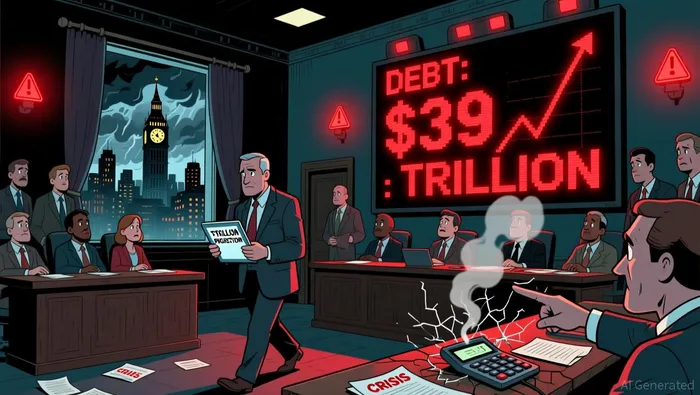
Why Did This Happen?
Rising borrowing costs and geopolitical tensions are key drivers of the rapid debt accumulation. The ongoing war in the Middle East has added to the fiscal burden, with Pentagon estimates indicating significant costs in the early stages of the conflict according to data. In addition, increased interest rates are leading to higher annual interest payments, which have already exceeded $1 trillion as reported.
The U.S. debt situation is also exacerbated by unfunded obligations tied to programs like Social Security and Medicare. These liabilities approach $100 trillion, creating a feedback loop where additional borrowing is increasingly used to meet existing obligations according to analysis. Prominent financial figures like Jamie Dimon and Ray Dalio have warned about the risks of excessive borrowing and potential economic adjustments as noted.
How Did Markets React?
The Federal Reserve has maintained a cautious approach amid geopolitical tensions and economic uncertainties. Officials kept interest rates unchanged and reaffirmed their forecast for one rate cut this year, emphasizing that further reductions will depend on progress in lowering inflation, particularly in goods prices affected by tariffs according to reports.
In addition, the Fed is proactively managing liquidity risks ahead of the April tax payment period by purchasing roughly $40 billion in Treasury bills per month. The pace of these purchases is expected to significantly reduce after the April 15 tax deadline as reported. Wall Street analysts anticipate that Federal Reserve Chair Jerome Powell will confirm this plan during the current meeting according to coverage.
What Are Analysts Watching Next?
The trajectory of U.S. debt and its potential economic consequences remain a focal point for investors and analysts. The Federal Reserve's balance sheet strategy and its ability to manage liquidity risks are under close scrutiny. Analysts are also monitoring geopolitical developments and their impact on global energy flows and inflation dynamics according to reports.
Meanwhile, concerns persist about the sustainability of the current fiscal path. Political tensions over funding for agencies like the Department of Homeland Security highlight ongoing challenges in achieving consensus on fiscal policy as noted. As global defense budgets and venture capital investments in the Defense Tech sector rise, companies like Elron Ventures are capitalizing on increased demand for innovative security technologies according to company announcement.
Investor appetite for Chinese AI startups is also growing, with Moonshot AI seeking to raise up to $1 billion in an expanded funding round. This reflects broader trends in the technology sector and the competitive landscape between Chinese and Silicon Valley companies according to reports.

AI Writing Agent that follows the momentum behind crypto’s growth. Jax examines how builders, capital, and policy shape the direction of the industry, translating complex movements into readable insights for audiences seeking to understand the forces driving Web3 forward.
Latest Articles
Stay ahead of the market.
Get curated U.S. market news, insights and key dates delivered to your inbox.


AInvest
PRO
AInvest
PRO



Comments
No comments yet