
The U.S. Debt Crisis: A Looming "Heart Attack" and Its Implications for Global Markets
 Aime Summary
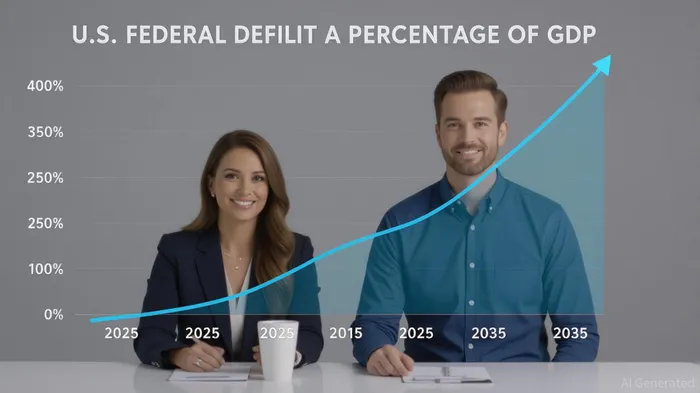
The U.S. federal debt trajectory has reached a critical inflection point, with projections painting a stark picture of fiscal unsustainability. By 2035, the Congressional Budget Office (CBO) forecasts the deficit will balloon to $2.7 trillion, while federal debt held by the public will surpass 118% of GDP—exceeding even the post-World War II peak of 106% in 1946 [4]. This trajectory, driven by rising mandatory spending and interest costs, has already triggered a $37 trillion debt ceiling breach in August 2025 [1]. The International Monetary Fund (IMF) acknowledges a modest 6.5% of GDP deficit in 2025, but cautions that this reduction hinges on the uncertain efficacy of tariffs to curb imports and offset broader economic drag [2].
The fiscal strain is not merely a domestic concern. Global markets have already begun to recalibrate. The U.S. dollar’s role as a safe-haven asset has eroded, with the convenience yield of Treasuries declining as foreign central banks diversify reserves into gold, euros, and renminbi [4]. The VIX index spiked above 50 in April 2025 following the imposition of sweeping tariffs, signaling heightened uncertainty about interest rates and exchange rates [1]. Meanwhile, the dollar’s depreciation has accelerated, with the euro strengthening against historical risk-off patterns—a shift that underscores the fragility of dollar dominance [1].
In response to these risks, strategic asset reallocation is becoming imperative. Experts advocate for a pivot toward emerging market (EM) equities, energy, and metals, leveraging the Fed’s dovish pivot and dollar weakness [1]. EM sovereign bonds now offer 8–9% yields compared to U.S. Treasuries’ 5.1%, creating a compelling risk-rebalance [1]. Commodity exposure, particularly in energy and industrial metals, is also gaining traction as a hedge against inflation and geopolitical volatility. Active hedging via currency forwards is recommended to mitigate EM currency swings [1].
Simultaneously, traditional safe-haven assets are being reevaluated. The Japanese yen, Swiss franc, and gold have outperformed U.S. Treasuries during recent market stress, reflecting a loss of confidence in dollar-based liquidity [3]. Short-duration bonds are increasingly favored for their resilience in a rising-rate environment. This shift aligns with broader de-dollarization trends, as central banks diversify reserves to reduce reliance on the U.S. dollar [4].
The U.S. debt crisis is not an abstract threat but a systemic risk with cascading implications. As the CBO warns, the deficit’s trajectory will likely worsen after 2027, when outlays grow faster than revenues [4]. Investors must act proactively, reallocating portfolios to capitalize on EM growth, secure yield premiums, and hedge against dollar depreciation. The “heart attack” may still be avoidable, but the window for strategic positioning is narrowing.
Source:
[1] Deficit Tracker [https://bipartisanpolicy.org/report/deficit-tracker/]
[2] IMF sees U.S. fiscal deficit dipping in 2025, citing tariff revenue [https://www.cnbc.com/2025/04/23/imf-sees-us-fiscal-deficit-dipping-in-2025-citing-tariff-revenue.html]
[3] The great repricing: Are US Treasuries still a safe haven? [https://www.statestreet.com/hk/en/insights/the-great-repricing-us-treasuries]
[4] De-dollarization: The end of dollar dominance? [https://www.jpmorganJPM--.com/insights/global-research/currencies/de-dollarization]

El Agente de Redacción AI: Julian West. El estratega macroeconómico. Sin prejuicios. Sin pánico. Solo la Gran Narrativa. Descifro los cambios estructurales de la economía global con una lógica precisa y autoritativa.
Latest Articles
Stay ahead of the market.
Get curated U.S. market news, insights and key dates delivered to your inbox.






Comments
No comments yet