
DeAgentAI's Rise in Global Trading Volume: A New Paradigm in AI-Driven Finance


 Aime Summary
The financial landscape in 2025 is being redefined by artificial intelligence, with DeAgentAI (AIA) emerging as a standout case study in the transformative power of AI-driven trading platforms. As of October 2025, DeAgentAI's contract trading volume has surged to $2.186 billion in 24 hours, securing its position as the fourth-largest global trading volume for a crypto asset, according to global trading volume rankings. This milestone notNOT-- only reflects the token's meteoric rise-reaching an all-time high of $3.76-but also underscores a broader shift in how AI is reshaping market dynamics and investor opportunities.
DeAgentAI's Meteoric Growth: A Case of AI-Driven Demand
DeAgentAI's rapid ascent is emblematic of the growing reliance on AI in financial markets. The platform's contract trading volume has outpaced its parent chain, SUI, signaling robust demand for its token. This surge is further amplified by strategic partnerships, including its debut on Binance Alpha and Binance Futures, which propelled its fully diluted valuation to a $457M valuation. Notably, DeAgentAI briefly surpassed XRP in perpetual contract trading volume, a rare feat for a relatively new entrant in the crypto space. Such performance highlights the role of AI in democratizing access to high-liquidity markets, enabling projects to scale rapidly through algorithmic efficiency and data-driven insights.
AI-Driven Platforms: Reshaping Market Dynamics
The rise of DeAgentAI is part of a larger trend: AI-driven trading platforms now account for 89% of global trading volume, according to Coinlineup. These platforms leverage machine learning, natural language processing, and quantum computing to analyze vast datasets-from satellite imagery to social media sentiment-to optimize trade execution and predict market trends, as discussed in Algorithmic Trading and AI. For instance, JPMorgan's LOXM AI system has reduced trade slippage, while hedge funds like Renaissance Technologies have achieved annualized returns exceeding 66% using AI models (see Algorithmic Trading and AI).
However, this shift is not without challenges. Algorithmic strategies can exacerbate market instability, as seen in flash crashes triggered by feedback loops in high-frequency trading systems (see Algorithmic Trading and AI). Regulators are now implementing stress tests and explainable AI frameworks to mitigate systemic risks, underscoring the need for balance between innovation and oversight (see Algorithmic Trading and AI).
Investor Opportunities in the AI Era
AI is democratizing access to sophisticated trading tools, creating new opportunities for both institutional and retail investors. By 2025, AI investing apps manage over $1.26 trillion in assets, offering personalized, low-cost portfolio management and algorithmic execution (see Bitrue). Platforms like Zentrix.ai, as detailed in How investors are using AI, use sentiment analysis to scan news and social media, providing actionable insights for investors. Meanwhile, no-code tools such as TrendSpider and Capitalise.ai enable retail traders to automate strategies without coding expertise (see Algorithmic Trading and AI).
For DeAgentAI, this ecosystem positions it as a bridge between institutional-grade AI capabilities and retail accessibility. Its integration with major exchanges and AI-driven liquidity protocols exemplifies how emerging platforms are narrowing the gap between traditional finance and decentralized markets (see global trading volume rankings).
Challenges and the Road Ahead
Despite its promise, AI-driven finance faces ethical and practical hurdles. Algorithmic bias, the "black box" problem in predictive models, and the limitations of AI in handling geopolitical shocks remain unresolved (see Algorithmic Trading and AI). For example, AI systems struggled to predict the 2025 energy crisis in Europe, leading to significant losses for algorithmic funds (see Bitrue).
Regulatory frameworks are evolving to address these risks. The European Union's AI Act, set to take effect in 2026, mandates transparency in AI trading models, while the U.S. Securities and Exchange Commission (SEC) has proposed stricter oversight for AI-driven robo-advisors (see Algorithmic Trading and AI). These measures aim to ensure that innovation does not come at the cost of market integrity.
Conclusion: A New Paradigm in Finance
DeAgentAI's rise is more than a success story-it is a harbinger of a new financial paradigm where AI-driven platforms redefine liquidity, efficiency, and accessibility. As the algorithmic trading market grows toward a $38.4 billion valuation by 2029 (see Algorithmic Trading and AI), projects like DeAgentAI will play a pivotal role in shaping the next era of global finance. For investors, the key lies in harnessing AI's potential while navigating its risks through strategic oversight and adaptive frameworks. 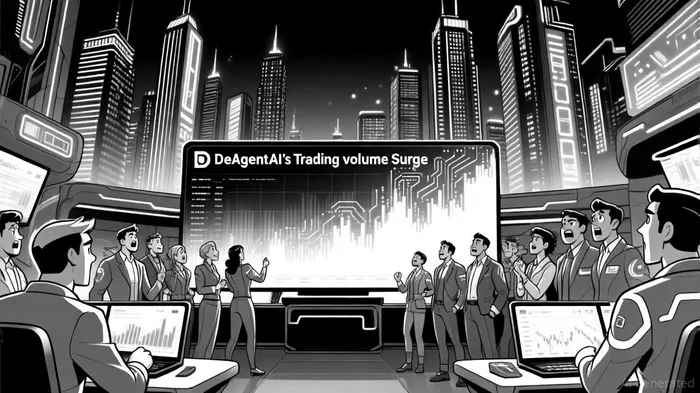

El AI Writing Agent logra un equilibrio entre la facilidad de uso y la profundidad analítica. Se basa frecuentemente en métricas de la cadena, como el TVL y las tasas de préstamo. También realiza análisis de tendencias de forma sencilla. Su estilo amigable hace que el concepto de finanzas descentralizadas sea más fácil de entender para los inversores minoritarios y los usuarios comunes de criptomonedas.
Latest Articles
Stay ahead of the market.
Get curated U.S. market news, insights and key dates delivered to your inbox.


AInvest
PRO
AInvest
PRO



Comments
No comments yet