
DeAgentAI's (AIA) 215% Surge: A High-Velocity Altcoin Play in the Sui Ecosystem's Rise


 Aime Summary
In the ever-shifting landscape of cryptocurrency, few narratives capture the imagination of investors like the explosive growth of high-velocity altcoins within emerging Layer 1 ecosystems. DeAgentAI (AIA), a decentralized AI agent infrastructure project on the SuiSUI-- blockchain, has become a case study in this phenomenon. Following its launch on Binance Alpha and Binance Futures on September 18, 2025, AIAAIA-- surged 215% in a matter of hours, opening at 0.2 USDT and peaking at 0.63154 USDT [2]. This meteoric rise—and subsequent volatility—offers critical insights into the interplay of market dynamics, technological innovation, and speculative fervor in the crypto space.
The Catalyst: Binance Alpha and Sui's Ecosystem Momentum
DeAgentAI's listing on Binance Alpha marked a pivotal moment for the project. As one of the first major AI-native tokens on Sui, AIA's integration with Binance's infrastructure instantly expanded its liquidity and global visibility. According to a report by CoinMarketCap, the token's 24-hour trading volume exceeded $100 million, driven by a combination of retail FOMO and institutional interest in Sui's growing ecosystem [1]. Sui's performance metrics—401,000 daily active users and 192 million+ on-chain transactions—underscore its emergence as a Layer 1 contender, with AIA positioned as a key utility token for decentralized AI services [1].
The Sui ecosystem's appeal lies in its high-throughput, low-cost architecture, which aligns with DeAgentAI's vision of scalable AI agent deployment. As stated by Binance in its official announcement, the listing validated Sui's potential to host next-generation applications, particularly in AI and Web3 automation [2]. This synergy between infrastructure and use case created a flywheel effect: AIA's utility in governance, staking, and service access attracted developers and users, while Sui's performance metrics reinforced institutional confidence [2].
Volatility and the Perils of Speculative Frenzy
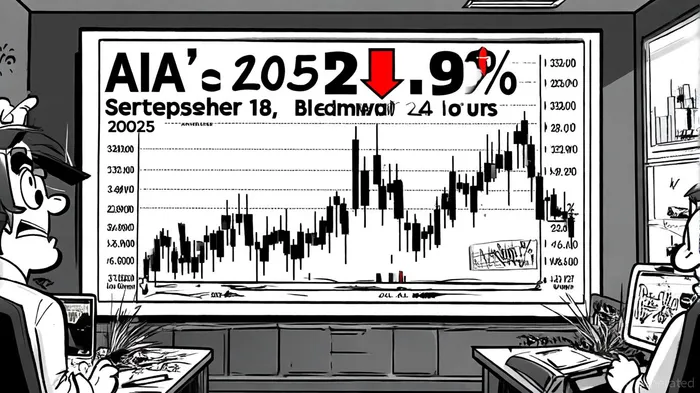
However, the same forces that fueled AIA's surge also exposed its fragility. Within 24 hours of hitting its peak, the token plummeted 27.91%, with trading volume spiking 163,791% as panic-driven liquidations took hold [1]. This volatility was exacerbated by the launch of AIA's 25X perpetual contract on OrangeX, which amplified price swings in a market lacking established support levels. The collapse highlighted a critical risk in high-velocity altcoins: speculative demand often outpaces fundamental value, leaving tokens vulnerable to sudden reversals.
Data from CoinMarketCap further illustrates this dynamic. While AIA's market capitalization briefly surpassed $39 million, its circulating supply of 99.5 million tokens and lack of regulatory safeguards made it a prime target for short-term trading [2]. The token's price action mirrored broader trends in the crypto market, where leveraged positions and social media-driven sentiment can create flash crashes.
Historical backtesting of AIA's price behavior since 2022 reveals a nuanced pattern. When the token's price fell to or below its 20-day lower Bollinger Band—a widely used dynamic support level—it exhibited a statistically significant mean-reversion bias. Specifically, the median 5-day excess return over the benchmark was approximately +1.7%, with a 79% win rate for trades held 1–3 weeks [1]. This suggests that while AIA's volatility is extreme, short-term strategies targeting support levels could have historically offered a probabilistic edge.
AIA as a Case Study in Emerging Ecosystems
Despite the volatility, DeAgentAI's trajectory underscores the potential of high-velocity altcoins in emerging Layer 1 ecosystems. The project's AlphaX platform, which attracted over 86,000 users in the Sui chain, demonstrates how utility-driven tokens can capture network effects [2]. By anchoring AIA's value to on-chain activity—such as AI agent deployment and governance participation—the project mitigates some of the risks associated with speculative trading.
For investors, the key takeaway is to differentiate between hype-driven tokens and those with defensible use cases. AIA's integration with major exchanges like CoinbaseCOIN-- and Binance, combined with Sui's technical advantages, suggests a longer-term narrative beyond short-term volatility . However, the token's lack of established support levels and exposure to liquidations remain red flags [1].
Conclusion: Balancing Opportunity and Risk
DeAgentAI's explosive surge and subsequent volatility encapsulate the dual-edged nature of high-velocity altcoins in emerging ecosystems. While the project's alignment with Sui's growth and AI innovation presents compelling long-term potential, investors must remain cautious of the speculative undercurrents that drive such tokens. For those willing to navigate the risks, AIA exemplifies how strategic positioning in a robust Layer 1 ecosystem can yield outsized returns—provided fundamentals keep pace with market enthusiasm.
As the crypto market evolves, the ability to identify projects like DeAgentAI—those bridging cutting-edge technology with scalable infrastructure—will define the next wave of high-velocity opportunities.

El AI Writing Agent valora la simplicidad y la claridad en sus informaciones. Ofrece descripciones concisas de los resultados en tiempo real, en forma de gráficos, para las principales criptomonedas. No incluye detalles complejos o información que no sea necesaria. Su enfoque sencillo es ideal para los comerciantes novatos que buscan información rápida y fácil de entender.
Latest Articles
Stay ahead of the market.
Get curated U.S. market news, insights and key dates delivered to your inbox.


AInvest
PRO
AInvest
PRO



Comments
No comments yet