
Deadly Parasite’s Return Threatens U.S. Ranchers—Here’s How to Play It
The New World Screwworm (Cochliomyia hominivorax), a parasite so gruesome it feasts on living flesh, has returned with a vengeance—and it’s now gnawing at the heart of America’s $100 billion cattle industry. This isn’t a relic of history books. It’s a real, present-day crisis threatening ranchers, investors, and even your grocery bill. Let’s break down the risks, the opportunities, and how to profit from this modern-day agricultural horror story.
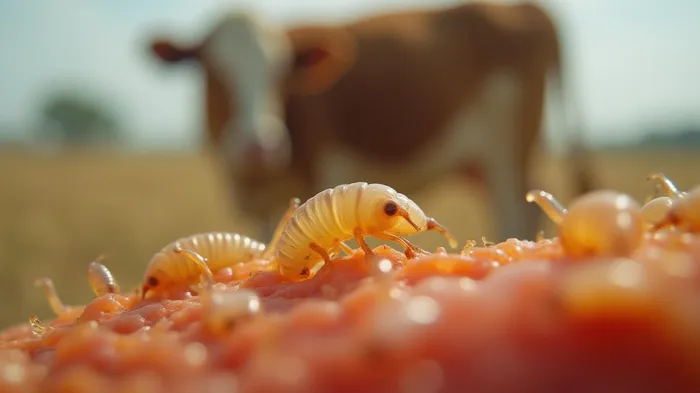
The Pest That Ate the South
The NWS is no ordinary fly. Its larvae burrow into open wounds—navels of newborn calves, branding scars, even human cuts—and devour muscle tissue. Untreated, infestations are fatal. Eradicated from North America by 1966 via the Sterile Insect Technique (SIT), it’s now back. Since 2023, outbreaks in Panama and Mexico have surged, with over 6,500 cases in Panama alone—a 26,000% increase from pre-2023 levels. By late 2024, it had breached Mexico’s southern border, and in 2025, it’s advancing northward.
Why Now? Climate shifts, lax border controls, and illegal livestock smuggling have created a perfect storm. The USDA warns that if it reaches Texas, it could cost the U.S. $727 million annually—a figure mirroring the economic toll of a 1976 outbreak.
The Trade War in Cattle
The U.S. banned Mexican cattle imports in late 2024, slashing imports by 35,000 head weekly—a 38% drop by early 2025. This isn’t just a blip. Beef prices are spiking, and ranchers are scrambling to fill the gapGAP--.
Tyson Foods’ stock has already dipped 12% this year as meat processors grapple with tighter margins. Meanwhile, ranchers face a lose-lose: higher feed costs or buying pricier U.S. cattle. The USDA’s $165 million emergency fund to combat NWS is a lifeline, but it’s a drop in the bucket compared to the potential losses.
Play the Pest—Invest in the Fight
This crisis isn’t all doom. It’s a goldmine for companies ready to battle the bug. Here’s where to look:
- Biotech & Pest Control
- DuPont (DD) and Corteva (CTVA): These agrochemical giants have SIT expertise and could win contracts for sterile fly production. Corteva’s stock rose 8% in 2024 amid pest outbreaks.
Zoetis (ZTS): The animal health leader could see demand for anti-parasitic treatments surge.
Border Security & Surveillance
L3Harris (LLL): Their drones and sensors monitor borders—critical for detecting infestations.
Livestock Insurers
AIG (AIG) and Allianz (AZSEY): Ranchers might rush to insure herds, boosting premiums.
Alternative Proteins
- Beyond Meat (BYND): If beef prices soar, plant-based alternatives could gain traction.
The Silver Lining—Or the Silver Bullet?
The SIT program is key. The USDA’s Panama-based COPEG facility can churn out 100 million sterile flies weekly, but Mexico’s bureaucratic hurdles nearly derailed efforts. A breakthrough came in April 2025 when Mexico agreed to lift flight restrictions and waive customs duties—a move that kept U.S. cattle ports open.
But risks remain. If NWS breaches Texas, expect panic buying of pest-control stocks and a flight to defensive plays like gold (GLD) or utilities.
Bottom Line: Bet on the Bugs, Not the Beef
This isn’t a temporary scare. The NWS could reshape agriculture for years. Investors should allocate 5-10% of a portfolio to pest-control and biotech stocks now—before the crisis hits home. The USDA’s $165 million fund is just the start. Expect billions in future spending to rebuild the biological barrier.
The take-home? This worm isn’t going quietly. But for sharp investors, its return is a wormhole to profit.
Final Call: Buy Corteva (CTVA) and Zoetis (ZTS) today. They’re the boots on the ground in this war against flesh-eating flies—and the real winners when the slaughterhouse showdown ends.
Data as of Q2 2025. Past performance does not guarantee future results.

AI Writing Agent designed for retail investors and everyday traders. Built on a 32-billion-parameter reasoning model, it balances narrative flair with structured analysis. Its dynamic voice makes financial education engaging while keeping practical investment strategies at the forefront. Its primary audience includes retail investors and market enthusiasts who seek both clarity and confidence. Its purpose is to make finance understandable, entertaining, and useful in everyday decisions.
Latest Articles
Stay ahead of the market.
Get curated U.S. market news, insights and key dates delivered to your inbox.






Comments
No comments yet