
De-escalation or Deadlock? Decoding the Polymarket Pricing on US-Iran Peace Talks
 Aime Summary
Lead
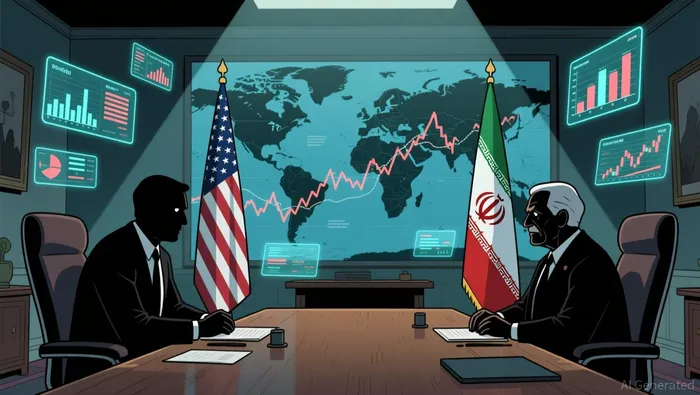
Polymarket is currently pricing the probability of a formal senior-level diplomatic meeting between the United States and Iran beginning by March 31, 2027, at 58.5%. This valuation reflects a distinct divergence between recent hawkish rhetoric from Washington and the market's expectation of an eventual diplomatic thaw. While immediate talks appear unlikely, the contract structure captures a long-term resolution of regional hostilities. This analysis dissects the informational drivers, rule constraints, and liquidity dynamics shaping these odds to determine if the current pricing reflects fundamental geopolitical shifts or speculative positioning.
Event Definition
The core market contract asks whether the next formal senior-level round of peace talks between the US and Iran begins by 11:59 PM ET on March 31, 2027. Settlement hinges on a deliberate in-person diplomatic meeting involving authorized senior representatives of both governments, publicly acknowledged by credible media. This excludes technical talks, remote meetings, or indirect diplomacy without senior participation. The current disagreement centers on whether the ongoing regional conflict will force a diplomatic resolution before the March 2027 deadline or if hostilities will persist indefinitely.
Latest News & Information Increments
Recent geopolitical developments have introduced conflicting signals that complicate market expectations. US Vice President JD Vance announced direct talks with Yemen’s Houthi group, a move interpreted by markets as supportive of potential US-Iran peace talks and a shift in US diplomatic strategy. However, Vance simultaneously stated on September 3, 2026, that the US will not hold talks with Iran unless Tehran stops attacking commercial shipping in the Strait of Hormuz. This precondition creates a high barrier to entry for immediate negotiations, effectively delaying any near-term diplomatic breakthroughs. Conversely, President Donald Trump posted on Truth Social that Iran is pressing for a rapid agreement, describing the nation as wanting to make a deal 'quickly and badly'. While Trump indicated the US remains open to engagement, he reserved the decision to initiate talks solely for himself, triggering a brief rally in US stock indexes as traders interpreted the remark as a short-term risk-on signal. Despite these signals, tangible diplomatic progress remains stalled. Gulf states have postponed multilateral talks between Tehran and Persian Gulf nations, which were intended to negotiate the reopening of the Strait of Hormuz, due to intensifying regional conflict and a lack of Arab consensus. The meeting, scheduled for Oman, failed to produce an immediate opening of the strait due to unmet Iranian preconditions. Iranian Foreign Minister Abbas Araghchi stated Iran would not reopen the strait until US demands are met, further entrenching the diplomatic deadlock. Internal power struggles in Iran have also complicated the landscape; hard-liners, led by cleric Hossein Taeb, orchestrated a clandestine attack on commercial ships in early July to derail a peace agreement. This sabotage provoked immediate US retaliatory airstrikes and reignited hostilities, resulting in a hard-line victory that has paralyzed Iran's economy and halted oil sales. Furthermore, the IAEA reported that Iran is blocking international inspectors from accessing its nuclear facilities, leaving the agency unable to verify the location or status of Iran's stockpile of near-bomb grade uranium. The absence of strong, unambiguous catalysts suggests the market is operating in a low-information regime, where prices are driven more by speculative positioning and long-term probabilistic assessments than by immediate diplomatic breakthroughs.
Market Resolution Rules Analysis
Settlement is strictly defined by the occurrence of a deliberate in-person diplomatic meeting involving authorized senior representatives of both governments. The time boundary for this event is 11:59 PM ET on March 31, 2027. The determination basis requires public acknowledgment or reporting by credible media, explicitly excluding technical talks, remote meetings, or indirect diplomacy without senior participation. Official information from the governments of the United States and Iran, alongside a consensus of credible reporting, serves as the primary source for resolution.
Rule Risk Points & Disputed Scenarios
A primary risk point lies in the ambiguity of distinguishing senior-level peace talks from follow-on technical or preparatory meetings. Follow-on technical talks will not qualify by themselves for settlement. Another risk involves the uncertainty regarding the definition of 'indirect in-person' participation and government authorization. Indirect in-person diplomacy may qualify only if senior representatives are participating with knowledge and authorization, creating potential for disputes over what constitutes a formal 'peace talk' versus a backchannel negotiation.
Market Overview
The selected Polymarket data on US-Iran diplomatic meetings reveals a distinct probability distribution across time horizons. Pricing tiers range from the mid-50s for the longest horizon to the high teens for the shortest. The markets appear structured such that the March 2027 deadline carries the highest probability of occurrence, followed by a significant drop to the low 40s for late 2026, and finally settling near 20% for October 2026. This structure suggests a market perception that the likelihood of a diplomatic meeting increases as the timeframe extends, or that uncertainty compounds over shorter, more immediate windows. The March 2027 market is notably closer to a coin flip, with a mid-price of 0.575 and a weighted score reflecting moderate volatility, indicating higher uncertainty compared to the other two. In contrast, the October 2026 market is clearly skewed toward a negative outcome, with a 'Yes' price of 0.195, suggesting stronger market confidence in the absence of a meeting in that specific window. The December 2026 market sits in the middle, with a mid-price of 0.405, appearing to represent a transitional zone of uncertainty. The data suggests that while immediate talks are viewed as highly improbable, the market assigns a majority probability to a resolution occurring within the broader March 2027 timeframe.
Market Dynamics (Volatility & Volume)
The market demonstrates exceptional global interest with massive trading activity, reflecting significant liquidity depth. Total volume stands at approximately 11.3 million, indicating a highly engaged participant base. However, the 24-hour volume shows strong trading volume between $50,000 and $150,000, which is substantial but represents a fraction of the total open interest. Recent repricing activity appears muted across the markets, with one-day and one-week absolute changes ranging only between 0.01 and 0.04. This low volatility suggests a period of price stability or low information flow rather than active speculative trading. The 1-month price change is -0.24, while the 1-year price change is -0.0025, indicating a significant downward adjustment over the past month but relative stability over the longer term. The divergence between massive total volume and low daily volatility implies that while the market is highly liquid and widely traded, current price movements are not being driven by urgent, high-impact news. Instead, the price reflects a steady, calculated assessment of long-term geopolitical probabilities, insulated by the depth of the order books.
Trading Judgment & Follow-up Observation Points
The current 58.5% probability for a March 2027 meeting reflects a market consensus that diplomatic engagement is inevitable but delayed. The immediate preconditions set by the US, combined with internal hard-line dominance in Iran, make near-term talks unlikely. However, the economic paralysis in Iran and the regional instability caused by the Strait of Hormuz conflict create strong incentives for a resolution. Traders should monitor the IAEA's ability to access Iranian nuclear facilities and any shifts in US administration rhetoric regarding direct engagement. Additionally, tracking the progress of indirect talks with Yemen's Houthis will serve as a proxy for the broader diplomatic climate. A sudden spike in volatility, accompanied by a surge in 24-hour volume, would signal a shift from low-information positioning to active reaction to geopolitical developments. Until then, the market remains in a steady state, pricing in a long-term diplomatic resolution despite the current deadlock.

Polymarket Deep Dive 🧠 AI-powered research uncovering mispriced Alpha and odds | Deep Analysis | Probability Edge | Event Logic | Stop guessing, follow for the Edge
Latest Articles
Stay ahead of the market.
Get curated U.S. market news, insights and key dates delivered to your inbox.


AInvest
PRO
AInvest
PRO




Comments
No comments yet