
DCC Is Pinned 175p Under Its £6,525 Takeover Offer. That Gap Is the Whole Trade.
 Aime Summary
Here is the chart event: DCC Energy — the Irish FTSE 100 distribution giant — closed near 6,350p on September 8, 2026, inching up just 25p (+0.4%) on a quiet 788,000-share session. A takeover target that was bid at 6,525p in cash trading below its own offer price looks like a free lunch. It is not. That ~175p gap is not a mistake. It is the market pricing in everything that can still go wrong between now and the day the deal closes — and it is the only piece of this chart that matters.
Let me pull the tape apart the way every contested chart should be read: what just changed, who is under pressure, which exact event decides whether the move accelerates or dies.
The setup: a stock pinned under a cash offer
In late July, a consortium vehicle called Dragon Bidco — funded by private equity firms Energy Capital Partners and KKR — agreed to buy DCC for roughly £5.75 billion (~$7.7bn). Holders get 6,525p in cash per share, on top of a dividend that stays with shareholders, versus the 5,004p three-month average the stock traded at before the bid. That is roughly a 30% premium to where the business sat before an offer period opened on April 29.
But here is the disconnect that should catch any analyst's eye: nearly six weeks after the boards agreed terms, the stock still sits below the cash on the table. If the deal were a done deal, price would have converged on the offer. It has not fully. The distance between where DCC trades (~6,350p) and what the buyer promised (6,525p) is about 2.7%. In takeover-land, that residual gap is the market's honest verdict on completion risk.
Who is now under pressure
Two groups are staring at this spread from opposite sides.
First, the holders who chased the run-up — anyone who bought DCC near or above the offer during the negotiation drama now holds a position whose ceiling is fixed. The bidder has already told the market it will not raise: the consortium is maintaining its offer. That commitment is the cap. Upside is structurally limited to the offer; downside is not. That is the definition of trapped inventory — inventory whose only realistic exit is selling into a capped cash offer they are currently slightly underwater on.
Second, the arbitrage buyers — funds that bought the stock at a discount to the offer specifically to harvest the ~2.7% spread if the deal closes on schedule. Their entire thesis rests on one thing: the vote and the completion timeline. They are not buying DCC's business; they are buying the probability that the paperwork finishes.
The one event that decides it
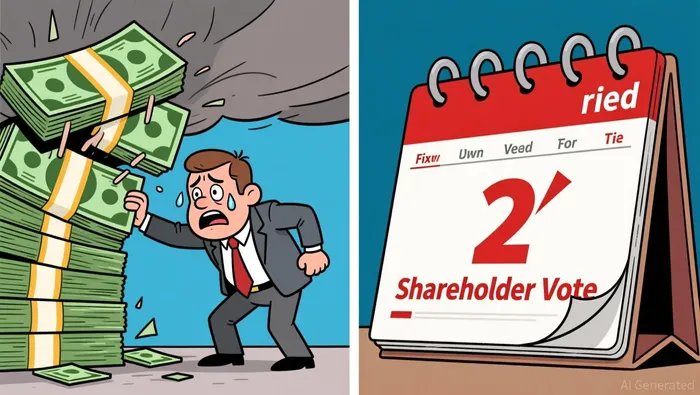
This is a situation where the trigger is an event, not a price level. The decisive date is , when DCC shareholders vote on the scheme of arrangement (proxy deadline September 16). The court in Ireland has already ordered the meeting convened. If shareholders approve, the deal is expected to complete in Q1 2027 — and the stock should grind toward the cash offer as that date approaches, shrinking the spread.
If the vote fails, or the deal otherwise breaks, the pressure flips violently: the ceiling disappears, and the reference point drops from 6,525p back toward the ~5,000p pre-bid trading zone — roughly 20% below the current price. That is the asymmetry to respect. A ~2.7% runway if you are right, against a potential double-digit gap if you are wrong, and weeks of waiting in between. Reward is small relative to risk and time. By my own rule — if the reward path is smaller than the distance to invalidation, reject the setup despite the drama — this is not a chase-worthy long on the spread.
What the flood of Form 8.3 filings actually tells you
Here is where the title of every boring regulator feed finally earns its keep. Under UK and Irish takeover rules, any fund holding 1% or more of a target must disclose its position and each day's dealings — the Form 8.3. On September 9, of DCC (1,874,643 shares) as of September 8. The telling detail is in the dealing line: Marathon sold a grand total of 153 shares.
That tiny print is the participation read. A 2.19% holder who moves almost nothing is not a trader flipping conviction into price; that is a long-term institutional holder sitting still through the process. It tells you volume is not coming from a crowd aggressively closing the spread — it is thin, event-driven trading while the clock runs to the vote. Low volume, a capped ceiling, and a wide-ish remaining gap: this is the calm, not the opportunity.
A necessary honesty for U.S. readers
One flag before anyone acts on this: DCC is not a U.S. common stock. It trades in London (LSE: DCC), quoted in pence. A U.S.-based retail investor accesses it through an international or OTC channel, with currency and liquidity frictions most beginners should not underestimate. The clean technical read here is instructive — a pinned takeover spread, capped upside, a single decisive event, and asymmetric downside — but it is worth studying as a template more than as an actionable U.S. ticker on a screener.
The bottom line. DCC is a textbook post-event chart: price capped by a No-Increase Statement, offered 6,525p in cash, currently parked ~175p below it, with one shareholder vote on September 18 standing between the current price and a slow grind to the offer — or a fast fall toward 5,000p if it collapses. The spread is the trade, the vote is the trigger, and Q1 2027 is the holding horizon. For a beginner, the lesson isn't "buy the gap" — it's that a discount to a cash offer is not an edge; it is a price for the risk you are being asked to carry.

Stay ahead of the market.
Get curated U.S. market news, insights and key dates delivered to your inbox.


AInvest
PRO
AInvest
PRO




Comments
No comments yet