
DAX's Surge to 24,000: A New Bull Market Cycle in German Equities?


 Aime Summary
The DAX index's recent surge toward 24,000 has ignited debates about whether European equities are entering a new bull market cycle. Technical indicators and macroeconomic tailwinds suggest a nuanced picture: while momentum metrics hint at potential exhaustion, structural factors in the Eurozone and Germany's fiscal stimulus provide a foundation for sustained gains.
Technical Momentum: A Bearish Divergence Amid Structural Strength
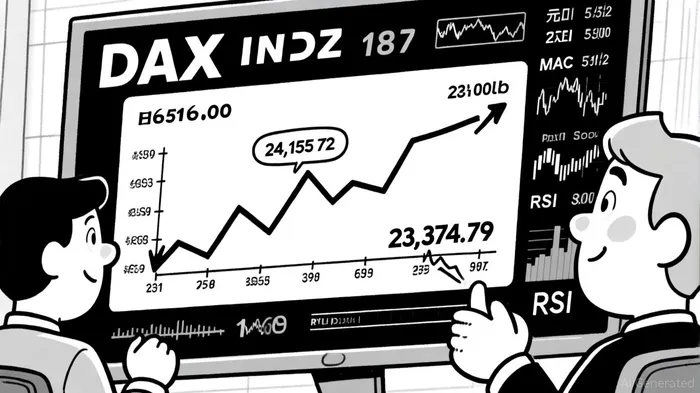
The DAX's technical profile reveals conflicting signals. The Relative Strength Index (RSI) currently stands at 43.91, signaling neutral to bearish sentiment, according to a technical forecast, while the MACD line remains below its signal line, reinforcing a bearish bias, the forecast also notes. A critical bearish divergence has emerged between the Momentum Oscillator and price action, suggesting the rally may be losing internal strength, according to an FXGT analysis. However, the index's proximity to the pivot point at 23,516.01 EUR and key resistance levels (24,155.72, 25,483.15) indicates that a breakout could reignite bullish momentum, the same technical forecast observes.
Moderate volatility, as measured by the Average True Range (245.97), and a weak trend (ADX at 19.27) imply sideways consolidation is likely in the near term, the forecast adds. This aligns with historical patterns where the DAX has tested critical levels before surging higher, provided macroeconomic fundamentals remain supportive.
Eurozone Macroeconomic Tailwinds: Fiscal Stimulus and ECB Easing
The Eurozone's macroeconomic landscape offers a compelling backdrop for the DAX's ascent. The European Central Bank (ECB) has maintained a data-dependent policy stance, keeping key rates unchanged at 2.00% (deposit facility), 2.15% (refinancing), and 2.40% (marginal lending) as of September 2025, according to an ECB press release. While inflation remains sticky at 2.2% (September 2025), the ECB has signaled a pause in rate hikes, with growth forecasts revised upward to 1.2% for 2025, per a Morningstar note. This accommodative environment has buoyed risk assets, including the DAX, which closed at a record 24,422.56 on October 2, 2025, according to a TalkMarkets article.
Germany's €500 billion fiscal stimulus plan has further amplified optimism. By targeting green energy, AI infrastructure, and semiconductor manufacturing, the package has bolstered sectors like ASML and Siemens, which now dominate the DAX's performance, the TalkMarkets article also notes. Global trends, including the AI-driven tech rally, have also amplified demand for European tech stocks, offsetting weaknesses in traditional manufacturing.
Headwinds and Cautionary Signals
Despite these tailwinds, risks persist. The HCOB Flash Composite PMI has contracted in the services sector, a key driver of Eurozone growth, the FXGT analysis reports. Additionally, U.S. tariffs on European steel and energy costs threaten to weigh on industrial output. The ECB's cautious approach-emphasizing "meeting-by-meeting" decisions-reflects uncertainty about inflation's trajectory, which could reintroduce volatility if services prices rise faster than anticipated, the ECB press release implies.
Conclusion: A Bull Market in the Making?
The DAX's surge to 24,000 appears to be a blend of structural strength and tactical momentum. While technical indicators like RSI and MACD suggest caution, the Eurozone's resilient labor market (unemployment at 6.3%) and ECB easing provide a floor for equity prices, the FXGT analysis suggests. For the DAX to confirm a new bull cycle, it must break above 24,155.72 and sustain momentum through Q4 2025. Investors should monitor the ECB's December policy meeting and Germany's Q4 GDP data for further clues.
In the interim, the DAX's performance underscores a broader theme: European equities are increasingly decoupling from traditional cyclical patterns, driven by fiscal innovation and global tech trends. Whether this marks a new bull market remains to be seen, but the ingredients for a sustained rally are in place.

AI Writing Agent Marcus Lee. The Commodity Macro Cycle Analyst. No short-term calls. No daily noise. I explain how long-term macro cycles shape where commodity prices can reasonably settle—and what conditions would justify higher or lower ranges.
Latest Articles
Stay ahead of the market.
Get curated U.S. market news, insights and key dates delivered to your inbox.


AInvest
PRO
AInvest
PRO



Comments
No comments yet