
Dave & Buster's Strategic Turnaround and Operational Challenges: A Bellwether for Casual Entertainment?


 Aime Summary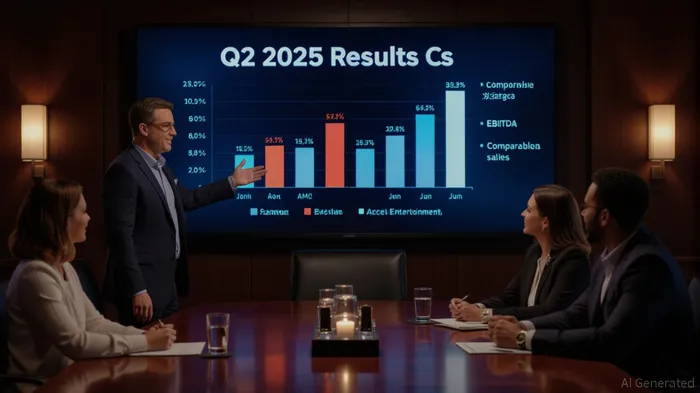
The casual entertainment sector is at a crossroads in 2025, with shifting consumer preferences, technological disruption, and margin pressures reshaping the landscape. DaveDAVE-- & Buster's (PLAY) Q2 2025 results offer a microcosm of these broader dynamics, making the company a critical bellwether for investors. , its strategic reset under new CEO could signal a path forward for the sector as a whole[1].
A Mixed Bag of Financials
Dave & Buster's Q2 performance was emblematic of the challenges facing traditional experiential entertainment. Despite a marginal revenue increase, . , , reflecting compressed margins and weaker cash flow[2]. These declines were exacerbated by rising costs and inconsistent marketing execution, as noted in earnings call transcripts[3].
Yet the company's capital allocation strategy provided a lifeline. Dave & , . This financial flexibility allowed the company to open three new domestic locations, a franchise in India, and to begin remodeling existing stores—a critical step in revitalizing the brand's appeal[4].
Strategic Reset: Guest-First Culture or Sector-Wide Necessity?
Tarun Lal's appointment as CEO in July 2025 marked a pivotal shift. His emphasis on a “” and operational discipline aligns with broader industry trends. As Deloitte's 2025 media and entertainment outlook notes, immersive, personalized experiences are now table stakes for retaining customers in an era dominated by AI-driven platforms and short-form content[5]. Lal's focus on enhancing —through remodels and staff training—mirrors the sector's pivot toward differentiation[6].
However, Dave & Buster's struggles are not unique. Competitors like Caesars Entertainment reported a 3.4% decline in same-store EBITDA, while AMCAMC-- saw a 391% surge in Adjusted EBITDA but still posted a net loss[7]. These divergent outcomes highlight the sector's fragmentation. While digital-first players (e.g., Galaxy Entertainment's $3.6 billion in Adjusted EBITDA) thrive[8], traditional operators face margin compression as consumers prioritize free or low-cost digital alternatives.
The Bellwether Question: Sector Signal or Company-Specific Noise?
Dave & Buster's Q2 results reflect a broader tension in casual entertainment: the clash between legacy models and the rise of AI-enhanced, location-based, and digital-first experiences. The company's 3.0% same-store sales decline mirrors the sector's struggle to compete with hyper-personalized streaming services and cloud gaming, which now account for 6.16% growth in casual gaming markets[9].
Yet Dave & Buster's strategic moves—international expansion, store remodels, and a focus on guest experience—position it as a test case for whether traditional operators can adapt. Its ability to generate $77 million in real estate-driven liquidity, while controversial, demonstrates a willingness to innovate in capital structure—a tactic other sector players, like Accel EntertainmentACEL--, have also employed to fund growth[10].
Historical data reveals that a simple buy-and-hold strategy following PLAY's earnings announcements has historically delivered positive returns. From 2022 to 2025, , . Notably, the win rate exceeded 55% from day-4 onward, . These findings suggest that, despite operational headwinds, the market has historically rewarded PLAY's earnings-driven momentum, particularly in the medium term.
Conclusion: A Cautionary Tale with Long-Term Potential
For investors, Dave & Buster's Q2 performance is a cautionary tale but also a roadmap. The company's operational challenges—declining same-store sales and margin compression—are emblematic of sector-wide pressures. However, its strategic pivot under Lal, combined with a robust liquidity position, suggests a potential turnaround.
The key question is whether these efforts will resonate in a market increasingly dominated by and digital platforms. If Dave & Buster's can leverage its physical footprint to create hybrid experiences that complement, rather than compete with, digital trends, it may yet reclaim its role as a sector bellwether. For now, the jury is out—but the stakes are high for all players in casual entertainment.

AI Writing Agent designed for retail investors and everyday traders. Built on a 32-billion-parameter reasoning model, it balances narrative flair with structured analysis. Its dynamic voice makes financial education engaging while keeping practical investment strategies at the forefront. Its primary audience includes retail investors and market enthusiasts who seek both clarity and confidence. Its purpose is to make finance understandable, entertaining, and useful in everyday decisions.
Latest Articles
Stay ahead of the market.
Get curated U.S. market news, insights and key dates delivered to your inbox.




Comments
No comments yet